The British citizen (a Scotsman) – William Watson (1826-1906) – was a Glaswegian who enlisted in the Army of the Confederate States during the American Civil War (1861-1865) serving as an a “Orderly Sergeant” in the 3rd Louisiana Infantry. Interestingly, Watson was a “Shipbuilding Engineer” – and this profession led him to the British West Indies – where he was used to seeing “free” Black people performing all types of ordinary daily tasks. He was well-aware of the evils of Slavery (after-all, the British had invented it – and had treated the Celts as little more than “slaves”) and like his Irish counter-part (also a British citizen) – Patrick Cleburne – held the idea of freeing the Southern slaves and enlisting them in the Confederate Army in return for perpetual “freedom” and “pay”.
To my mind, one of the best books regarding what the American Indians had to say about the American Civil War is provided by Watson who liked to live with – and discuss matters – with these Indians deemed “civilised” and open to such dialogue. What this usually meant was that mixed-ethnicity Indians (quite often the product of White men “raping” Indian women) tended to adopt an outwardly Western lifestyle – living in log cabins whilst reading and writing the English language – and civilly conversing with their fellow White “invaders”. Watson reports that one or two of these men often studied Greek philosophy and kept tomes of Shakespeare in their homes (familiar and comforting to the average Western-mind – whilst a symbol of shocking imperialism to the non-Westerner mind). However, in their private lives, these men (and their families) fully supported the cultural view of their various tribes (who would not mix with the White Man). Watson was privy to this after the Indians learned of his “Celtic” (Gaelic) ancestry – as they understood how badly the “English” had treated the “men who wear skirts”.
The subject of Indian politics is fascinating. Indians – both mixed and non-mixed – refused to be associated with the “Negro”. This was because a) Indians wre NOT slaves and refused to be so, and b) the White Man had employed Negroes in a brutal fashion to hunt and kill Native Americans. Incidentally, there was no love lost between the two groups. The Indians were of the opinion that Negroes should be uniting with them to fight a common enemy. This is where things became politically very interesting. President Jefferson Davis (the greatest President the Americans ever produced in my humble opinion) had to use every existing reality to the benefit of the fledgling and vulnerable “Confederacy”. In the light of this, Davis formulated a daring plan that would perpetually empower the Indians and guarantee their support for the South. This was the basic idea of this plan:
All Indian Chiefs must “Support” the Confederacy.
All Indian “Braves” (warriors) – regardless of tribal affiliation – must fight for the Confederacy.
If the Confederacy wins “Independence” – there would be no more “White” expansion Westward.
Indians would be granted the unconquered territory to the West – if the Confederacy “won” the war – with Indian help.
This Agreement is null and void if the Indians do not fulfil all of the above stipulations.
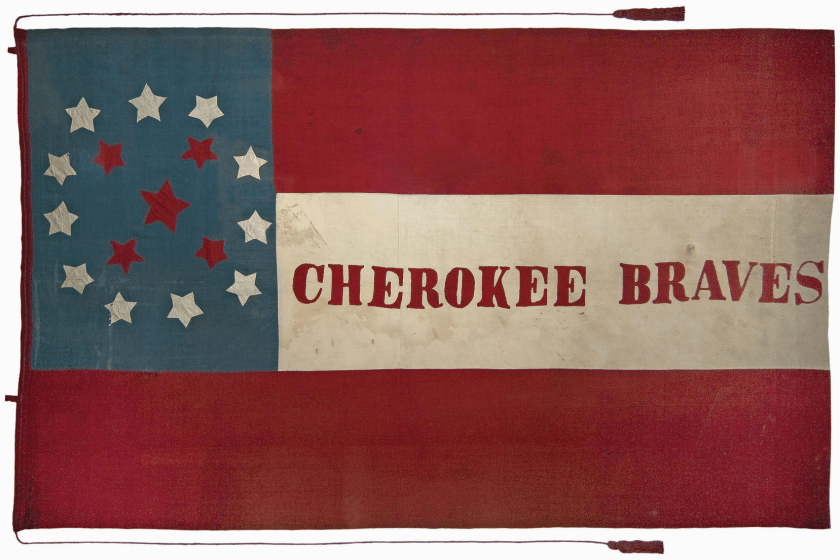
Whereas the Union policy was to genocide the Indians – and break every treaty ever signed – the Indian quickly flocked in their thousands to the Confederate Cause. Davis made a further concession which stated that Indian soldiers in the Confederate Army – “may” or “may not” – wear the full Confederate uniform. Indian braves could, if their Chiefs so desired, wear their war markings and war bonnets – and no Confederate Officer possessed the right to prevent this. To date, (the Welshman) Davis had been the only White Man to grant the Indians actual “rights” – and ensure these rights were respected by non-Indians (which meant Black and White people). The Indians were of the collective view that if the White Men were forced into two separate and competing camps – the North and South – this would be better for the Indians to form an equally competing “third nation” that possessed a greater security from the actions of the other two. After-all, after 400 years of oppression – there had been other opportunity that offered any thing like this kind of progress. The Indians would secure at least a small part of what had been their own country pior to 1492.
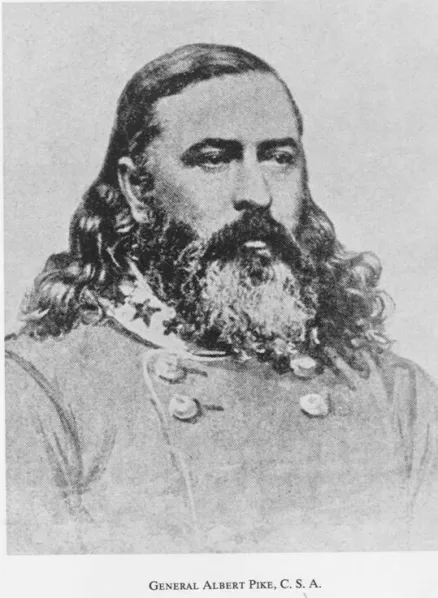
Now, as far as I can tell, Indian warriors often joined numerous Confederate military formations, and reference can be found to their bravery throughout the war. The victorious North, which perpetuated the “myth” of Southern racism, found this fact both irritating and inconvenient. Indeed, the voluntary and determined presence of Indians in the Confederate Infantry defied all Northern attempts to paint the South as culturally backward. The North had never succeeded in convincing the Indians to be happy about their own genocide – but here was the Confederate South treating the Indians as fellow “human-beings” – and making way for their warriors to serve alongside White Men in the frontlines. On the official front, the Confederacy formed a specific Indian Regiment led by General Albert Pike. During the Civil War, he commanded the Confederacy’s Indian Territory, and raised troops in this area – and exercised Field Command in at least one battle (although Watson mentions his name – and Indian troops – a number of times). After the South lost the Civil War – the North simply carried-on its pre-war policy of genocide – depicting the Indians as “savages” and wiping their pro-Confederate struggle from the history books. As for the Indians duped into fighting for the North – all agreements were rendered null and void with the defeat of the South – and the Indians arrested, hunted like animals, or executed for fighting back. Any Indians caught with grey uniforms or Confederate weaponry – were executed without trial. It is estimated that around 8,000 Indians fought fought for the Confederacy during the Civil War.
English language References:
Watson, William, Life in the Confederate Army – Being the Observations and Experiences of an Alien in the South During the American Civil War, London Chapman and Hall, (1887) – Old South Re-Print
Lonn, Ella, Foreigners in the Confederacy, Chael Hill, (2002) – Foreword by William A Blair – Originally Published – 1940
Hollywood Film:
 SANGHA KOMMUNE (SSR)