Blogger’s Note: My father grew-up in the bombed-out slums of Leicester – and learned to play cricket by watching and copying the posh school boys – who played on their own perfectly laid-out cricket-pitches. Mt father persisted and was eventually permitted to play – this is how the middle-class taught my working-class father how to play cricket. My Dad played football in the Winter (Leicester City Reserves) and cricket in the Summer. Decades later, my father single-handedly founded the Tiverton Cricket Club (East Devon) and managed it for a few years – the games he played in (and managed) were reported in the local Tiverton Gazette (a record was set whilst Tiverton bowled-out Kentisbeare for a small number of runs) – but in the end a clique of locals decided to take over the team and my father resigned (they had contributed nothing creative, performed no hard work, but wanted all the glory).
At his peak, however, he was a very good all-rounder wielding the bat and ball. When a child, my father taught me all the rules of cricket and this is why I know a) how to play the game, and b) what is going on when watching it (we support Leicestershire County Cricket Club – and we watched them play once). I have tried to teach my partner and children – but the modern youth now have the internet to take their attention! I have played “in-door” cricket – as well as cricket on a proper pitch – and I never wore a helmet (I couldn’t afford one). When standing at the crease – the mind must be calm and expansive – clear and reflective. Peace and self-control must permeate reality – whilst the bat and ball must be properly utilised in a technically perfect manner. There is no hatred for the opposition – or unnecessary attachment to one’s team-mates – all are equal to the true gentleman. This is why I refer to cricket as a form of English Confucianism! ACW (25.9.2025)
British Council Film Archive – Cricket (1950)
About the film
As England battles it out against Australia at Lord’s cricket ground, skills both on and off the field are focused on, revisiting some of the greats of the sports history along the way.
Details
- Release year – 1950
- Director – Grahame Tharp
- Production company – Pathé Documentary Unit
- Producer – Peter Baylis
- Screenplay – Jack Howells
- Cinematographer – George Stevens
- Narration – John Arlott, Ralph Richardson
- Editor – A. Milner-Gardner
- Sound recording – W.S. Bland, George Newberry
- Running time (minutes) – 17 mins 20 secs
Original description
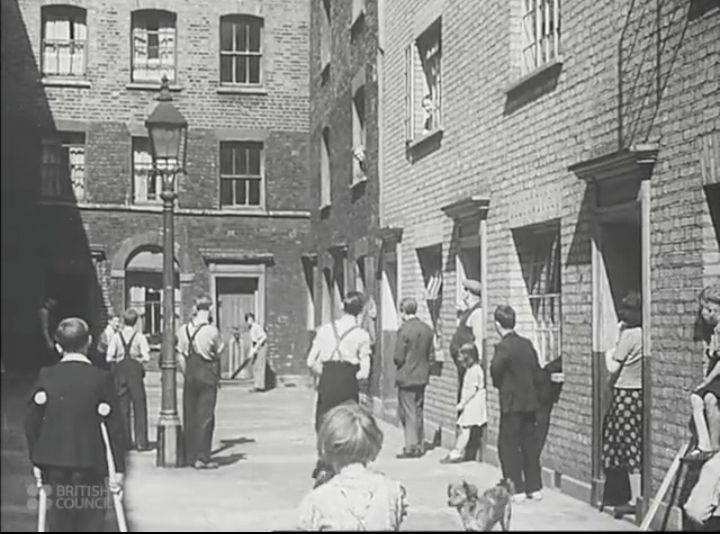
‘Through the pattern of this film a ‘Test’ at Lord’s runs like a thread and a broadcast commentary on the match is imposed on the background of cricket as a game, a craft, an interest of a people, a piece of history. The craftsmen are shown who make the ball and the bat – that ‘fourth straight stick’ with which the batsmen defend ‘the other three’. The craftsmen are shown who play the game, from W. G. Grace in the ‘nets’ to D. G. Bradman and Denis Compton in the thread of the ‘Test’. The history of the game is epitomised in the Long Room shots at Lord’s and from there the camera moves to the village green; to the London side- street where the urchins play on a ‘bumping pitch’; to South Africa, and India, where in the ‘blinding light’ there is often ‘an hour to play and the last man in’.
(Films of Britain – British Council Film Department Catalogue – 1947-50)
Did you know?
- The two narrators are none other than actor Sir Ralph Richardson and cricket commentator John Arlott.
- Rather than script the film, the decision was taken to film the game and then build the film around the recorded events.
- At around the 18-second mark, during the opening credits, you can hear the tapping of a microphone – the sound of the narrators testing the microphone that was turned on. This sound was accidentally left in the finished film.
 SANGHA KOMMUNE (SSR)