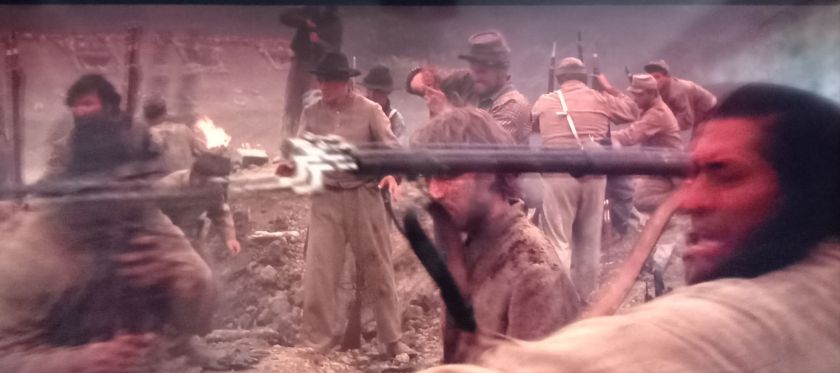
Cold Mountain is a 2003 film that covers the last year (1864-1865) of the American Civil War (1861-1865) from the Confederate point of view. The US Blockade is taking its toll – and the Southern people are cold and starving. Decisive victory on the battlefield eluded the CSA – and France and England still will not recognise the Confederacy. The military action takes place in the Western Theatre of the war – that is – the Western part of the Confederate States of America. This Theatre tends to be ignored or downplayed in favour of the Eastern Theatre where most of the more famous battles occurred (including Fredericksburg, Sharpsburg, and Gettysburg, etc). The first 15-minutes depicts the “Battle of the Crater” which was fought on Saturday, July 30th, 1864, near Petersburg, Virginia, (around 25-miles South of Richmond) between the Confederate Army of Northern Virginia, (Commanded by General Robert E. Lee), and the Union Army of the Potomac, (Commanded by Major General George G. Meade). The Union had devised a plan of using soldiers who were miners in civilian life – tasked with digging a tunnel under the entrenched Confederate lines, and then building up piles of explosives – to be ignited at a distance. This is a type of demoralization operation was common in WWI – but this might have been the first time it was used in modern warfare.
When the explosion was set-off, hundreds of Confederate soldiers were blown to bits. Many thousands more were wounded. Grey-clad soldiers were stunned, concussed and totally confused. Some were blown tens of feet – but survived with minor wounds. A huge crater (and hole) was blown in the Confederate trenchworks surrounding Petersburg. Meanwhile, thousands of blue-clad Union soldiers had crept-up to the Confederate lines and were lying-down in strict military formation waiting for the explosion – and the signal to attack. The idea was to run into the gap and spread-out on both sides – killing and maiming the Confederate defenders until the area was taken. It is said that a number of high-ranking Union Field Officers were killed as the attack unfolded and that the Union-attack had to be led by the lower-level Field Officers who had no one directing the attack. Instead of running around the lip of the crater on both-sides – the Union men were led directly into the centre of the crater – and hit the steep and unclaimable wall at the other end. The Union soldiers became trapped and there was a sickening crush of bodies. Already the muddy water started to run red with blood!
Whilst all this was unfolding, many of the Confederate soldiers recovered – whilst those stationed further away came to their aid. Confederate infantry took-up position all around the lip of the crater and opened fire down into the massed Union soldiers. Also in the crater were Confederate soldiers who had survived the explosion and were trying to fight their way out. A crush of bodies was happening – causing more dead and wounded simply by the pressure of the desparate pushing. In the Confederate Army were a number of Native American Indians who jumped down into the crater to fight with their knives and axes. Some Indians threw guns with bayonets affixed – using the device as a spear. One Indian fought hand-to-hand with a tough Union man who had clay staining his face. It was only when he looked closer that the Indian realised he was fighting a Black African-American soldier. The main character of the film – a Confederate soldier played by Jude Law – is wounded and taken from the battlefield to a nearby Field Hospital to recover. The film is really about his journey back to North Carolina – and to the love of his life. The brutality of the war is shown clearly with the Confederate Home Guard arbitrarily rounding-up men assumed to be deserters – executing some – returning others to the frontline. Any runaway slaves are mercilessly struck-down.
 SANGHA KOMMUNE (SSR)