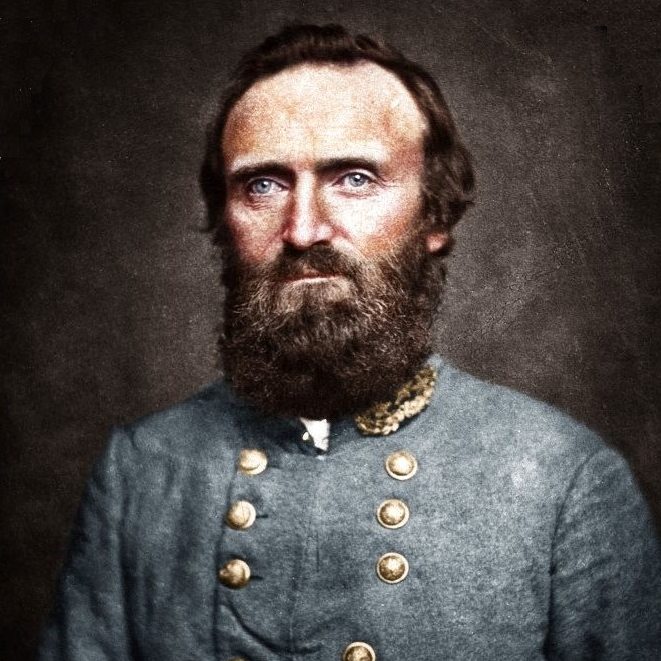
I refer to Confederate General – Thomas Jonathan Jackson (1814-1863) – as “Stonewall” out of a sense of respect, and not merely out of historical convention. I choose to do this on the grounds that I believe this extraordinary man had earned this recognition of stoicism long before he was granted it on the battlefield of Manassas (1st Bull Run) in 1861. Today, Stonewall Jackson would have been considered a person possessing disabilities. Due to the atrocious manner in which ALL people with disabilities are treated across the world today (with a few exceptions) – Stonewall Jackson (as a man considered a “hero” on both sides of the American lines), cannot be viewed as possessing disabilities – whilst simultaneously being perceived as acting as a beacon of inspiration, bravery, and innovation. Jackson, as a “visually impaired” person, would not be permitted to serve in a modern (professional) army. His eyesight was so poor that this alone qualifies him to be considered “disabled” – but he also suffered from various other maladies and dysfunctions.
Stonewall Jackson had to carefully regulate his diet as a means to control his poor digestive system. Although his family was originally of British descent, and his grandfather (and father) in America had been lawyers (involved in, and supported by “Free Masonry”) – Stonewall Jackson was one of at least six children – and the youngest of many competing siblings. He would not inherit the family wealth, land, or social and political responsibilities, and so very few of the family’s financial resources were spent on his education – or progression through society. As little money had been spent on him – Stonewall Jackson was not a lawyer and could not join a Free Mason Lodge. He had to work hard for everything he achieved – as nothing was given to him as a matter of birth-right. His physical weakness and poor eyesight compounded this sense of redundancy and being last in-line for everything available. However, he did learn to read and write, and he possessed a very clever mind. He was aware of his weaknesses and blamed no one else for the difficulties he faced in society.
The Ancient Greek idea of inner strength – mediated through a cultivated wisdom – was the Classical model Stonewall Jackson used to enhance his own health and social standing. Due to his honesty and humility, those who personally encountered his personality were always drawn toward his charisma. Although his family were not willing to “waste” money on a military education for their son, a friend of the family was made aware of an unusual Scholarship being offered which permitted “one” successful candidate to enter West Point to train as an “Officer” in the US Army. Around five very clever men competed for this Scholarship – and it was predictably won by an impoverished “Lawyer”. However, this “Lawyer” came from a privileged background and lasted just one-day when subjected to military discipline at West Point. The Scholarship was once again thrown open to the four remaining men – through another round of examinations – and Stonewall Jackson prevailed. This is how Stonewall Jackson gained access to West Point.
As he could not read the chalkboard (due to his short-sight) he was always punished and moved further away – to the back of the class. This hopeless situation also led to Stonewall Jackson being continuously “punished” on the grounds that he was “lazy” – rather than hindered by his disabilities. He was moved out of the warm barracks and into a cold single room. Like a monastic cell, this is exactly where he planned and activated his fight-back! He stayed up most of the night reading books held very close to his face (he hid this need during the day) and taught himself to learn and understand long texts off by heart. In the day, and in front of the class, he would hold the book a long way from his face (giving the false impression he was “reading” at a normal distance) and would recall the entire text by memory. This was how he started to crawl-back his position and reputation at West Point (surpassing a number of recruits who possessed no disabilities at all). Once he understood the entire syllabus, his otherwise good guiding sight allowed him to ride, use a sword, run, shoot (poorly), and use the bayonet – to an averagely “good” degree. He started reading the latest medical books in an attempt to cure his digestive troubles. He switched to a vegetarian diet (he was always kind to animals) and would sit with his spine kept “straight” so that no undue “pressure” was placed on his inner organs.
He graduated from West Point at the lower rung of the top one-third of students. This was a magnificent achievement made by a man who could not afford to attend the Military College and was close to being expelled for continuously failing. He had applied a logical mind to overcome the weaknesses of a dysfunctional body and an unjust social system – and had prevailed. This required a strong fighting-spirit – one that would not be pierced or deflated when obstacles and disappointments presented themselves. Although he spent some time in the frontline of the US Army – Stonewall Jackson did not like the culture of bullying, nepotism, and favouritism (although he did see action during the US invasion of Mexico). This led to him “Resigning” and taking-up the post of “Professor” in the Virginia Military Institute, conveying the principles of “Natural and Experimentary Philosophy”. He would learn his lectures by heart – and then teach his students without notes. However, a number of his students found out about his eyesight and developed a disrespectful attitude toward him – despite his lectures being precise and correct. Stonewall Jackson believed that African slaves should be taught to read and write. His family was rich and did possess slaves. He inherited around five slaves as part of his wife’s dowry. He never pronounced in support of slavery, and it is generally believed he opposed it as an institution.
Lieutenant General (CSA) Stonewall Jackson assisted the building of a “new” army for the Confederate States of America in exactly the same manner in which he taught himself to overcome the limitations imposed by his own disabilities. He built upwards from a solid foundation – within an external world that was inherently “unfair”. The stern discipline he imposed upon himself every moment of his life – he imposed upon every Southern “Volunteer” (usually dirt-farmers) who turned-up to fight in the Army of the Confederacy. Whether they were bare-footed or not, these men stood in dead-straight lines (like British Red Coats) for hours on end regardless of the weather. Stonewall’s Brigade would march around 20 miles a day carrying rifle, bayonet, pack, ammunition, and food, etc. Men would also “jog” certain distances as a matter of routine. Jackson’s Brigade was taught to manoeuvre (like British Red Coats) and drill in and out of formation with a consummate ease. Jackson taught his men to “prepare” in a meticulous manner to face whatever task lay ahead. This is how a man with disabilities taught able-bodied men to benefit from the requirement of forward-planning. To be “equal” – those with disabilities need to be “better”! As regards to the Confederacy, those States that possessed less material resources – had to use what they had to the best of their abilities – and “shock” their opponents with unusual and spectacular manoeuvres!
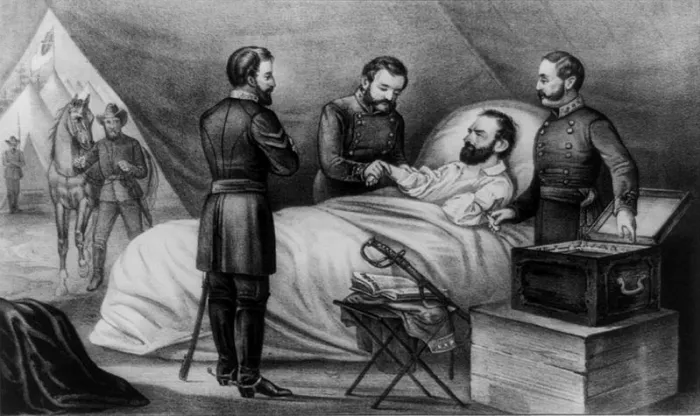
Of course, Stonewall Jackson taught his men to “stand” (like British Grenadiers) in the face of danger and in defiance of an enemy’s deadly intention. Whenever his men were not marching, Jackson had them “drilling” or carrying-out acts of labour – such as road building and defence strengthening. At one point in the Battle of Manassas (1st Bull Run) – Thomas Jonathan Jackson – earned his honorific of “Stonewall” when he (and his men) stood in defiance of the withering fire laid-down by the Union Army – like a “Stone Wall”. Just what this meant is still argued over by historians today. Indeed, Stonewall Jackson has been described as being a “man or iron” during times of war. This must be juxtaposed with his peacetime activity of often being struck-down to long bouts of bed-rest. He was, like all outstanding men, cut-down at his peak. He was shot and wounded by Confederate troops – who mistook him and his Command troop for Union Cavalry. He later died from his wounds – in terrible pain but hardly moaning.
Reference:
Donald A Davis: Stonewall Jackson – The Great Generals Series, Blackstone Audio, (2007)
 SANGHA KOMMUNE (SSR)