
Blogger’s Note: Soviet scientists first hypothesised (in the mid-1920s) that a continuous and rapidly changing environment first led to atoms forming into molecules and elements – and forming the building blocks of organic life. This hypothesis was confirmed in 1959 by US scientists who proved that organic life emerged out of environmental chaos – and would not have formed if the environment was peaceful and non-changeable. Indeed, dramatic and rapid (natural) climate change has precipitated all animal and human evolution – with the species adapting to meet each new material challenge.
Genuine academic-derived history – the product of strictly monitored (apolitical) observation – is a very different beast to the “popular” (culturally produced) notions and perceptions perpetuated by the US government. Popular history is entirely “political” and superimposes upon the world an “Idyllic” and “preferred” set of circumstances that contain no basis in reality. For instance, US culture continuously misrepresents the history of Native American Indians – giving the false impression that these tribal people are culturally primitive. As this false-narrative permeates all aspects of US anti-intellectualism – few are unaware that North American Planes Indian Culture (comprised of nomads riding horses throughout the hinterland of North America) stems only from around 1776.
This is the year that European settlers declared their exclusive ownership of the land they had invaded – and the expulsion of all Native Americans from it. Native Americans were originally driven from the villages, towns and cities they had built located on the prime coastal areas – and forced into the dangerous hinterlands they had tended to avoid. To survive, the Native Americans adapted by riding horses imported by the Spanish (and other Europeans), living in tents, and migrating with the herds – three aspects of existence unknown to Native Americans prior to European settlement.
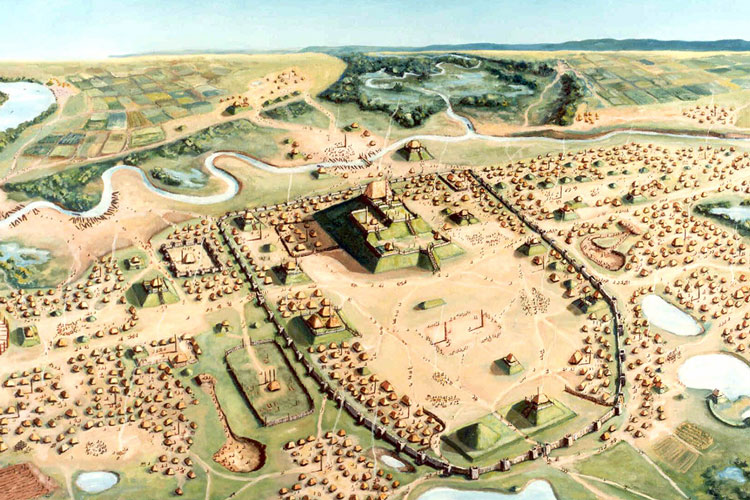
Natural climate change has always happened – and is happening now – with the caveat that certain Environmentalists now suggest that the agency of human behaviour also contributes to the process of climate change. Indeed, it has become stylish in certain quarters for climate change (natural or unnatural) to be blamed for environmental alterations that cannot be readily or conveniently explained. Until recently, the dominant hypothesis – presented as fact – was that the ancient (Pre-Colombian) City of Cahokia (located in the region of St Louis) had disappeared in the 1200s (13th century) exclusively due to climate change. New academic research, however, has provided reliable (objective) academic evidence that climate change was not partially (or entirely) responsible for the demise of Cahokia. ACW (9.8.2024)
Mystery behind disappearance of ancient American city finally unravelled
Archaeologists suspect city’s disappearance was gradual, not sudden as previously thought
(9.8.2024)
Cahokia, one of the world’s largest ancient cities in present-day St Louis, did not suddenly disappear due to climate change at the end of the 13th century as previously thought.
The pre-Columbian settlement, which housed over 50,000 people with complex roads, public plazas, and even an astronomical observatory, was gradually abandoned as its residents moved in search of better opportunities, the study published in the journal The Holocene, suggested.
Until now, scholars had thought Cahokia residents abandoned the settlement after climate change triggered prolonged drought and a massive crop failure.
However, researchers from the Washington University in St Louis found that Cahokians were skilled and resilient to adapt to climate change and likely had other reasons to leave town.
In the new study, scientists assessed carbon atoms left behind by fossil plants that grew when the ancient city’s population collapsed and drought was common across the Midwest.
Drought-adapted plants like prairie grasses and maize incorporated carbon into their bodies at rates that left a tell-tale signature compared to the crops Cahokians harvested for food such as squash, goosefoot, and sumpweed.
By analysing carbon atom signatures at the Cahokian archaeological site, scientists found that there was no radical shift in the types of plants growing in the area during what was thought to be the drought period.
“We saw no evidence that prairie grasses were taking over, which we would expect in a scenario where widespread crop failure was occurring,” study co-author Natalie Mueller said.
“It’s possible that they weren’t really feeling the impacts of the drought,” Caitlin Rankin, another author of the study said.
Researchers now suspect the sophisticated society almost certainly had a storage system for grains and other foods which could have powered them through such drought periods.
They say the pre-Columbian society had also adapted to a diverse diet including fish, birds, deer, forest fruits and nuts, which would have kept them nourished throughout even if a few sources disappeared.
Scientists say the abandonment of the ancient city was a gradual process.
“I don’t envision a scene where thousands of people were suddenly streaming out of town. People probably just spread out to be near kin or to find different opportunities,” Dr Mueller said.
“The picture is likely complicated,” the archaeologist added.
 SANGHA KOMMUNE (SSR)