
Translated by Adrian Chan-Wyles PhD
Translator’s Note: The original author seems to place no value on two important events that happened during the time period in question. During 1908 – the child-Emperor “Pu Yi” (溥儀) was crowned. He was the three-old nephew of the all-powerful Empress Dowager. He was “abdicated” in 1911 – during the overthrow of the Qing Dynasty by the “Nationalists” – aged just six-years old. Pu Yi was the last Emperor of China who passed away in 1967 – working as a humble Gardener. The ship’s name is “Hai Qi” – and follows the Chinese language convention of having the ideogram ‘号’ (hao2) added as a suffix (meaning ‘To Be Known As”). I have retained this arrangement because it is correct in the Chinese language – even though it is unnecessary within English translation. As for the name “Hai Qi” (海圻) – this literally translates as “Ocean Boundary” – but is probably (used in this instance) to mean something like “Boundless Ocean” or “Ocean Without Limit”. The ocean has no boundary – hence no boundary (on a round Earth) can be found! In this context, sailing becomes an act without limitation and this name is a play on words – common within the Chinese language – possibly chosen to signify China’s intended modernisation by purchasing a British-built naval ship! Racism against Chinese people is perennial and is to be expected. I did not personally know about the race-hate issues mentioned here – regarding a US-controlled Cuba and a Mexico that had just undergone a “Socialist” Revolution! The Chinese Honour Guard looks magificant – as good as British Guardsmen! ACW (11.3.2024)
The Qing Dynasty – during 1911 – was coming to its end. Although the main force of the Beiyang (北洋) Navy – just a few years ago – was completely destroyed in the Sino-Japanese War (1894-1894) – the failure of the war did not convince the Qing Dynasty Authorities to give-up the idea of constructing an ever-stronger Northern Coastal Defense. Instead, the Qing Dymasty continued to spend significant sums purchasing (modern) warships from European countries. The subject of this article – the Cruiser “Hai Qi Hao” (海圻号) – was ordered from the United Kingdom in 1896, just prior to the defeat of the Qing Dynasty during the First Sino-Japanese War (1894)-1896.
1908 was not a very important year for the Qing Dynasty, but it was an important year for the United States. During this year, the so-called American “Great White Fleet” was divided into two parts – designed to sail around the world to different areas- with its 16 main battleships engaged in ocean-going operations. While expressing a growing US naval strength, the US also spent much of their time propagating good diplomatic relations with Officials in Xiamen, Fujian and the Qing Dynasty in general.
Visiting the United States
Afterwards, the U.S. Navy repeatedly invited the Qing Dynasty Fleet to visit the United States as a show of friendship. Therefore, on April 11th, 1911, Cheng Biguang (程璧光), the Commander of the “Hai Qi Hao” was ordered to weigh anchor in Shanghai on April 21st – and set sail to the United Kingdom, (thousands of miles away), to attend the Coronation of King George V – and then cross the Atlantic to visit New York, USA. The Baiyang Navy – at the end of the Qing Dynasty – was extremely modernized. The uniforms, Ceremonial Guards, and drill methods of the soldiers were all adopted from the West (specifically the UK). The Officers and soldiers of the “Hai Qi Hao” also cut off their Manchu braided poney-tails – officially integrating with the (modern) Western Navy.
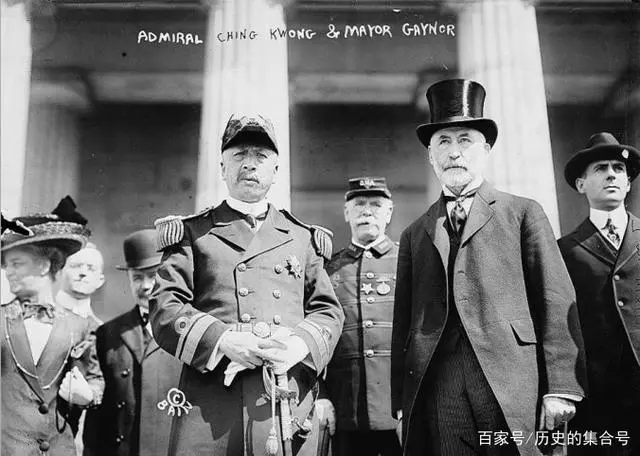
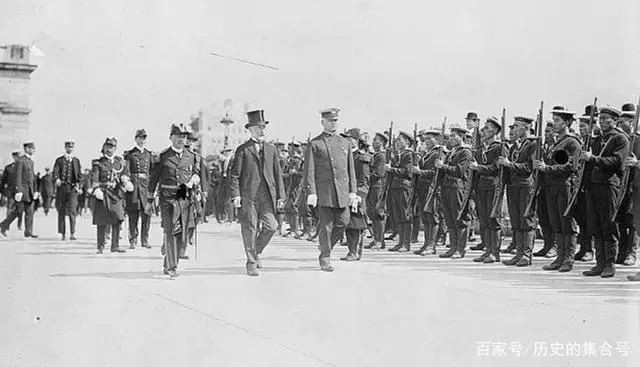
This event was a unique in the Qing Dynasty history at the time, similar to the day when China’s first nuclear-powered aircraft carrier first visited the West. When the Cruiser “Hai Qi Hao” arrived in the United Kingdom and the United States, it was with an extreme high courtesy. The old photographs were taken of all the activities carried out by the Officers and soldiers of the “Hai Qi Hao” after arriving in New York on August 10th, 1911. These include a group photograph of Commander Cheng Biguang and the Mayor of New York, New York Officials reviewing the Navy, and Naval Officers and soldiers visiting the Grant Memorial Hall and Mausoleum.
Applying Diplomatic Pressure on Latin American Countries!
After completing its visit to the United States, the Haiqi was preparing to visit Latin American countries. At this time, anti-Chinese (racist) protests had broken-out in Cuba and Mexico. In order to support the local Overseas Chinese people – and apply political pressure on the respective governments, the “Hai Qi Hao” first visited Cuba and stayed there for 10 days. The ship received a warm welcome from the local Chinese inhabitants. Seeing the warships of their Motherland was like seeing relatives from far away! The racial violence against the Chinese people immedistely ceased! The Cuban government was also under pressure and promised Cheng Biguang that discrimination against Overseas Chinese would never happen again. Only then did the “Hai Qi Hao” end its visit to Cuba and head to Mexico.
Before Cheng Biguang arrived, however, the Mexican government took the lead in issuing a Formal Apology to the Qing Government – promising to compensate those Overseas Chinese who had been harmed during the anti-Chinese race-riots. Only then did the Qing Government order Cheng Biguang to Cancel his visit to Mexico.
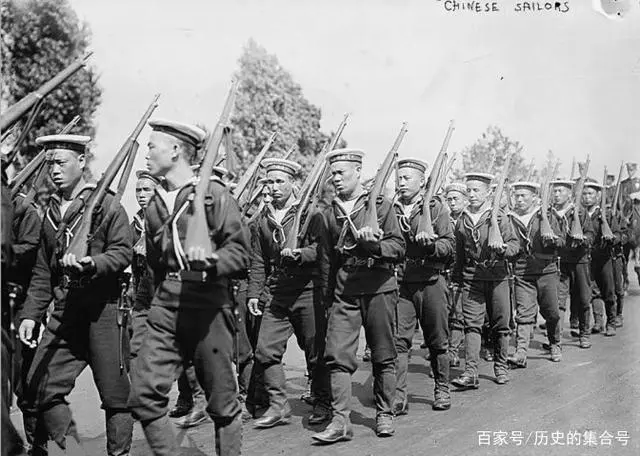
Obviously at this time, the Qing Dynasty also used gunboat diplomacy, (a tactic was often used by Westerners), to scare off the anti-China intentions of countries such as Mexico and Cuba – before returning home. However, when the “Hai Qi Hao” returned to Shanghai in May 1912 – the Qing Dynasty had ceased to exist. The Dragon Flag was still flying on the ship when it left – but the Five-Colour Flag was now flying when it returned home. The “Hai Qi Hao” and its Officers and soldiers also missed the Naval Uprising during the Nationalist Revolution of 1911 due to their visit, “and also missed the opportunity to send the Qing Dynasty on its final journey.”

In any case, this visit was a unique event in the history of the latter Qing Dynasty. It was also a sign of the Qing Dynasty’s transformation into a modern country and the last glory of the Qing Dynasty’s Baiyang Navy. Whether it was the inplications of the visit, the visit itself, or the quality of the Officers and soldiers – this voyage contributed to the Revolutionary processes within which the Qing Government progressed from a traditional conservative model to one of a firm modernization. The uniforms, military bearing, weapons and spirit of the Officers and soldiers, including the behaviour of cutting off their Manchu poney-tails, were all breaking away from the model followed by the Old Military. However, the Qing Dynasty at that time was already about to collapse, and history would no longer leave any time for this Dynasty to repent and progress.
Chinese Language Text:
大清海军最后荣光:访问美国吓退墨西哥,却错过江山更迭最后一刻
历史的集合号
2021-03-20 17:27
#清朝旧照#1911年的大清王朝即将寿终正寝,早在数年前的北洋水师虽在甲午战争中主力尽毁,可战争的失败并没有让清朝放弃北方海防的建设,反而继续花大把大把的银子向欧洲国家购买军舰,今天的主角“海圻号巡洋舰”就是在1896年向英国订购的,此时离甲午战败仅有一年。
1908年对清朝来说不算很重要,但对美国来说却是重要的一年,因为这一年的美国“大白舰队”正分为两部分进行环球航行,其16艘主力战舰的远洋行动在证明自己日益增长的海军实力的同时,也在福建厦门和清朝接待官员度过了一段相处融洽的美好时光。
访问美国
事后美国海军部多次邀请大清舰队访问美国以示友好,于是1911年4月11日海圻号一把手程璧光奉命在4月21日于上海起锚,远赴万里之遥的英国参加乔治五世的加冕典礼,再横穿大西洋去美国纽约进行访问。清末的海军已经极具现代化,军人的军装、仪仗、操练方式都取自西方,海圻号官兵也剪掉了发辫,正式和西方近代海军接轨。
这件事在当时的清朝是件绝无仅有的大事,类似于有朝一日中国第一艘核动力航母访问西方。
当海圻号巡洋舰到达英国和美国时都给予了极高的礼遇和规格,这些旧照就拍自海圻号官兵,1911年8月10日到达纽约后进行的一切活动。
包括统领程璧光和纽约市长的合影,纽约官员检阅海军,海军官兵参观格兰特纪念馆、陵墓等出访活动。
施压拉丁美国家
在结束对美国的出访后,海圻号准备对拉美国家进行访问,因为此时古巴、墨西哥刚刚爆发排华行动,为了给当地侨民撑腰打气,也为了给各别政府施压,海圻号首先前往古巴,这一待就是10天,受到了当地华人的热烈欢迎,看到祖国的军舰犹如看到了远方的亲人。
而古巴政府也迫于压力,向程璧光作出保证绝对不会再次发生歧视华侨的行为,海圻号这才结束对古巴的访问前往墨西哥。
可墨西哥政府还不等程璧光来,就率先向清政府做出了正式的赔礼道歉,许诺赔偿那些在排华运动中受到伤害的中国侨民,这样清政府才向程璧光下达了取消访问墨西哥的活动,显然此时的清朝也用了一下西方人经常使用的炮舰外交,吓退了墨西哥和古巴等国的反华意图开始回国。
不过,当海圻号于1912年5月回到上海时清朝已经不复存在,走的时候还悬挂的是龙旗,回来时则开始悬挂五色旗。海圻号及其官兵也因出访错过了辛亥革命时海军起义的行动,“也错过了送清朝最后一程的机会。”
但无论如何这次访问都是晚清历史上绝无仅有的事件,也是清朝在向现代化国家转变的一种标志,是清朝海军最后的荣光。
无论是访问规格、访问行动本身以及官兵的素质,都是清廷从传统保守向现代化进步的一个过程。官兵的军装、军姿、武器和精神气,包括剪掉辫子的行为都在和旧军队做割裂,只不过当时的清朝已经大厦将倾,历史将不再给这个王朝留有任何悔改进步的时间了。
 SANGHA KOMMUNE (SSR)