
Source: Xinhua Editor: huaxia 2023-07-04
TOKYO, July 4 (Xinhua) — The International Atomic Energy Agency (IAEA) does not endorse the Japanese government’s decision with its safety review report on Japan’s plan to release nuclear-contaminated water from the crippled Fukushima Daiichi nuclear power plant into the sea, the report presented Tuesday here by the IAEA chief showed.
“I would like to emphasize that the release of the treated water stored at Fukushima Daiichi Power Station is a national decision by the Government of Japan and that this report is neither a recommendation nor an endorsement of that policy,” the IAEA Director General Rafael Grossi noted in the foreword of the report, which he delivered in person here on Tuesday to Japanese Prime Minister Fumio Kishida.
“The views expressed herein do not necessarily reflect those of IAEA Member States,” said the report, noting that “neither the IAEA nor its Member States assume any responsibility for consequences which may arise from its use.”
The Japanese government has been pushing to start dumping the contaminated water this summer, which has aroused strong opposition and doubts from domestic fishing groups, neighboring countries, Pacific coastal areas, South Pacific island countries, and the overall international community.
Also on Tuesday, two South Korean media outlets said that Japan inked a “black deal” with the IAEA to “redact” the sensitive issues mentioned in its final report, citing anonymous informants.
Obtained documents supported allegations that the Japanese government provided the IAEA with at least 1 million euros to earn a draft of the IAEA final report ahead of its official delivery and demanded it be redacted in sensitive parts, The Tamsa and The Mindlenews told a joint press conference with foreign correspondents.
Chinese foreign ministry spokesperson Wang Wenbin on Tuesday told a regular press briefing that China believes that the IAEA should come to a conclusion on the ocean discharge of contaminated water from Fukushima that is responsible and can stand up to the test of history and science, and must not endorse Japan’s wrongdoings in the disposal of nuclear-contaminated water.
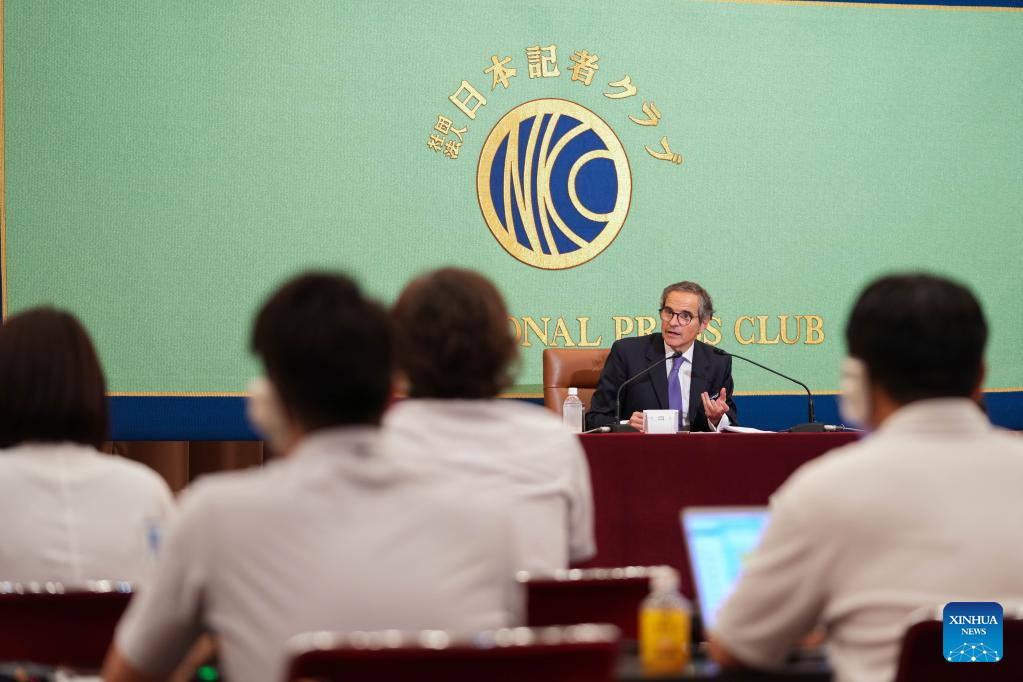
On Tuesday afternoon, Grossi stressed at a press conference held at the Japan National Press Club in Tokyo following the IAEA report delivery that the option to discharge the nuclear wastewater into the sea is one made by the Japanese government.
The IAEA will have a continued presence at the Fukushima Daiichi plant site to review, monitor and assess the discharge activities for decades to come, Grossi said, adding that whether to allow other countries to participate in the supervision is a decision to be made by the Japanese government.
During Grossi’s press conference, a group of protestors gathered outside the Japan National Press Club to voice opposition to Japan’s ocean discharge plan, shouting “The sea belongs to mankind. Don’t dump polluted water into the sea,” and “No discharge without consent. Keep your promise to the fishermen!”
At the invitation of Japan’s foreign ministry, Grossi started his four-day visit to Japan on Tuesday, including a trip to the Fukushima Daiichi nuclear power plant.
Source: Xinhua Editor: huaxia 2023-07-04
BEIJING, July 4 (Xinhua) — China on Tuesday said the report released by the International Atomic Energy Agency (IAEA) should not be a permission for Japan’s discharge of nuclear-contaminated water into the ocean, urging Japan to work with the IAEA to put in place a long-term international monitoring mechanism.
A Chinese foreign ministry spokesperson made the remarks when asked to comment on the report, which believes that Japan’s plan to discharge the nuclear-contaminated water into the sea complies with international safety standards, saying that the IAEA will conduct long-term monitoring over Japan’s discharge activities.
The spokesperson said it is learned that the report failed to fully reflect views from experts that participated in the review, and the conclusion was not shared by all experts. The Chinese side regrets the hasty release of the report.
Due to its limited mandate, the IAEA failed to review the justification and legitimacy of Japan’s ocean discharge plan, assess the long-term effectiveness of Japan’s purification facility and corroborate the authenticity and accuracy of Japan’s nuclear-contaminated water data. Therefore, the conclusion is largely limited and incomplete, the spokesperson said.
Simply for saving cost, Japan has insisted on discharging the nuclear-contaminated water into the sea in disregard of the concerns and opposition from the international community and taken the Pacific Ocean as the “sewer,” the spokesperson said.
The spokesperson added that no matter what the report says, it will not change the fact that Japan will release millions of tonnes of Fukushima nuclear-contaminated water into the Pacific Ocean in the next three decades.
“Will Japan’s purification facility be effective in the long-term? Can the international community be timely informed when the discharged water exceeds the discharge limit? What impact will the long term accumulation and concentration of radionuclides bring to the marine environment, food safety and people’s health? These are the questions that the IAEA report failed to answer,” the spokesperson said.
Noting that the United Nations Convention on the Law of the Sea stipulates that states have the obligation to protect and preserve the marine environment, and the Convention on the Prevention of Marine Pollution by Dumping of Wastes and Other Matter in 1972 prohibits the dumping of all radioactive wastes into the ocean from man-made structures at sea, the spokesperson said what Japan does contravenes its international moral responsibility and obligations under international law.
“We once again urge the Japanese side to stop its ocean discharge plan, and earnestly dispose of the nuclear-contaminated water in a science-based, safe and transparent manner,” the spokesperson said.
The spokesperson also urged the Japanese side to work with the IAEA to put in place as soon as possible a long-term international monitoring mechanism that would involve stakeholders including Japan’s neighboring countries.
 SANGHA KOMMUNE (SSR)