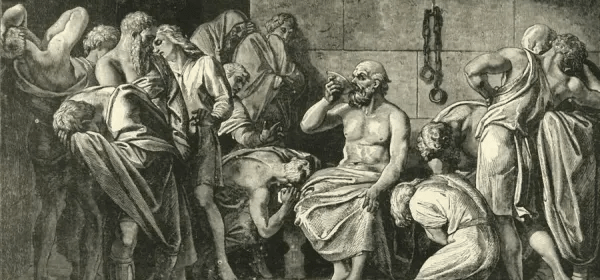
Socrates Drinks the Hemlock to Prove a Judicial Pont!

Email: “Who Owns Your Life – You or the State?” (25.6.2026)

The reality seems to be that as individuals we are the owners of our own existences. It is very difficult for the State to prevent the exercising of free-will in this instance. What is te point of charging a corps with a crime? In some countries, like Switzerland, people who are both “ill” and “rich” can access the voluntary dying system. This sees two doctors (or more) having to agree, social workers (having to agree) – and police officers present to support the rights of the patient. The right to “stop” exists right up to the ingestion of the State-administered drugs. I know this because a) I have read through the procedure, and b) YouTube used to host entire videos of the procedure. In one version, a billionaire walked into a lawyer’s office with his solicitor, sat on a comfy sofa and after a few minutes discussing and signing – ingested the drugs. He passed within seconds sat on the sofa – as if asleep. Of course, for minors (that is children aged beneath the age of consent within a certain country) – the decision will involve the parents, doctors, and other practitioners. I neither agree or disagree – but I do know that some human diseases are terrible to experience – particularly in the young.
Bill Hicks: The View From Within.

‘In 1992 much of his output centred on the defeat of George Bush Jr, in the US Presidential elections following his successful invasion of Kuwait and southernIraqin the first Gulf War. Through such material Hicks described his political stance ‘as a little to the Left’. He says that he did not vote for Bush because the recent Republican administrations had sponsored genocide in South American countries – whilst the US media limited the issue to whether a new Democratic President would raise taxes. The natural Rightwing bias within theUnited Statessystem is so prevalent that any legitimate notions of Socialism are treated as if they are a crime of immense immorality, stupidity and the product of extreme mental illness. Hicks detested the mainstream media – and along with corporate advertisers – viewed it as a product of Satan’s seed. In this respect he could be very forceful in his opinions – surprisingly so when his style of delivery is taken into account. The passion manifests suddenly within a meandering narrative about this or that. Regardless of the raw human emotion, he never abandoned the principle of considered opinion gained through intellectual analysis. The intelligence of Hicks – and his intelligence was as able as any renowned thinker Western civilisation has produced – never abandoned an accompanying morality that moulded ideas and directed actions.’