Photo taken on April 15, 2026 shows a container terminal of the Port of New York and New Jersey, which serves as a critical gateway for trade and a major logistics hub for the Northeast of U.S., in New York, the United States. (Xinhua/Zhang Fengguo)

US: 25 States “Sue” Trump Administration Over Section 301 Tariffs! (4.8.2026)

The coalition is asking the court to block the tariffs, declare them unlawful, and order refunds for the duties already paid.

The legal challenge centres on the administration’s effort to preserve Trump’s broad tariff regime after federal courts rejected two earlier versions imposed under different statutory frameworks. The states argue that federal officials seized upon Section 301 of the Trade Act of 1974 and forced-labour concerns merely as a pretext to rapidly recreate nearly identical global duties that the Supreme Court previously struck down in February.

“President Trump’s illegal tariffs are nothing more than a tax on hardworking families, driving up the cost of groceries, household essentials, building materials, and countless everyday goods that New Yorkers rely on,” said New York Governor Kathy Hochul in a statement.

Volunteers Fought At Harrisburg!

CSA: The Peculiar [1863] Union Defence of Harrisburg! (17.5.2025)

At one-point a thousand White volunteers from Harrisburg joined a large group of Black people to dig trenches and build ramparts around the geographical extremities. After one day, 700 of the White people returned home – saying the labour “hurt their hands” – whilst the other 300 acted as foremen directing the Black labourers (as if they were slaves). Black people built the defences of Harrisburg – but by and large were excluded from defending the place on the grounds that Black men carrying guns (and acting “free”) would scare the women and children. The situation was a little more nuanced than this, however, as NO White person from Harrisburg possessed the courage to join a local militia to defend the place they lived in. This led to the local authorities agreeing to arm a small company of local Black men that everyone knew – who had to drill away from the sight of ordinary people from Harrisburg. Meanwhile, thousands of White volunteers poured into the area to offer their services in defence of the place (risking their lives) – but were met with indifference and hostilities from the locals. Shop-keepers, hoteliers, and bar-owners put up their prices by ten or twenty times (even charging for a glass of water) – asking for excessive amounts of money for the smallest necessity of life.

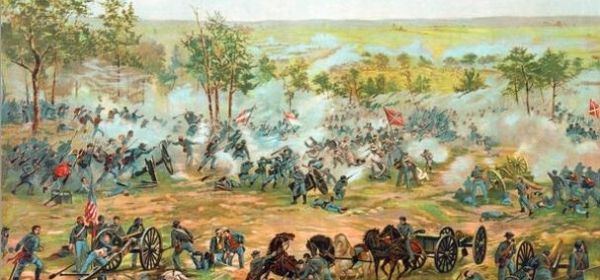
Battle of Gettysburg - Painting by Paul Philippoteaux

CSA: Confederate Army Uniforms, Hats, Ranks & Badges c. 1861! (27.4.2025)

Sometimes, CSA Units proudly wore “Blue” – whilst certain Union Units proudly wore “Grey”. Both sides also possessed Units that dressed (and acted) like English Red-Coats – a designation that then sent shudders through most people due to the reputation the Red-Coats possessed – namely that of strict discipline and ruthless close-quarter-fighting (all wounded were bayoneted as an act of compassion – due to the lack of any reliable medical treatment). English Red-Coats would march indifferently into enemy-fire – safe in the belief that once the distance was closed – the enemy would pay the price. The CSA Units attempted to replicate this attitude and make the Union pay for the damage its forces inflicted upon the Southern States.

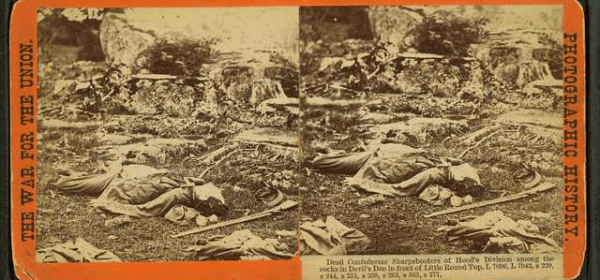
Dead Confederate sharpshooters of Hood's Division among the rocks in Devil's Den in front of Little Round Top.

CSA: Remembering the Bravery of “Irish” Company “K” – 15th Alabama – Little Round-Top [2.7.1863] – Gettysburg! (3.4.2025)

The weather was hot – and the Confederates had to advance over open ground before storming an inclined slope (in the form of a steep hill) – with the intention of sweeping the Federals off its top and consolidating the victory. The previous day had seen the Confederates sweep the Federals out of West and Central Gettysburg – and into the hills to its East. Washington was just 80 miles to the South – and legend has it that Lincoln was packing his belongings to flee! I have audio-typed part of a chapter from Stephen Sears’ book – carefully reproducing the text from an Audible edition (in my native British English). This provides a general background to the battle – but does not mention the Irish specifically – other than one or two fighting for the Union. For the story of “Company K” of the 15th Alabama Regiment of the Confederate States of America (CSA) – we must turn to the excellent work of Phillip Thomas Tucker – who has produced an excellent book examining the contribution to the Confederate cause made by the Irish!

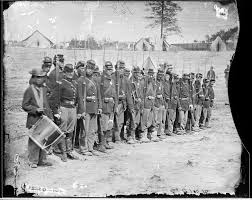
Possibly a a Photograph of the "Philadelphia Greys"

CSA: General Robert E Lee Sues for “Peace” [1863] – Pennsylvanian “Minutemen” Non-Existent! (17.3.2025)

This reflected a remarkable situation. A Confederate Army was riding rampant through the Pennsylvanian countryside – the State within which Washington DC is situated – and yet “no one” amongst the young, elderly, disabled or wounded men (considered medically “unfit” to join the Regular Army due to ill-health or age) were prepared to defend the Union. Within the city of Philadelphia, 8,000 men of the already existing “Philadelphia Greys” bravely volunteered to march to the front in defence of the Union. Due to the general lack of volunteers from the ordinary population – the city of New York sent 12,000 of its own existing Militiamen to supplement the regular Union Army. How brave these men were! Militiamen are often called “Sunday Soldiers” – as they are working men, fathers and patriarchs who live in society, work and look after their families. They come together once a week, once a month, or just a few times a year to compare notes, fire their weapons, and discuss homestead self-defence. They are not frontline soldiers. Of course, Confederate citizens showed the same extent of bravery when the time came. 

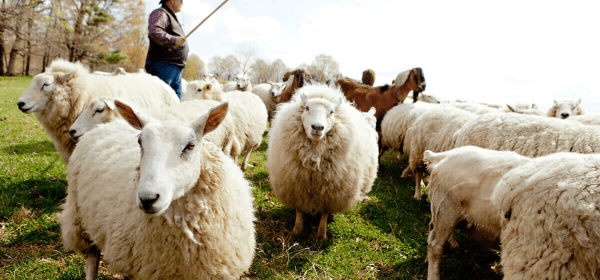
Sheep Are Generally "Apolitical"!

FBI: Surname “Crooks” NOT Related to Habitual Crime! (14.7.2024)

FBI Files report that the surname ‘Crooks’ is an ancient English surname relating to an individual who specialises in the care of adult sheep or juvenal lambs. As a surname, it is related to the surnames ‘Shepperd’ and ‘Lambert’ – with ‘Crooks’ referring to a six-foot wooden staff that possess a ‘hook’ (or ‘crook’) at one-end – used to ‘envelop’ the neck-area of a sheep or lamb – ‘at a distance’. This piece of pre-modern technology allows for troublesome and quick-footed sheep and lambs that need to be captured and brought near to their human carer. 

1 2