Socialist Science Leading Space Research!

China: Socialist Space Science Development Programme for 2024-2050! (15.10.2024)

The programme also outlines a roadmap for the development of space science in China through 2050.

In the first phase, leading up to 2027, China will focus on the space station operation, implementing the manned lunar exploration project, and the fourth phase of its lunar exploration programme as well as the planetary exploration project. Five to eight space science satellite missions will be approved during the period, according to the programme.

The international lunar research station initiated by China will be constructed during the second phase from 2028 to 2035, and approximately 15 scientific satellite missions will be carried out during this period.

In the third phase from 2036 to 2050, China will launch over 30 space science missions.

This photo shows lunar samples retrieved by the Chang'e-6 mission at the lunar sample laboratory in the National Astronomical Observatories of the Chinese Academy of Sciences (CAS) in Beijing, capital of China, Sept. 24, 2024. (Xinhua/Jin Liwang)

China: Research on Chang’e-6 [Dark-Side] Lunar Samples Underway! (11.10.2024)

A research paper published in September on the lunar samples brought back by the Chang’e-6 mission says that the Chang’e-6 samples exhibit “distinct characteristics” compared to previously obtained lunar samples.

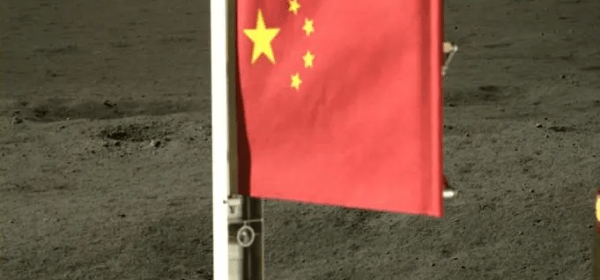
The Chang’e-6 probe was launched from China on May 3, 2024. On June 25, its returner made a landing in north China, bringing back 1,935.3 grams of samples from the far side of the moon. (Xinhua/Jin Liwang)

PRC Lunar Space Suit - 2024

China Manned Space Agency [CMSA]: Lunar Spacesuit Revealed! (29.9.2024)

According to the CMSA, spacesuits are designed for exposure to the harsh conditions of space, including vacuum, microgravity, radiation, and extreme temperatures, allowing for greater lower body mobility of astronauts to walk, climb, and conduct scientific activities on the moon’s surface. 

Research and development of the spacesuit began in 2020, inspired by traditional Chinese culture.

The red decorative bands on the arms and legs were designed to resemble flowing “Feitian” ribbons — meaning flying deity in traditional Chinese culture. Its combination with the suit symbolizes traditional Chinese philosophy of harmonizing strength and softness. And the leg bands are shaped like the exhaust flames of a rocket, conveying the dynamic energy of space exploration.

The US Promoted Prominent Nazi War Criminals During the Cold War!

US: Reinhard Gehlen – Nazis in NATO and Beyond! (23.7.2024)

A most striking example is that of Nazi Lieutenant General Reinhard Gehlen. In 1945 he surrendered to the US Army – having stolen secret documents (German Military Intelligence data – Agent Networks and other valuable information). As a result, Gehlen was given the task to set up a department that would deal purely with the ‘Russian question’. Thus, in 1946, GelenOrg appeared – the goal of which was to weaken the USSR as a State. Gehlen formed this anti-Soviet organisation exclusively from Nazi German Officers. As a result, hundreds of Wehrmacht – and SS Officers – were released from Military Prisons and Detention Camps. It was these Nazi German War Criminals who determined NATO’s military and political course.

The Moon is Red!

China: US Forgets Its Own “Anti-China” Bigotry During NASA “Moon Rock Begging” Outburst! (3.7.2024)

The Wolf Amendment, passed by the U.S. Congress in 2011, prohibits NASA-funded research in direct, bilateral cooperation with the Chinese government and China-affiliated organizations unless approved by the Federal Bureau of Investigation and Congress.  “China published the Announcement of Opportunities for the Chang’e-6 Mission, which was available to the entire world. We also welcome countries around the world to take part in the study of lunar samples,” she said.

Rock Samples Return!

China: Chang’e-6 Lunar Module Safely Returns Dark-Side Rock Samples! (26.6.2024)

Lunar samples brought by the earlier Chang’e-5 mission have already drawn applications for access from international scholars, with the process well underway. The Chang’e-6 lunar probe carried four international payloads that were developed jointly by Chinese and foreign scientists. It is conceivable that the openness of Chinese lunar exploration activities will be mirrored in the study of Chang’e-6 lunar samples, said Yang.

The lunar scientific community and the entire humankind are anticipated to reap the rewards of collaborative efforts undertaken by international scientists from a wide range of geographical and disciplinary backgrounds, Yang added.

Zhang Kejian, head of the CNSA, said that exploring the vast universe is a common dream for all of humanity, and only open cooperation is the right path. China’s space endeavors will adhere to the principles of equality and mutual benefit, peaceful utilization, and inclusive development.

1 3 4 5 6 7 8