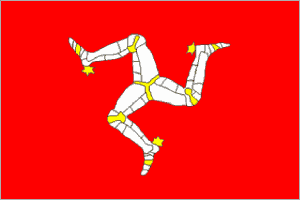
Three Armoured-Legs Moving Clockwise in the Direction of the Sun!

Isle of Mann: The 5,000-Year-Old Grave on a Manx Front Lawn! (3.8.2026)

As Celts, we are very much on our path toward a progressive future. After the English Civil Wars of the 1640s-1650s – the absolute monarchy was permanently abolished and has never been bought back. What we have is a “Constitutional Monarchy” that possesses no political power and acts as an unelected Head of State – employed by the democratically elected Parliament – the winner of the Civil War(s). The term “Crown” is a misnomer – as in this instance the term “Crown” refers to “Parliament” – or that (bourgeois) body which now possesses control of the means of production (which it took-off the aristocracy by force of arms – executing King Charles I in the process). Cromwell was centre-left – but after his death, his son was overthrown and a centre-right bourgeois government took its place. It has been this way since 1659 – with every attempt of a Socialist Revolution being defeated. This centre-right bourgeois government even brought back a very weakened CofE, etc. So, the Isle of Mann (Manx) is an island of 85,000 Celts who live on an island in the Irish Sea between West England and East Ireland. The Celts used to occupy all the islands in this part of the world and shared a common identity. There are graves like this in Stonehenge, etc.
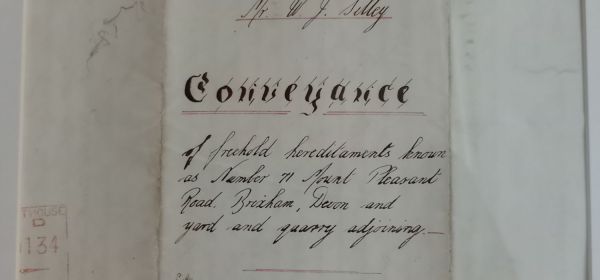
Conveyance Title - 71 Mount Pleasant Road, Brixhan

Brixham: Framed 1920 Conveyance Deed – Kai-Lin Helped Me Read It! (3.4.2026)

Today, such people are “preserved” as a “right” – as their presence helps us understand our own human history (the Celts – my ethnicity – used to strip naked, get drunk, and cover themselves in shit before a battle). But I digress. In the bedroom our two daughters are occupying – the above legal document has been “framed” and hung on the wall for all to see and admire. Indeed, until, this morning, none of us had actually noticed it. In 2026, this second-floor building (“71a” is beneath us) is termed “Rock Hopper” – and this is the name used in all the advertising literature. The back yard is a narrow strip of land – but I suspect that “71” and “71a” were originally one and the same dwelling. The steep rock-face at the end of the garden turns-out to be the edges of an old quarry – whatever that was used for – probably prior to these houses being built on a steep and narrow hill (incline).

Ancient Seafaring Scaffolding from the Time of Henry VIII!

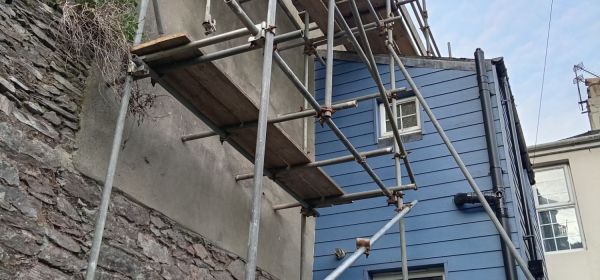
Brixham: “What’s this Scaffolding? It’s a Feature”! (29.3.2029)

Of course, as The Beatles once reminded us “Nothing is Real!” – in the hyper-extension of capitalism that is “the holiday”. It is a time of no work (unless you are on a working holiday – we’ve all been there – labour in exchange for ten-minutes on a beach), no struggle, and comfortable living – but this week or two takes around 50-weeks of hard graft just to raise the deposit. When I was in Spain, I once witnessed an Englishman arrive with his case at our holiday resort – returning after just two or three weeks after his last visit. His previous sojourn had been “magical” in his own words and he had gone home, re-mortgaged the house, and rebooked in exactly the same Benidorm hotel! The problem was that no one else he had stayed with had rebooked – and none of the staff could remember who he was!

Market Overton - 17th Century Window!

Market Overton: 17th Century Window! (6.11.2025)

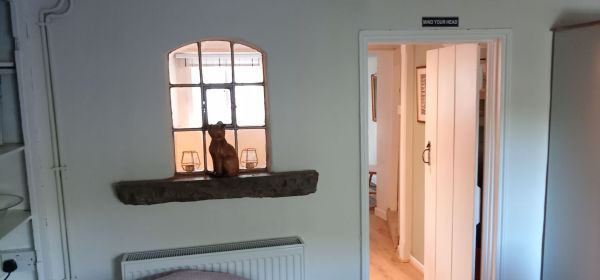
What is now the dining area – where I set-up my study space – was probably once part of the garden. Therefore, the window itself was once considered the height of building technology. In those days, draughts from blowing winds were a major issue. The frame of this window is firmly embedded in the wall-structure so that no wind can penetrate. The cement and plaster hold it robustly in place – whilst its relatively small surface area allows for strength and stability. As glass was not as strong then as it is now – the panes of glass used were far-smaller – with each held in-place by its own frame. Furthermore, and a feature I like, is the central pane that possesses a stout hinging and opening and shutting mechanism. Even today – this design still retains much of its original strength – whilst being now inside the house means it is now better preserved.

36 The Main Street - Market Overton - Rutland

Rutland: Teddy’s Cottage – Market Overton! (27.10.2025)

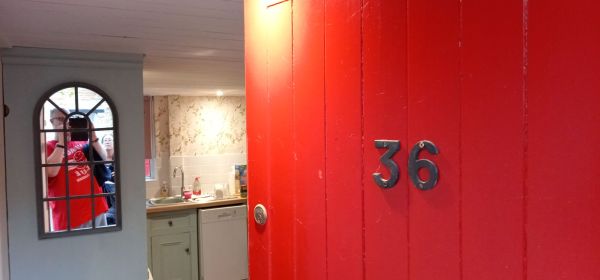
The above is extracted from the linked (historical) articled presented at the top of this article. I believe this information refers to the row of cottages – one of which – we are currently staying within for five-days. This is our current Research Headquarters for this visit (25.10.2025-30.10.2025) – where we will be travelling to and from Duddington (and the surrounding areas). In the information pack provided in the property – it states the house dates from the 17th century (1600s). It possesses two floor, two bedrooms, a downstairs living-room, dining-room, kitchen, and foyer. Much of the downstairs flooring is flagstone – with the floor levels from one room to the next being uneven (on different levels). Apparently, this has something to do with the age of the building.

Rockingham Castle - Battlements!

Rutland: Visiting Rockingham Castle! (29.7.2025)

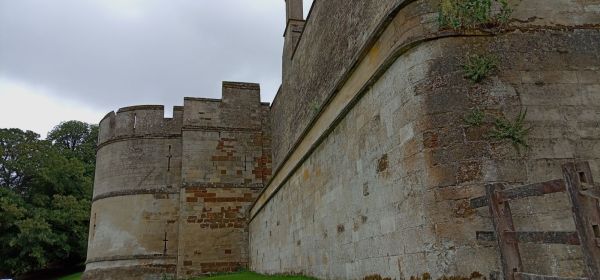
Despite visiting Duddington (in Northants) regularly since 2009, we had never seen any signs for “Rockingham” – and wondered where this place was. Furthermore, whereas King Henry VIII used to frequent “Nonsuch” (in Sutton and Cheam – where we live) – I am told that King John (1166-1216) of Magna Carta fame, used to spend his leisure time staying at Rockingham Castle – which is near Rockingham village. He used to hunt in the local woods. Apparently, Henry VIII granted the castle (the Norman version of which is currently over 950-years old) to the Watson family (it was leased to Edward Watson in 1544). Prior to this, the general area the castle is now constructed upon possessed a Roman (a coin production industry) – and then a Saxon (Lord Bovi) – presence. The locale of Rockingham (probably the nearby village) is mentioned in the 1066 Doomsday Book – with the castle proper being built between 1066-1071.

1 2