China Has Explored the Celestial Realms for Thousands of Years!

China: Ancient Astronomical Instruments Draw Museum-Goers to Cosmic Quest! (15.8.2026)

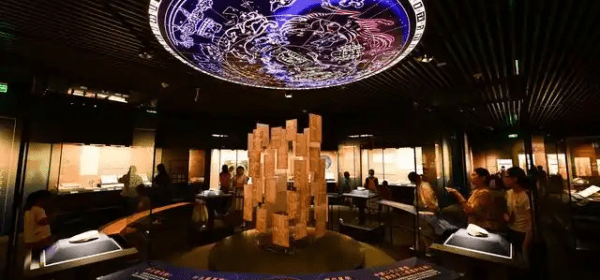
HEFEI, Aug. 14 (Xinhua) — China’s museums are often defined by their porcelain, calligraphy and ritual vessels. But a new exhibition in east China’s Anhui Province is turning the spotlight away from traditional treasures and toward scientific endeavors of the past, showcasing jade cosmograms, celestial star charts and bronze globes crafted by astronomers centuries ago.

Titled “Divine-Sky Exploration: The Cosmological Vision of Chinese Civilization,” the exhibition at the Anhui Museum brings together nearly 300 artifacts from 48 institutions nationwide. It is a rare exhibition in China focused specifically on presenting the country’s “understanding of the universe” through cultural relics.

Since its launch in July, the show has drawn some 350,000 visitors, fascinated by the instruments ancient Chinese used to observe, measure and pay homage to the universe.
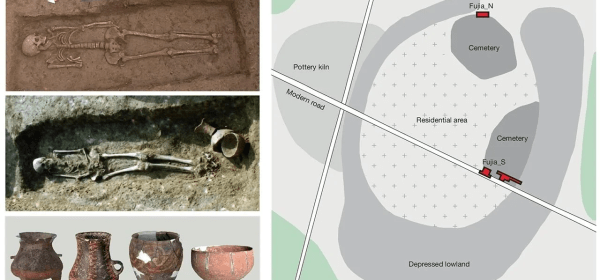
Painted pottery (bottom left) from the Fujia cemetery, as well as from the southern grave (FJ_S21; middle left) and northern grave (FJ_N07; top left). The right panel illustrates the layout and features of the Fujia archaeological site, highlighting residential areas, pottery kilns and the two cemeteries. Scale bar, 50 m. Credit: J. Wang et al., Nature (2025)

China: DNA Study Reveals “Fujia” Matrilineal Society! (4.1.2026)

All 14 individuals from the northern cemetery possessed the same maternally inherited mitochondrial DNA haplogroup — a genetic population group sharing a common ancestor — and exhibited identical mitochondrial DNA sequences, while 44 of the 46 individuals from the southern cemetery had another mitochondrial DNA haplogroup and identical mitochondrial DNA sequences, indicating that the individuals in each group shared a maternal lineage.