When sense-organs disengage from sense data, his attainment will be similar to that achieved by a reciter of the Buddha’s name when his training becomes effective and when the Pure Land manifests in front of him. In this state, noumemon and phenomenon intermingle, Mind and Buddha are not a duality and both are in the state of suchness which is absolute and free from all contraries and relativities. Then what difference is there between Chan and Pure Land?
Category: Buddhism
Sila or ‘Moral Discipline’ as Qi Cultivation
The maintaining of physical discipline in the Buddhist sense, is a form of what is known in China today as ‘qigong’ (氣功), or to use the much older name – ‘daoyin’ (導引). Qigong is the cultivation of inner energy (qi) through directed willpower and effort (gong), whilst daoyin is the practice of ‘directing’ and ‘leading’ (dao) inner energy (qi), whilst ‘yin’ is the wilful process of ‘pulling’ the inner energy (qi) through the body and causing it to flow to all areas without hindrance.
How Long Can Human-beings Live?
A more extreme example of longevity belongs to that of the modern Daoist Immortal Li Qing Yun whose birth and death dates are given as 1677 – 1933. This means that he lived for 256 years and according to Chinese record, there is ample documentary evidence for this extraordinary life-span.
Generating Positive Karma and Diminishing Negative Karmic Fruit
(Translated by Adrian Chan-Wyles PhD) Some people follow the Buddha as a means to gain blessings. As everyone knows, the Buddhist path is not about
Master Xu Yun: On the Relationship Between Ch’an & Pure Land Buddhism
Then Mahakasyapa transmitted to him the Tathagata’s Mind Seal, making him the second Indian Patriarch. The transmission was handed down to following generations, and after the Patriarchs Asvaghosa and Nagarjuna, Chan Master Hui-wen of Tian-tai Mountain in the Bei-qi Dynasty (550-78) after reading (Nagarjuna’s) Madhyamika Shastra, succeeded in realizing his own mind and founded the Tian-tai School.269 At the time, our Chan Sect was very flourishing.
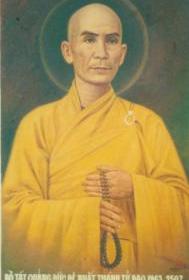
Thich Quang Duc (释广德) [1897-1963]
Thich Quang Duc’s action produced a mind altering paradigm shift throughout the world that is still being discussed today. He demonstrated the power of Buddhist mind control during a very painful death – whereas no Christian believers (beyond the realms of imagination, superstition, or the paranormal) have managed to rise from the dead.
 SANGHA KOMMUNE (SSR)