Blogger’s Note: The US leviathan should have rolled-over Iran by now – and it is a remarkable indictment of the Trump II Administration that it has not yet won – and has arguably been bettered by Iran’s missile system. Iran dumped Cuba and Venezuela in search of its own Islamacist agenda. The cease fire seems a ruse perpetuated by the US – as a means to put Iran at its ease – and it lasted about two-hours – before Trump resumed its bombing but on a massive scale. Shooting-down a handful of US aeroplanes is admirable – but to be honest – it is nowhere near enough to deter US aggression. The Arabs wiped-out the entire Israeli Airforce in 1973 – and it eventually meant nothing – as Israel still prevailed with US weaponry and political support. Warfare is an entirely material affair and Iran does not have the physical resources to equal the US equivalent. Iran cannot win a physical war with the US. Yes – the pseudo-leftists like to think that “losing” is in fact “winning”. What a mess it all is. Most Arab countries have denounced the Palestinian cause they used to support on the grounds that they do not support anti-Semitism or the general racism that underlies much of this resistance. Confronting a US-backed and supported Zionism cannot be defeated on the battlefield. This is the reality. I remember the Lebanese Communist Party celebrating the victory of ISIS in Syria and the fleeing of Assad! Why? Because it is a false-front claiming to be “Communist” – but is in fact an (anti-Socialist) “Islamicist” entity. This is why it was purged from my blog. I am not surprised by what is happening as the world is opposed to any form of Socialism – even a left-leaning Islamacist version. The same regime that hangs people from cranes in public – almost as bad as the Saudi beheadings in car-parks on Friday night! The genuine left must maintain a dialectical awareness of the situation and not be seduced into religionism. Islam is not the answer to any problems – as no politicised religion is. Socialism is a mess – and has been ever since Khrushchev lied about Stalin in 1956 (Israel was behind spreading this lie around the world). ACW (9.4.2026)
Thursday, 09 April 2026 10:01 AM [ Last Update: Thursday, 09 April 2026 10:01 AM ]
By Mohammad Molaei
It was not the first time the US sent special forces deep inside Iranian territory to carry out a rescue operation. In 1980, as part of the so-called “Operation Eagle Claw,” US Delta Force troops landed at a deserted airport near Tabas in an attempt to free Americans in Tehran.
However, that mission ended in total disaster due to technical failures and a massive sandstorm. It led to the destruction of one C-130 Hercules transport aircraft and one CH-53 Sea Stallion helicopter. The operation was eventually canceled, and US forces scrambled to exit Iranian soil.
During the hasty retreat, five CH-53 helicopters and the remains of eight slain troops were left behind in the Tabas desert.
Now, some 46 years after that humiliating episode, the US once again conducted a “rescue mission” inside Iran, this time during the Ramadan War.
The objective, as they claimed, was to save two crew members of a US Air Force F-15E fighter jet that had been shot down by Iranian air defenses over Iranian airspace.
According to American media reports, the rescue took place over two consecutive days: one mission to recover the pilot, and another to save the weapons officer. President Donald Trump announced the success of these operations on social media.
However, a closer examination of the details reveals a story filled with ambiguities, contradictions, and unmistakable signs of failure.
Following US Secretary of War Pete Hegseth’s official announcement that Iran’s air defense systems and missiles had been completely destroyed, a US Air Force F-15E Strike Eagle — assigned to the 494th Squadron based at RAF Lakenheath in Britain — was targeted and shot down on Friday, April 3.
Just hours after the crash, Iranian media published images of the jet’s vertical tail debris, which bore the identification code “LN” and the squadron’s distinctive red markings.
In the first few hours after publication, some visual similarities in the early imagery — combined with the unusual tail shape — led many commentators and social media users to mistakenly believe the wreckage belonged to a stealth F-35 Lightning II fighter.
However, after independent experts closely scrutinized the images and compared technical specifications — including paint scheme, tail serial number, wing and tail structure, and unit markings — it soon became clear that the debris was from the same American F-15E Strike Eagle involved in the mission. This shoot-down invalidated Hegseth’s claims for the first time.
The first pictures and news of the appearance of the American MH-60 Black Hawk helicopters, which were refueling in the air with the help of the HC-130 Combat King II search and rescue helicopters was first published at 14:40 Iran time.
These special combat search and rescue (CSAR) helicopters, which have an advanced FLIR system, multi-purpose radars, can fly very low, and have electronic warfare equipment, entered the airspace of the Islamic Republic, and one HC-130J Combat King II, which is an aerial tanker.
They were filling their tanks in a mountainous region in the Kohgiluyeh and Boyer-Ahmad province and then departed from Iranian airspace at the southern boundaries. Western media reports claimed that they had rescued the American pilot, without any evidence.
In the early hours of April 5 — two days after the initial incident — reports emerged of fierce confrontations and gunfire at multiple locations in southwestern Iran.
Iranian police forces (Faraja) and local tribesmen engaged in encounters with special forces of the American regime, which had entered Iranian airspace for a second time.
Simultaneously with these clashes, several telecommunication towers in Dehdasht, Kohgiluyeh and Boyer-Ahmad Province, were struck to severely disrupt communications between the Islamic Republic’s defending forces.
At 3 a.m. Iran time, Western media reported the “successful rescue” of the weapons officer. However, the confrontations continued until sunrise, and the full scale of the incident became clear only when daylight broke.
The release of images showing two HC-130 aircraft in southern Isfahan in the early morning hours — both of which were then ground-targeted — brought new twists to the story.
The second rescue operation was accompanied by clashes across multiple locations in Kohgiluyeh and Boyer-Ahmad Province, as well as parts of Isfahan province. This contrasted sharply with the relatively confined area of the first rescue, suggesting an unprecedented magnitude and strategic intricacy to the operation.
In this delicate step, the US forces attempted to land two HC-130J Combat King II planes at a deserted airport in southern Isfahan. In addition to transporting Delta Force and SEAL Team Six special operators, these two heavy transport planes were also carrying two light MH-6 Little Bird helicopters.
These helicopters are configured for rapid infiltration missions, instant extraction, and extremely low-altitude operations, and are equipped with sophisticated night vision sensors and terrain-following radars.
According to American media reports, after a failed landing in which the landing gear became stuck on the loose, uneven ground, these sensitive assets were bombed and destroyed by US forces themselves to prevent them from falling into Iranian hands. Subsequently, Trump posted on Truth Social that the “rescue” of the second pilot had been successfully completed.
However, upon closer inspection of the details of this tense operation, strange ambiguities and numerous contradictions emerge that call the entire “pilot rescue” story into question.
Looking at the first and second operations, it seems the operations were carried out in two totally different locations. The distance geographically that separated the crash point of the F15e that crash occurred near Isfahan and the last rescue point in Kohgiluyeh and Boyer-Ahmad is so large that, with the extreme mountainous terrain, limited vegetation, very limited time scale on which to carry it out, and the very prevalent presence of the defending forces, should the weapons officer (second pilot) have ejected even with the main pilot.
Even though the F-15 E could separately eject both the pilot and the weapons officer, more likely scenario is that at the time the air defense missile hit the F-15E over Isfahan, the weapons officer panicked and the pilot did not eject and continued flying controlled with powerful Pratt and Whitney F100-PW-229 engines and the high stability of the flight control system till it reached an area of Kohgiluyeh and Boyer-Ahmad.
This scenario is conceivable, yet the main question remains: why, after five days, has the complete wreckage of the fighter jet still not been discovered?
On Iranian soil, no other sections of the fuselage, engines, or other major components have been found — only a single vertical tail section. Given its powerful engines and high flight control stability, the F-15E is capable of remaining airborne for an extended period even after sustaining serious tail damage, and it could have potentially left Iranian airspace.
However, the fact that the full wreckage has yet to be found several days after the incident is highly noteworthy, suspicious, and raises serious questions.
We must next turn to southern Isfahan. According to Western media reports, the American regime’s army decided to land two HC-130J Combat King II planes at an abandoned airport in that region. It appears that the aircraft were unable to take off after landing — likely because the landing gear failed upon touchdown and because the soft, uneven soil conditions of the area had not been anticipated.
As a result, both aircraft became stuck and could not depart. Additionally, MH-6 Little Bird helicopters were unloaded from inside the planes.
What is intriguing and worth mentioning is that two HC-130J aircraft were not necessary to rescue a single weapons officer; the mission could have been accomplished with one plane. This suggests a larger operation, and possibly undisclosed objectives.
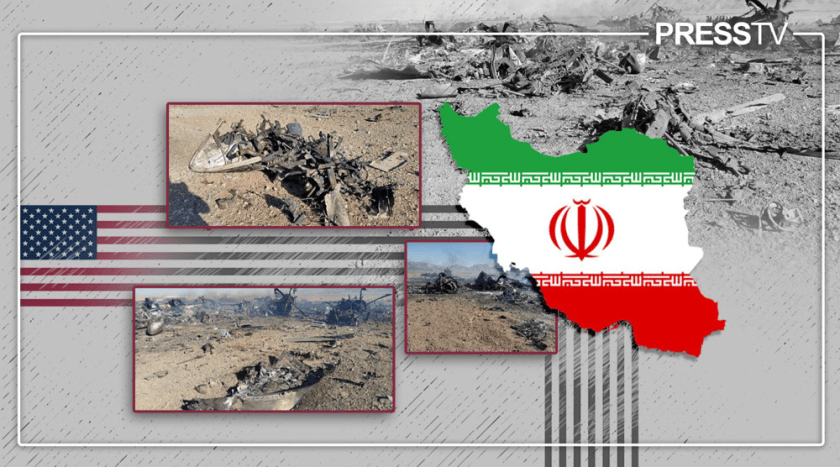
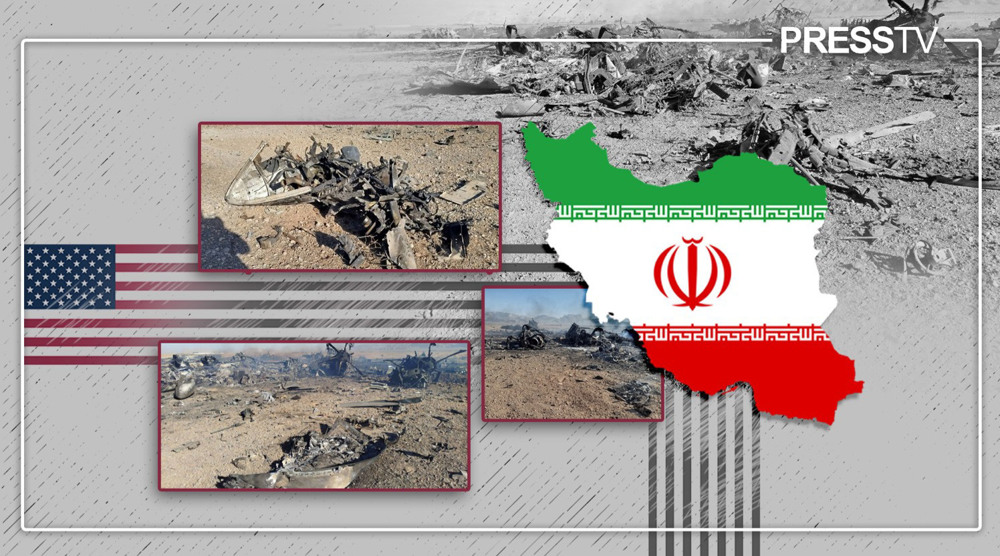
As seen in the earliest published photos of the HC-130s on the ground prior to their destruction, the planes landed first and were subsequently destroyed on the ground. Some images of the debris show that the helicopters had been completely unloaded from the transport aircraft and were lying beside it, rather than remaining inside.
Examination of the destroyed aircraft’s wreckage also shows they were hit on the ground or just before landing. The aircraft propellers show bending resulting from high heat and the melting of carbon fiber propellers.
Although further examination of the wreckage reveals holes resembling bullet impacts on the fuselage — indicating the body was hit — these hits could not have caused the plane to crash.
One way or another, had there been any other operation in the background of the pilot rescue operation, it was definitely followed by extreme failure with not only the loss of four advanced aircraft (two of the HC-130J, two of the MH-6 Little Bird helicopters) but also in the fact that it is the complete total failure of this operation that is not mentioned with any official and documented reference.
Only the so-called “rescue” of the weapons officer, who incidentally is said to have been seriously wounded, is mentioned.
To date, CENTCOM has not released the complete information on the specifics of these operations, which in fact only serve to relay other viable theories and suggest that the US forces, deep within Iranian territory, not only failed to achieve their goals but also lost heavy equipment and had their strategic vulnerabilities revealed.
Mohammad Molaei is a Tehran-based military affairs analyst.
(The views expressed in this article do not necessarily reflect those of Press TV)
 SANGHA KOMMUNE (SSR)