by MINSAP Editorial Team · 12 February 2026 – Written by Redacción MINSAP
What can happen in the vital wards of a hospital if the energy siege imposed on Cuba by the tycoon persists, particularly in the light of the Donald Trump remaining President?
Imagining maintaining a moving courage in the face of a scary impotence. What can happen in the vital wards of a hospital staff – if the energy siege imposed on Cuba by the tycoon continues – and Trump remains President?
Although it is shocking, the answer does not admit any embellishments: without power, the hospital equipment would stop working and patients placed at immediate risk of death. Human life does not matter to the occupant of the White House and his buffoons. But, to Cuba, yes.
Doctor Ernesto Guevara de la Serna General Teaching Hospital is an example in comprehensive health care, not only for residents in the province of Las Tunas but also for those who come from the municipalities of Calixto García (Holguín), Río Cauto (Granma) and Guáimaro (Camagüey).
“It has all medical specialties, except Psychiatry and Cardiovascular Surgery,” explains its general director, Marianela Zapata Romero, “and we provide emergency care, outpatient consultation and specialties in specific consultations, as well as other outpatient services, especially surgical ones.
“We have approximately 450 to 500 beds occupied each day. In the emergency room, an average of 400 to 500 patients are treated daily and in the outpatient clinic we also oscillate between 500 and 600 per day. We all need electricity.”
The Electric Company of Las Tunas protects the circuit in which the largest health institution in the territory is located; however, the concern is tangible because all procedures are subject to electricity.
“It is essential. Technology, ventilation of the bass, surgeries depend on it. In addition, many patients must be in an air conditioning environment, according to the established epidemiological standards.
“We have two very powerful generators that support the hospital, but they demand high fuel consumption.
“In addition, there is the fuel for the boilers, the fuel oil, which sustains the sterilization, food processing and laundry of the hospital. We also use oetrol for emergency department and guard car transportation.
“With liquefied petrol, several activities are carried out in the institution. One of them is the processing of samples in laboratories. And, finally, there is the oxygen plant that guarantees the service for the centre and the rest of the health units in the province,” concludes Zapata Romero.
“In Las Tunas, as in all of Cuba and in the world, cardiovascular diseases are the leading cause of death, and among them acute myocardial infarction,” says Dr. Yurina Cruz Fernández, a first-degree specialist in Cardiology, a master’s degree in medical emergencies, assistant professor and associate researcher.
“Every day, patients are admitted here not only with heart attacks but also with other types of heart disease, whether they are decompensated vascular diseases, heart failure, arrhythmias and complicated infectious endocarditis. Serving them is a challenge, but we do the best we can.”
The doctor mentions the shortage of essential medicines and supplies, but recalls that the priority of the group is to save the lives of the sick and for this they spare no time or effort.
He says that the C-arm equipment, essential for implanting permanent pacemakers in the operating room, is currently broken. “So we have to transfer our patients with severe heart rhythm disorders to the provinces of Holguín and Granma.
“For that we need the integrated medical emergency system and sometimes it becomes a little difficult for us because it must be an advanced life support team, with all the necessary conditions to take this type of patient.”
On each of the trips there is one patient, or at most two, because they require special care to solve any emergency that arises on the road. Calculate how much fuel is required, just for that activity.
“Note that, in addition to that petrol, in the service we also require electrical energy to perform electrocardiograms, ergometric tests and echocardiograms, among other tests that evaluate the state of health of people,” said the specialist.
Ana María Madrazo Mejías is torn between the uncertainty of seeing her mother sick and the satisfaction she feels for the care lavished on her by the doctors and nurses of the Cardiology service.
“She came from the municipality of Colombia, because she was diagnosed with low heart failure. She was immediately attended to by wonderful doctors who have given us all the information about her condition.
“He needed a transient pacemaker and they put it in. Now we are waiting for them to take her to Holguín or Bayamo to put a permanent one on her. Thanks to this Revolution, my mother will be able to have another few years of life.
“I hope that the president of the United States does not make the situation we have more difficult.”
Dr. Adrián Hernández Carballo is the head of service of the intensive care unit of the Doctor Ernesto Guevara de la Serna Hospital, a “purely technological” area that is among the three with the best results in the country, “thanks to the medical and nursing team we have here.”
There, despite the scarcity of medical supplies, all treatments are carried out with precision. And this is attested to by the recovered patients and their families, who arrive from the other existing therapy rooms in the province, to centralize resources.
In relation to seriously pregnant women, excellence in services is sought, and for more than a year none has died. This is one of the indicators that the Washington government wants to reverse with its inhumane measures to hurt the Cuban population.
“We depend on equipment to monitor the patient and to treat the seriously ill,” says Dr. Jaime Julián Rey, a first-degree specialist in Intensive Care and Emergency Medicine, and a member of the intensive care service of the provincial hospital.
“They are two completely different concepts, because they are monitoring equipment and replacing organ systems that fail in the critical patient. They inexorably depend on electrical energy to function.
“Specialized technology comes with batteries included; but, as they are used, they have deteriorated. We can only tolerate short power cuts here, because we have a backup unit.”
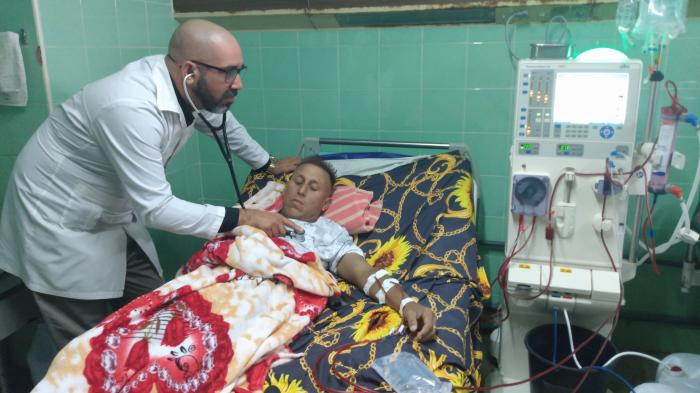
Without electricity, the “Guevara” would be chaos. And although the country protects hospitals, if the measures of the U.S. government fulfill their mission, mechanical ventilators, artificial kidneys for those with kidney failure, incubators that protect the lives of newborns with conditions and countless pieces of equipment would stop working.
A fuel cut would have dire consequences. The Cuban government is taking steps to minimize the impact. Friendly countries are already extending their hand of solidarity. And the empire that believes itself to be the owner of the world will forever bear the guilt of threatening the lives of innocent people.
Text and photos: Granma Newspaper
Spanish Language Text:
Si se apaga la vida
por Redacción MINSAP · 12 febrero 2026
Written byRedacción MINSAP
¿Qué puede suceder en las salas vitales de un hospital si se mantiene el cerco energético que impuso a Cuba el magnate, devenido presidente de Estados Unidos, Donald Trump?
Imaginarlo conmueve, asusta, da impotencia y coraje. ¿Qué puede suceder en las salas vitales de un hospital si se mantiene el cerco energético que impuso a Cuba el magnate, devenido presidente de Estados Unidos, Donald Trump?
Aunque estremece, la respuesta no admite adornos: sin energía, los equipos dejarían de funcionar y pondrían en riesgo inmediato de muerte a los pacientes. La vida humana no le importa al inquilino de la Casa Blanca y a sus bufones. Pero, a Cuba, sí.
El Hospital General Docente Doctor Ernesto Guevara de la Serna es un ejemplo en la atención integral de Salud, no solo para los residentes en la provincia de Las Tunas sino para quienes llegan desde los municipios de Calixto García (Holguín), Río Cauto (Granma) y Guáimaro (Camagüey).
«Cuenta con todas las especialidades médicas, excepto Siquiatría y Cirugía Cardiovascular –explica su directora general, Marianela Zapata Romero– y brindamos atención de urgencia, consulta externa y de especialidades en consultas específicas, así como otros servicios ambulatorios, sobre todo los quirúrgicos.
«Tenemos un aproximado de camas ocupadas entre 450 y 500 cada día. En el cuerpo de guardia se atiende un promedio de 400 a 500 pacientes diarios y en la consulta externa también oscilamos entre 500 y 600 por jornada. Para todos necesitamos energía eléctrica».
La Empresa Eléctrica de Las Tunas protege el circuito en el que está la mayor institución de Salud del territorio; sin embargo, la preocupación es latente porque todos los procedimientos están sujetos a la electricidad.
«Es imprescindible. De ella dependen la tecnología, la ventilación de los graves, las cirugías. Además, muchos pacientes deben estar en un ambiente de climatización, según las normas epidemiológicas establecidas.
«Tenemos dos grupos electrógenos muy potentes que sostienen el hospital, pero demandan un alto consumo de combustible.
«Además, está el combustible de las calderas, el fuel oil, que sostiene la esterilización, la elaboración de alimentos y la lavandería del hospital. También usamos la gasolina para el transporte del servicio de urgencias y del carro de guardia.
«Con el gas licuado se hacen varias actividades en la institución. Una de ellas es el procesamiento de muestras en los laboratorios. Y, por último, está la planta de oxígeno que garantiza el servicio para el centro y el resto de las unidades de Salud de la provincia», concluye Zapata Romero.
«En Las Tunas, como en toda Cuba y en el mundo, las enfermedades cardiovasculares constituyen la primera causa de muerte, y dentro de ellas el infarto agudo del miocardio», significa la doctora Yurina Cruz Fernández, especialista de primer grado en Cardiología, máster en urgencias médicas, profesora auxiliar e investigadora agregada.
«Aquí cada día ingresan pacientes no solo con infartos sino con otros tipos de cardiopatías, ya sean enfermedades vasculares descompensadas, insuficiencia cardíaca, arritmias y endocarditis infecciosas complicadas. Atenderlos es un reto, pero lo hacemos lo mejor posible».
La galena menciona la escasez de medicamentos esenciales e insumos, pero recuerda que la prioridad del colectivo es salvar la vida de los enfermos y para ello no escatiman ni tiempo ni esfuerzos.
Comenta que actualmente está roto el equipo Arco en c, elemental para implantar en el salón de operaciones los marcapasos permanentes. «Entonces tenemos que trasladar a nuestros pacientes con trastornos graves del ritmo cardíaco hasta las provincias de Holguín y Granma.
«Para eso necesitamos del sistema integrado de urgencias médicas y a veces se nos torna un poco difícil pues debe ser un equipo de apoyo vital avanzado, con todas las condiciones necesarias para llevar a este tipo de enfermos».
En cada uno de los viajes va un paciente, o a lo sumo dos, porque requieren cuidados especiales para resolver cualquier emergencia que se presente en el camino. Calculen cuánto combustible se requiere, solo para esa actividad.
«Anote que, además de esa gasolina, en el servicio también requerimos de energía eléctrica para realizar los electrocardiogramas, las pruebas ergométricas y los ecocardiogramas, entre otros exámenes que evalúan el estado de salud de las personas», apuntó la especialista.
Ana María Madrazo Mejías se debate entre la incertidumbre por ver a su mamá enferma y la satisfacción que siente por los cuidados que le prodigan los médicos y enfermeros del servicio de Cardiología.
«Ella vino remitida desde el municipio de Colombia, porque le diagnosticaron una insuficiencia cardiaca baja. Enseguida la atendieron unos médicos maravillosos que nos han dado todas las informaciones sobre su estado.
«Necesitó un marcapaso transitorio y se lo pusieron. Ahora estamos esperando que la lleven a Holguín o a Bayamo para ponerle uno permanente. Gracias a esta Revolución, mi mamá podrá tener otros años más de vida.
«Espero que el presidente de Estados Unidos no haga más difícil la situación que tenemos».
El doctor Adrián Hernández Carballo es el jefe de servicio de la unidad de cuidados intensivos del Hospital Doctor Ernesto Guevara de la Serna, un área «puramente tecnológica» que está entre las tres de mejores resultados en el país, «gracias al equipo médico y de enfermería que tenemos acá».
Ahí, pese a la escasez de insumos médicos, todos los tratamientos se realizan con precisión. Y de eso dan fe los pacientes recuperados y sus familiares, quienes llegan desde las otras salas de terapia existentes en la provincia, para centralizar los recursos.
Con relación a las gestantes graves se busca la excelencia de los servicios, y desde hace más de un año ninguna ha fallecido. Este es uno de los indicadores que quiere revertir el Gobierno de Washington con sus medidas inhumanas para lastimar a la población cubana.
«Dependemos de equipos para realizar la vigilancia del paciente y para realizar el tratamiento de los graves», comenta el doctor Jaime Julián Rey, especialista de primer grado en Medicina Intensiva y Emergencia, y miembro del servicio de cuidados intensivos del hospital provincial.
«Son dos conceptos completamente diferentes, porque se trata de equipos de monitorización y de sustitución de los sistemas de órganos que entran en falla en el paciente crítico. Inexorablemente dependen de la energía eléctrica para funcionar.
«La tecnología especializada viene con baterías incluidas; pero, a medida que se usan, se han ido deteriorando. Aquí solo toleramos cortes breves de la electricidad, porque tenemos una unidad de respaldo».
Sin electricidad, el «Guevara» sería un caos. Y aunque el país protege a los hospitales, de cumplir su cometido las medidas del Gobierno estadounidense, dejarían de funcionar los ventiladores mecánicos, los riñones artificiales para quienes presentan fallas renales, las incubadoras que resguardan la vida de los recién nacidos con afecciones y un sinnúmero de equipos.
Un corte de combustible tendría consecuencias nefastas. El Gobierno cubano adopta medidas para minimizar el impacto. Países amigos ya tienden su mano solidaria. Y el imperio que se cree dueño del mundo cargará por siempre la culpa de amenazar la vida de personas inocentes.
Texto y fotos: Periódico Granma
 SANGHA KOMMUNE (SSR)