

From the very beginning of the American Civil War (1861-1865) – the Union (Northern) States applied a more or less water-tight coastal embargo on all coming and going trade between the Confederate (Southern) States of America and the rest of the world. This was highly effective as the Northern States possessed a large naval force that could theoretically be enlarged without limit – and which could effectively patrol the Southern coasts. This meant that the South had a severe lack of iron ore and smelting facilities. Indeed, so bad was this deficiency that the CSA had to rip-up and use otherwise equally valuable railway tracks. Although the South possessed ample wood supplies, the North was moving toward iron-clad ships – a concept the South had been responsible for developing first. As a youth, I was astonished to learn that the CSA had designed and built the world’s first functioning military submarines (the wreck of the CSA Submarine H.L. Hunley was found in 1995 off the coast of South Carolina).

Despite the naval blockade, small shipments of supplies and foreign volunteers did manage to make their way to the CSA. Indeed, many non-Americans sided with the South on the grounds that it was preserving the true spirit of the 1776 Declaration of Independence. Just as many fought in the Army – others volunteered to construct and/or man the Navy of the CSA. Contrary to popular belief, their many free Black men living in the South who chose to assist the Confederacy and this was particularly true in the area of building the required naval ships. On top of this, many foreigners assisted in this task, as did small groups of qualified slaves. As there was no rebellion in this area, it can be reasonably assumed that these slaves were at least unconcerned with the work they were ordered to provide. Slaves often cut-down the trees, whilst free Black men processed that wood whilst constructing the ships. Skilled labourers were also responsible the working the furnaces, smelting the iron ore, and manufacturing the armour-plating that would be laid over the wooden hulls – thus creating the infamous “Iron-Clad”.
As of February 1865, one report stated that half of all CSA naval personnel were “Black” – meaning that even when the South was losing the war, the free Black population of the South did not desert the Confederate Cause. Indeed, footnote (23) relevant to the above quote reads:
‘Feb. 1, 1865, Office of Ordnance and Hydrography Letterbook, Record Group 109. The Chief of the Niter and Mining Bureau reported in September 1864 that government controlled blast furnaces and mining operations employed 4,301 Negroes. The naval ordnance works at Selma employed 310 slaves and 91 free workers in early 1865. Official Records, Ser. IV, Vol. III, 696; Bell Wiley, Southern Negroes, 1861-1865 (New Haven, 1938), pp. 122-113.’
The CSA Navy was primarily tasked with defending the waterways leading from the coastal areas (and the open sea) into the Southern hinterland from attack by the Union. The secondary mission was to venture out into the coastal areas and the open sea to attack any approaching Union ship. The problem with this latter requirement is that once CSA ships were drawn away from the protection of CSA estuary and coastal batteries – the Confederate ships were often sitting ducks and destroyed by overwhelming fire-power. This being the case, and given that stocks of new iron were low, the secondary objective was only rarely exercised. Of course, Confederate submarines did do some surprising damage to Union shipping – but this technology was still new, quite often unreliable, and usually deadly to its own crew. Despite being side-lined in favour of the CSA Army – the CSA Navy (and those who administered it) did an extraordinarily good job against incredible odds. African-Americans, both free and still in slavery, assisted the CSA in its naval requirements.
English Language Reference:
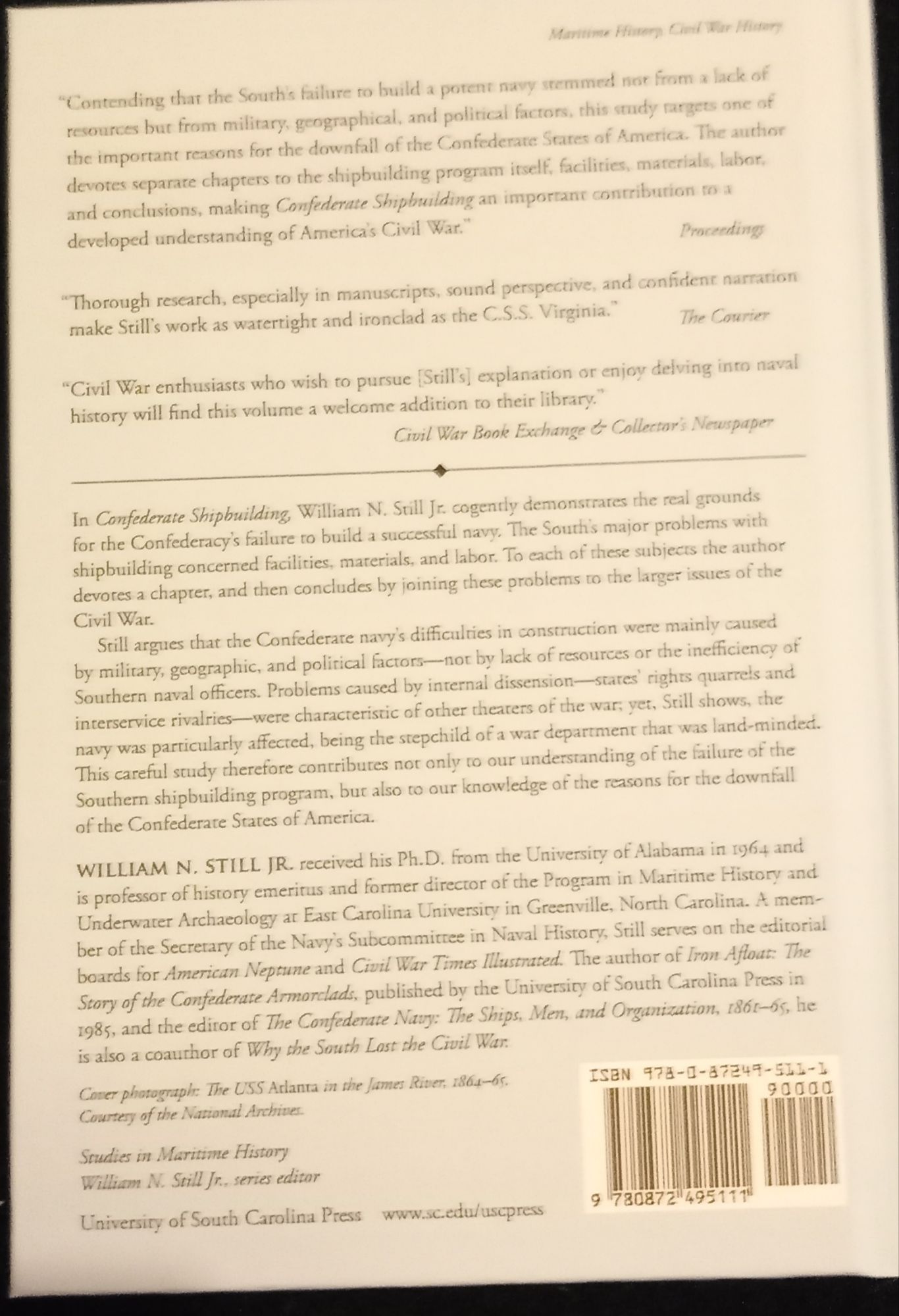
William N Still Jr, Confederate Shipbuilding, University of South Caroline Press, (1987)
 SANGHA KOMMUNE (SSR)