

JVL Introduction
The letter below was sent to Kent police in protest at the arrest of a member of Thanet4Palestine for waving a Palestinian flag, saying Free Palestine and protesting peacefully about the genocide in Gaza.
You can see a video of the “offence” here. It makes chilling viewing.
We warned in our statement Proscribing Palestine Action is an Outrage! that:
The order makes any and every action in support of Palestine a possible terrorist offence as this might be construed as support for Palestine Action’s goal of “solidarity with the Palestinian people”.
We heard assurances in parliament when Palestine Action was proscribed that lawful protest would not be threatened.
Dan Jarvis, a Minister of State for the Home Office, told MPs unambiguously:
“Proscribing Palestine Action will not impinge the right to protest. People have always been able to protest lawfully or express support for Palestine, and they can continue to do so.”
These words were reinforced by Justice Chamberlain when an interim injunction against the order was sought.
“97. It will remain lawful for the claimant and other persons who were members of PA prior to proscription to continue to express their opposition to Israel’s actions in Gaza and elsewhere, including by drawing attention to what they regard as Israel’s genocide and other serious violations of international law. They will remain legally entitled to do so in private conversations, in print, on social media and at protests. Even if their protests take the form of direct action which involves criminality, the fact that they were previously members of an organisation which is now proscribed would not as a matter of law aggravate their criminal conduct. It follows that it is hyperbole to talk of the claimant or others being “gagged” in this respect (as the claimant has alleged). They could not incur criminal liability based on their past association with a group which was not proscribed at the time.”
As Haroon Siddique’s Guardian report Armed police threatened to arrest Kent protester for holding Palestinian flag makes clear, the Kent police are interpreting the proscription in draconian fashion, their spokesperson saying
“Under the Terrorism Act it is a criminal offence to carry or display items that may arouse reasonable suspicion that an individual is a member or supporter of a proscribed organisation such as Palestine Action.”
Everyone’s liberty is under threat. Is this what the goverment really meant? They must not be allowed to get away with this.
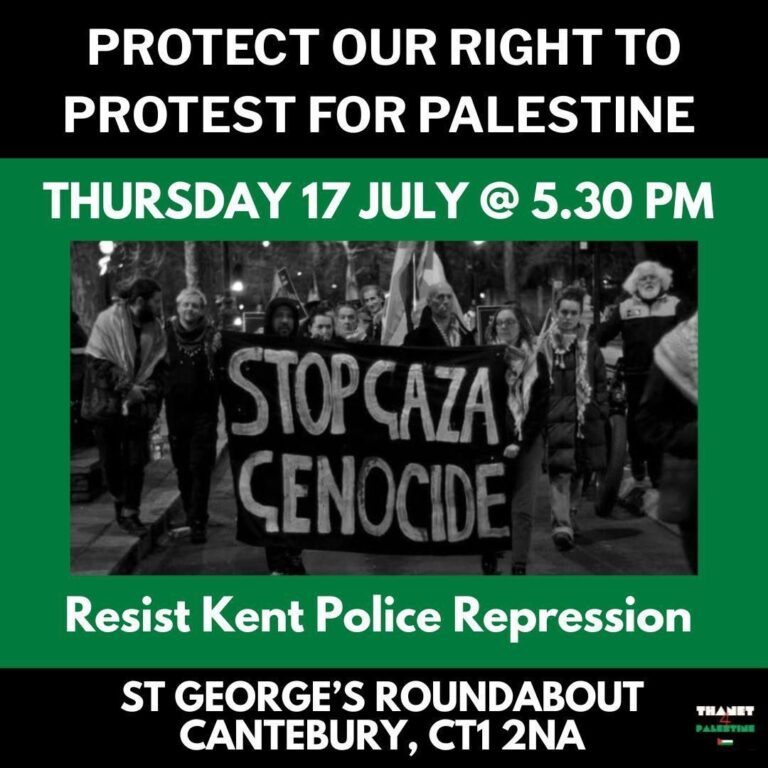
A demonstration is planned this afternoon at 5.30pm. We will be watching to see how police react.
Thanet4Palestine letter to Kent Police, lightly edited for publication
Drafted by Thanet4Palestine member Matthew Pearce
Dear Kent Police,
We write to express our most vehement criticism and disapproval at the threatened arrest of one of our members, Laura, for a lawful protest action.
To point out why Laura’s actions were lawful, we shall briefly recall the facts of the incident.
The Facts
Laura was peacefully protesting near a roundabout in Canterbury. She did not enter the road, nor obstruct traffic in any way. As part of the protest she attached to a streetlamp a sign stating that ‘Israel is committing Genocide’ and held aloft a separate placard that stated, ‘Free Gaza’. She also held a Palestinian flag for the duration of the protest. Two armed officers then arrived and informed Laura that her protest was unlawful, on the basis that it was reasonably suspected that she had expressed an opinion or belief supportive of a proscribed organisation (s12 of the Terrorism Act 2000). It was mentioned by the two officers during the interaction that phrases including Free Gaza and Free Genocide constituted sufficient basis for reasonable suspicion under s12. Officers then threatened to arrest Laura on those grounds unless she supplied identifying details to the two officers. Having supplied the relevant details, the encounter between the two parties then concluded without any arrests having been made.
The Law
We are outraged by this interaction between Police and citizen and consider it little more than a blatant act of intimidation, given the multiple legal errors and factual mistakes conducted by the two officers in question.
Firstly, it must be emphasised that we are not in possession of any information concerning how Kent Police have been briefed regarding their duties under the Terrorism Act and on what constitutes support for a proscribed organisation. Beyond expressing disapproval, we also hope this letter will serve as a guide on what the law is in the UK, so future legal overreaches by the police can be avoided and citizens better left to enjoy their right to freedom of Assembly, guaranteed under the European Convention on Human Rights.
Proceeding to determine what the law states, s12 of the Terrorism Act 2000 sets out that it is unlawful if someone ‘expresses an opinion or belief that is supportive of a proscribed organisation’. It must also be conceded that Palestine Action is, as asserted by the Officers, currently a proscribed organisation under Schedule 2 of the 2000 Act.
Expressing an opinion or belief that is supportive of an organisation is a rather vague and unclear provision when taken in isolation. As an example, hypothesising that an animal rights group committed to violent killings was proscribed under the Terrorism Act, there might be an understandable degree of confusion in police forces as to whether support for animal rights in general could be taken as supportive of a proscribed organisation, or whether something more was needed to establish criminal liability.
As such, it is useful to turn to recent case law when trying to better understand the meaning of s12.
The Court of Appeal, in ABJ v REX, recently provided a guide to s12. In what amounts to the most comprehensive statement of the relevant law, Baroness Carr established that:
‘it is necessary to consider the terms of s. 12(1A) itself. The expression must be of an opinion or belief that is supportive of the “organisation”. To express an opinion or belief that is shared by the organisation is not the same thing as to express an opinion or belief that is supportive of the organisation. The organisation does not merely exist to promote a (terrorist) belief. It exists to promote that belief by the means identified in the definition of terrorism in s. 1 of the TA . The offence requires the expression of an opinion or belief that is supportive of Hamas, and not merely that it may be supportive of the achievement of aims which Hamas shares’
Although the reference here was to Hamas, the principles it sets out are applicable to proscribed organisations more generally. It affirms that any statement, to amount to support for a proscribed organisation, must be concerned with the organisation itself. It is not enough for a person to express a belief or opinion that a proscribed organisation also embraces, whether as ideology, policy or anything else.
Applying this logic to Palestine Action, and Laura’s case, there was nothing in Laura’s conduct that could have given rise to a reasonable suspicion that she expressed an opinion or belief supportive of Palestine Action. Firstly, when questioned by Officers, Laura clearly and without ambiguity set out that she did not support Palestine Action. There was nothing in the signs or flag that Laura held which call the honesty of this statement into doubt.
The assertion that Gaza should be free is a direct reference to the ongoing occupation of that territory, with the State of Israel possessing near total control over the borders, airspace, movement of essentials (like food and water) and supply of electricity into Gaza. The occupation is unlawful under international law, as set out by the ICJ. It is also highly repressive, involving an extreme degree of genocidal violence alongside extensive physical and digital surveillance. Hence the calls for a free Gaza do not concern Palestine Action, but merely express support for an aspiration, namely the aspiration that all Gazans should be entitled to live free of violence and occupation, in accordance with what the tenets of international law demand.
True enough Palestine Action, if asked, would likely endorse this aspiration. However, this is not of any relevance to Laura’s conduct. She made no reference to supporting the organisation and its methods in the manner required for criminal liability under s12 of the Terrorism Act. She only expressed an opinion likely shared by Palestine Action, which cannot constitute evidence of criminality under the Terrorism Act. There is therefore nothing here upon which a reasonable suspicion could be based.
The same is true of Laura’s sign stating that Israel is committing Genocide in Gaza. It should be recalled at this point that while the presence or absence of genocide in any given place is necessarily a matter of opinion, all major civil society organisations (including Doctors Without Borders, Amnesty International and Human Rights Watch), the United Nations (through the work of Special Rapporteur Francesca Albanese), and a near-unity of genocide scholars have all concluded that a genocide is occurring in the Gaza Strip. To allege that saying ‘Israel is committing genocide’ amounts to an opinion that is supportive of Palestine Action again confuses an opinion shared by Palestine Action with a belief that supports Palestine Action. Laura, in her sign mentioning the Israeli genocide, did not make any reference to Palestine Action whatsoever. As such, the sign she held cannot constitute evidence for a s12 offence.
Lastly, a Palestinian Flag is not evidence of a s12 offence. It is, in lieu of evidence indicating otherwise, a symbol of Palestinian nationalism and solidarity, much as the Union Jack is a symbol of British nationalism and patriotism. A Palestinian flag flying therefore cannot, in general, be taken as an endorsement of any one organisation,. It would make the mistaken assumption that Palestine is indissociable from a single organisation like Hamas or Islamic Jihad. In Laura’s case, there is no surrounding evidence that suggests, by waving the Palestinian flag, Larua was attempting to communicate any kind of endorsement of Palestine Action. Indeed, as already established, the signs she produced were not concerned in the slightest with Palestine Action. By extension, Laura’s waving of the Palestinian flag must be considered an expression of Palestinian nationalism and not support for a proscribed organisation under s12.
Given neither Laura’s speech, signage, nor flag demonstrated any support for Palestine Action, we consider it a grave abuse of police powers to threaten arrest on the basis that an officer held a ‘reasonable belief’ that she expressed an opinion supportive of that organisation. There was no evidence on which such a reasonable belief could be founded. Terrorism convictions under s12 result in serious jail time (up to 14 years) and we are outraged that Kent police considered an arrest (and potential future charges) under the Terrorism Act a proper response to what was an entirely legal act of solidarity with the Palestinian people. Moreover, threatening to make such an arrest if identity details were not provided has no basis in law, given individuals are under no general obligation to supply their identity to police. We therefore demand that Laura’s case be dropped and a note be provided that she is no longer being investigated for any wrongdoing by Kent Police.
We would like to round off this letter by reminding Kent Police of their ethos of policing by consent. Set out in the Peelian principles, Kent Police are obliged to uphold ‘absolutely impartial service to law, in complete independence of policy, and without regard to the justice or injustice of the substance of individual laws’. The law, as set out above, cannot sustain arrests based on Palestinian solidarity, or anti-Israeli feeling, alone. As such, regardless of any orders or sentiment that may have been communicated by the government, arrests made on these bases cannot be justified. Impartial adherence to law demands lawful Palestine protests be treated as such and we demand the police adhere to this premise in their future policing of Palestine protests.
 SANGHA KOMMUNE (SSR)