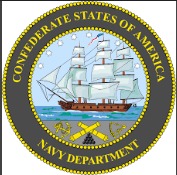

‘The Alabama, built like a merchant-ship, sailed in peaceful garb from British waters, on a far-distant sea received by her crewvand armament, fitted for operations against the enemy’s commerce. On “blue water” she was christened, and in the same she was buried. She lived the pride of her friends and the terror of her enemies. She went out to fight a wooden vessel, and was sunk by one clad in secret armor. Those of the crew rescued by the Deehound were landed at Southampton, England.”
Jefforson Davis – A Short History of the Confederate States of America, Amazon, (2022), Chapter 34, The Confederate Navy On The High Seas, Page 241
Flags, or “Banners” – have been used for thousands of years – in one form or another, to distinguish one group of humans from another. Each such entity conveys “difference” of intent and identity. Each flag is designed to gather together those who “belong” – and “push-away” those who do not. Like the tribal body-markings of the Celts and Picts, each piece of material containing pictures and coloured sections serve as an identifier of “sameness” and a marker of “difference”. As the “Confederate” States of America (CSA) viewed itself as the “true” and “genuine” conveyor of the authentic 1776 “Revolution” – the flags chosen to represent this reality were similar to – but different from – the “Stars and Stripes” as carried by the “United States” of America (USA). There were many “unofficial” flags flown by the citizens and military of the Confederacy – due to the democratic (free) nature of its society and culture. These popular flags were flown alongside (and parallel to) the “official” flags designed and adopted by the government of the CSA. Indeed, these “local” flags lasted throughout the entire war and influenced all the official designs.

When Mississippi seceded from the USA during January, 1861, the “Bonnie Blue Flag” was unofficially adopted by the CSA to represent its independence. A white, five-pointed star positioned in the centre of a “blue” rectangle was first associated with the Republic of West Florida (1810) when the local inhabitants protested against Spanish rule – and again when the inhabitants of the Republic of Texas (1836) protested against Mexican rule. However, it was not until the forming of the Confederacy that this design became known as the “Bonnie Blue Flag” – which flew above the Confederate cannons that bombarded Fort Sumter (in Charleston, South Carolina) during early 1861.


The Battle Flag of the Army of Northern Virginia (right) was “square” in shape – whilst a “rectangular” version (left) was known as the “Second Confederate Navy Jack”. Generally speaking, the CSA Naval version was comprised of a lighter blue (compared to the darker-blue version flown by the Army of Northern Virginia) and was flown by Confederate shipping between 1863-1865. The Battle Flag of the Army of Northern Virginia (right) was adopted as the “copyrighted” emblem of the “United Confederate Veterans” after the Civil War. Later, it was also adopted by the “Sons of the Confederate Veterans” and the “United Daughters of the Confederacy”.
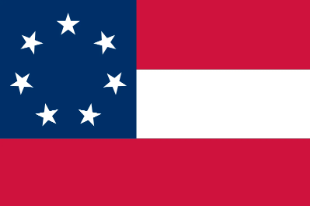
The top left-hand square has a blue-background containing seven (white) five-pointed stars – arranged in a circle. the main body of the flag is comprised of a red, white, and red stripe. The “Stars and Bars” flag existed between March 4th, 1861 and May 1st, 1863. The seven-stars represent those seceded States (there were originally “five”) which left the USA and joined together (in Montgomery Alabama) to form the “Confederacy”. Contained within the original (1776) Constitution of the United States – the manner in which each “State” (an independent country) related to all others – was through a “voluntary association” referred to as a “Confederacy”. This design was rendered by Nicola Marschell – an American of of Prussian-German descent – in Montgomery, the first capital of the CSA (it is said that this flag was similar that of “Austria” – due to the ethnicity of its designer. As Austria was a totalitarian State and the CSA was democratic – this association was thought not to be entirely appropriate). This individual was also responsible for designing the early uniforms of the CSA military. The CSA government involved the people of the Confederacy – asking what designs the people preferred – with an influential number opting to keep a flag similar to that of the USA. However, the more radical population of the Confederacy rejected this design – exactly because it was similar to that of the USA. A further complication was that more States had joined the CSA and were not represented on this flag – whilst confusion often prevailed on the battlefield – as both armies confused it for either their own flag, or that of the enemy. As the CSA evolved and developed – its official flags had to change to represent these new differences.
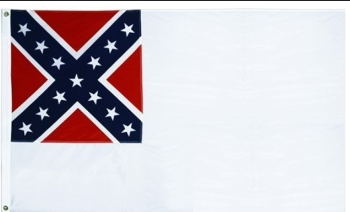
A “Battle Flag” had developed out of the original flag – consisting of a blue saltire (similar to a Cross of St Andrew) superimposed over a red (rectangular) background – containing thirteen (white) five-pointed stars – the actual number of States comprising the Confederacy. As this flag evolved from the populace of the Confederacy itself – as opposed to a governmental department – it was officially adopted on May 1st, 1863 – albeit in modified form. This new design was developed by William T Thompson and William Ross Postell. The “Battle Flag” was superimposed onto the top left-hand corner of a “white” rectangle. This development removed the obvious association between the Confederacy and the Austrian national flag. However, although liked at first, the white background soon became dirty and faded. Furthermore, many military Officers believed that the “white” background signified a “truce” which did not exist – or signified the “surrender” of the Confederate Forces – a situation thoroughly rejected by Officers and men alike. Such associations were considered morale-sapping and problematic. This flag was replaced during March, 1865.
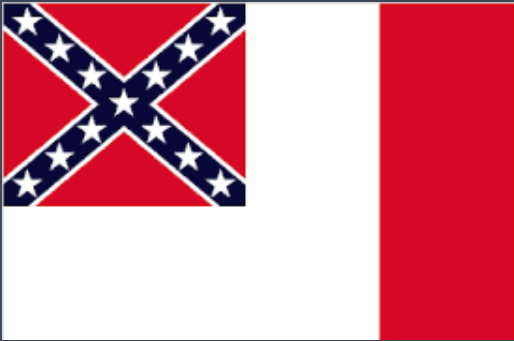
This flag was similar to the “Stainless Banner” it replaced – with a red boundary vertically added down the right-hand side. Major Arthur L Rogers proposed this design change to alter the previous flag design away from its obvious associations with a “truce”. He explained (in the Confederate Senate) that it was important to avoid the Yankee blue – whilst retaining the “Cross of St George” to maintain an association with Great Britain – and a red bar signifying (Revolutionary) “France”. These were two countries considered “Democratic” following “Revolutons”.
English Language References:
Jefforson Davis – A Short History of the Confederate States of America, Amazon, (2022),
George Davis: The Confederate Flag – a Brief History, 2nd Edition, George Leist, (2015)
James Stutts: The Flag and the Confederate States of America – What the Yankee History Books Omit, Falsify, and Lie About, Cobb Publishing, (2020)
 SANGHA KOMMUNE (SSR)