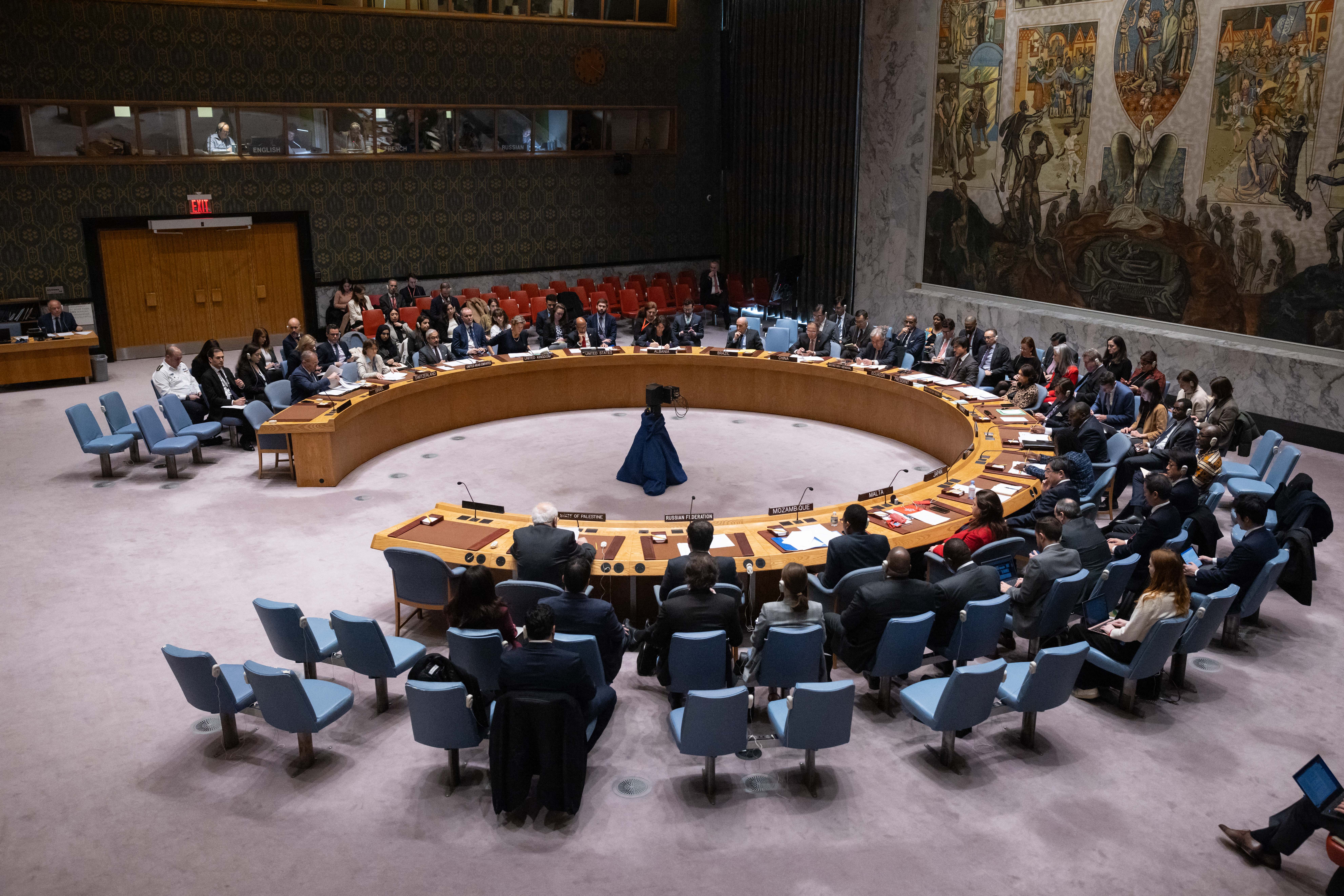
NEW YORK, Friday, December 8, 2023 (WAFA) – US vetoed the United Nations Security Council resolution urging for an immediate humanitarian ceasefire in Gaza, despite UN chief warnings in a letter invocating Article 99 saying he had written because “we are at breaking point”.
Palestinian envoy to the UN decried the resolution’s failure as “disastrous”, saying Israel’s continued war on Gaza will lead to more atrocities, killings, and destruction.
The resolution was supported by 13 out of the 15 UN Security Council members, while Britain abstained and the United States vetoed it.
The United Nations Security Council held today an emergency session to discuss the catastrophic situation in the Gaza Strip as a result of the ongoing brutal Israeli aggression against it.
Ecuador, currently presiding over the council in December, has called for the session in response to the escalating Israeli aggression against the Palestinian people.
The United Arab Emirates had also submitted a draft resolution to the Security Council demanding an immediate ceasefire in Gaza.
Displaced Palestinians driven to overburdened Rafah amid Israeli shelling
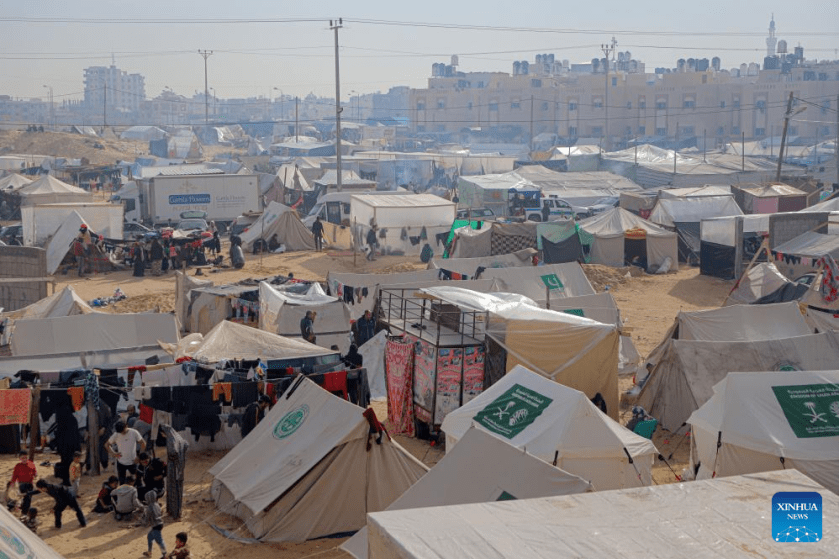
GAZA, Dec. 8 (Xinhua) — Om Mohammed Mahani, a Palestinian woman from Gaza, finally reached the Rafah city at the southern tip of the Gaza Strip, her fifth temporary shelter after the Hamas-Israel conflict broke out two months ago.
“The Israeli army forced us to displace five times, from my house in Gaza City to Dier al-Balah City in the centre of the strip, and to eastern Khan Younis, and then to the western Khan Younis until reaching Rafah,” the 52-year-old mother of seven complained to Xinhua.
During her displacement journey, Mahani lost her husband, three sons, two daughters, and ten of her grandchildren in an Israeli attack targeting their residential block in Khan Younis city a few days ago.
“Each time we reached a place, we thought it would be safe, but every time, we found that we were stuck in another dangerous place as the Israeli army attacked the nearby places,” she recalled. “I lost everything,” she added.
Since the Israeli army started its ground operation in Khan Younis city a few days ago, Rafah city has become the last refuge for dozens of thousands under the ongoing Israeli attacks.
Amid the lack of accommodations, thousands of families were forced to establish tents in streets, schools, and open areas without necessary housing requirements.
“No water, no food, no electricity, and no bathrooms,” Mahani complained.
Ibrahim al-Sawwaf, a Khan Younis-based Palestinian man, was busy establishing a tent for his 20-member family in Rafah.
The 56-year-old father of six told Xinhua that he came to Rafah after exhausting all his means to find suitable accommodation for his family.
“The Israeli army sent us from one dangerous place to another without caring about our suffering at all. There are no safe places in Gaza,” he said.
As more and more people flock to Rafah, the shelters available now cannot meet the surging demand, said the United Nations Office for the Coordination of Humanitarian Affairs (OCHA), forcing most of the newly arrived to settle on the streets without a shelter.
It is estimated that about 1.9 million people in Gaza, or approximately 85 percent of the population, have become internally displaced.
The conflict so far has left 17,487 Palestinians dead, and more than 46,000 injured, said the Gaza-based Health Ministry on Friday.
UN official raises alarm as humanitarian crisis in Gaza keeps worsening
GENEVA, Dec. 7 (Xinhua) — The current humanitarian program in Gaza “is no longer functioning well,” said the head of the UN Office for the Coordination of Humanitarian Affairs (OCHA) at a press conference here on Thursday.
Martin Griffiths expressed his grave concerns, saying the relentless military assault has obliterated the once-established safe zones, rendering the existing humanitarian plan ineffective.
He said that the initial design, aimed at protecting civilians and facilitating aid delivery, has crumbled, Consequently, what remains is a disjointed, opportunistic response lacking reliability and sustainability.
Griffith, who also serves as a UN undersecretary-general, underscored the difficulties in planning and executing humanitarian deliveries at present. He said the absence of safety guarantees could expose convoys to the risk of interruptions, attacks and diversions.
The pressure on the two million people of Gaza intensifies as they are forcibly pushed further south, with no safe zones in sight and an uncertain future, he said.
Griffith underlined that on Dec. 6, in an unprecedented move, UN Secretary-General Antonio Guterres invoked Article 99 of the UN Charter, emphasizing the imminent threat to international peace and security posed by what’s going on in Gaza.
However, the senior UN official mentioned the opening of the Kerem Shalom crossing as a promising sign. Discussions have been underway within a committee known as the COGAT (Coordination of Government Activities in the Territories), involving representation from Israel, the United States, Egyptians and the United Nations.
According to him, an OCHA representative is currently in Jordan actively coordinating potential aid deliveries through the Allenby Bridge, a crossing point between Jordan and the West Bank. Such deliveries can significantly enhance the logistical process and base for humanitarian operations.
The OCHA chief underlined that humanitarian agencies remain unwavering in their commitment to assisting the people of Gaza. He called the international community to “not lose faith in the possibilities of humanity.”
An estimated 1.9 million people are displaced in Gaza (about 85 percent of the population), lacking necessities such as food, water, dignified shelter, sanitation facilities and medical care, according to the UN Relief and Works Agency for Palestine Refugees in the Near East.
A recent phone-based survey by the UN World Food Programme showed that between 83 and 97 percent of families have no adequate food, and in some areas as many as 90 percent of households report spending a full day and night without any food, some even having no food for as many as 10 days in the last month.
 SANGHA KOMMUNE (SSR)