
Dear Sir
My mother – Diane Wyles – has forwarded your email to me. My name is Adrian Chan-Wyles and I have been in contact with the ‘RACM‘ in the past following my family’s attendance at the Soviet War Memorial in London.
SEAMAN ARTHUR JAMES GIBSON [1911-1997] – (ROYAL NAVY NO: JX381363) WAR RECORD (1942-1946) – HMS BEAUMARIS CASTLE (FY 992)
‘He served much of that time aboard a minesweeper named the – HMS Beaumaris Castle – (a converted trawler launched in 1917 and Commissioned by the Royal Navy during February, 1940). Part of his duties concerned the spotting of Nazi German sea-mines, and using a rifle from the deck, taking a careful aim and trying to hit the detonator on the mine (thus safely exploding the device). This was not easy as the ship was continuously rising and falling in the water, and many seamen became expert shots under less than ideal conditions. This process kept the shipping lanes as clear as possible for the North Atlantic Convoys taking much needed aid to our allies in the Soviet Union. If there were large clusters of mines, and time was of the essence, occasionally the captain (or commander) would order that a machine-gun be used to clear the area. (If needed, the trawler was often equipped with either a 3-inch (76 mm) or 4-inch (102 mm) gun at the bow to counter any submarine attack).’
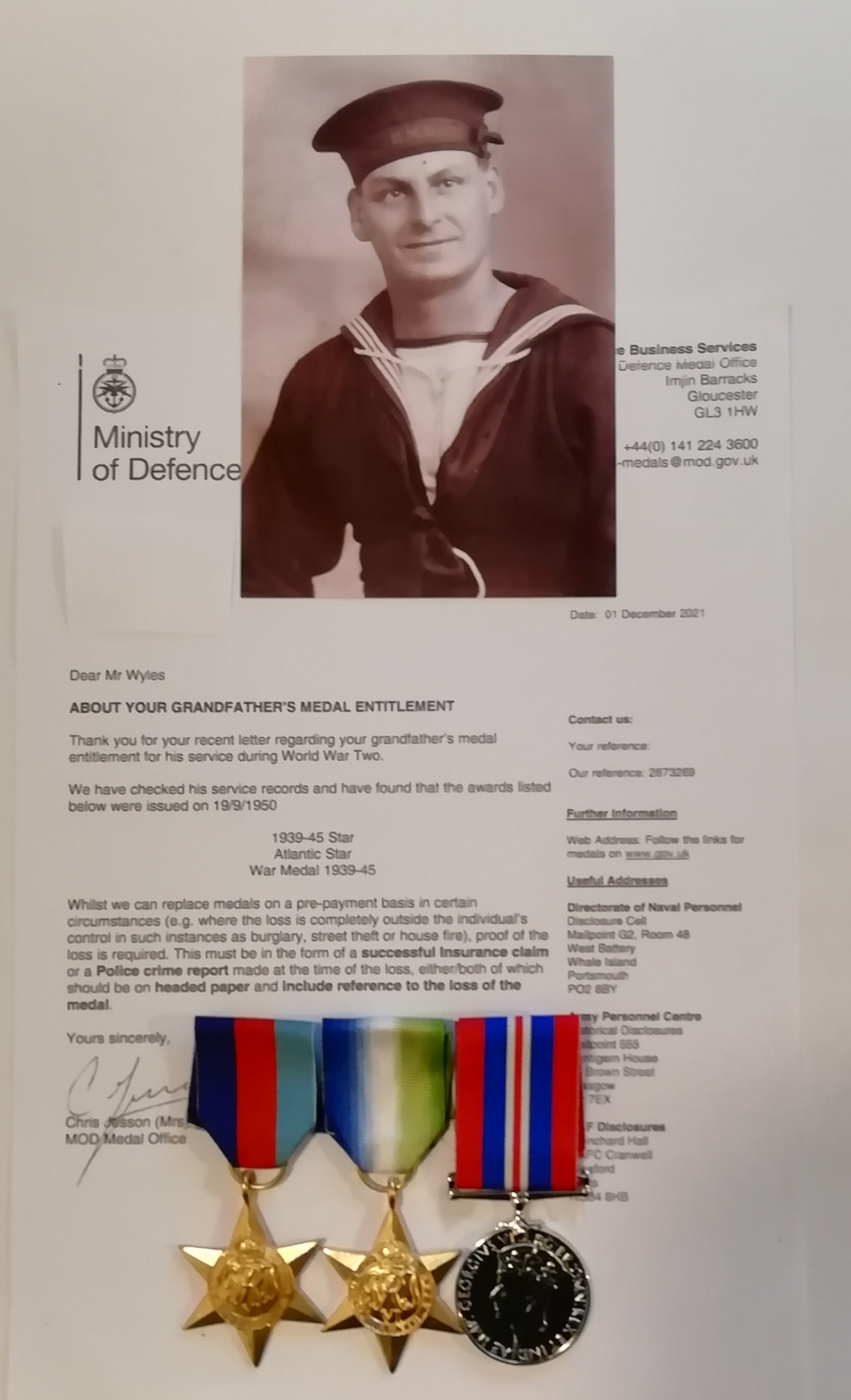
Seaman Arthur James Gibson – RNPS – (NO: JX381363) – Medals
a) Star 1939-1945
The 1939-1945 Star Medal, awarded to British Forces serving overseas during WWII. The 1939-45 Star Medal was introduced to reward the service of forces who served at least 180 days operational service overseas during WWII. Specifically, the 180 days must have been spent between the dates of 3rd September, 1939, and 8th May, 1945 (2nd September if spent in Far East). There are also some cases of special circumstances, where the medal was awarded for a single day’s service. The medal features the Royal cypher “GRI VI” on the front, supported by the text “THE 1939-1945 STAR” below, and the crown above. The ribbon displays equal stripes of red, light and dark blue, to represent the different arms of the armed forces.
b) Atlantic Star
Awarded for service in WWII, the Atlantic Star is a campaign medal of the British Commonwealth. The Star was to commemorate the Battle of the Atlantic which took place between 3rd September, 1939 and 8th May, 1945, while Allied convoys transporting goods and valuables from America and the colonies were under attack by German U-boats. The medal was granted for ‘six months’ afloat in the Atlantic, Home Waters, parts of the South Atlantic and Arctic Convoys to Russia. Ribbon: Shaded and watered stripes of blue, white and green to represent the Atlantic. Worn with the blue edge furthest from the left shoulder. Awarded to personnel of the Royal Navy and Merchant Navy, provided they had earned the 1939-45 Star for six months service in operational areas. The locations and areas differ from the Royal Navy and Merchant Navy to qualify for this campaign medal. Special conditions apply governing this award for those Naval personnel entering service less than six months before the end of the qualifying period, provided it was the last operational theatre that they would serve. The Atlantic Star was also awarded to the R.A.F and Aircrew who took part in operations against the enemy at sea within the qualifying areas, subject to two months service in an operational unit. However, the 1939-1945 Star medal must also be earned by the recipient before commencing qualifying service for the Atlantic Star medal.
c) War Medal 1939-1945
The War Medal 1939–1945 is a campaign medal which was instituted by the United Kingdom on 16th August 1945, for award to citizens of the British Commonwealth who had served full-time in the Armed Forces or the Merchant Navy for at least 28 days between 3rd September 1939 and 2nd September 1945.
‘Seaman Arthur Gibson joined the Royal Navy Patrol Service (RNPS) in late 1941, and was soon aboard the Minesweeper – HMS Beaumaris Castle – stationed in the North Atlantic. His job was to keep the shipping lanes free of Nazi German mines (by shooting to sink them or explode with using mounted Lewis Machine Guns, or WWI 303 Lee Enfield or MK III Ross [303] Rifles), so that the Russian Arctic Convoys could deliver vital aid to the UK’s ally – the Soviet Union! As Arthur Gibson saw frontline service nearly everyday of his four-year service – this fact alone triggered a cascade of medals for time-served in the face of the enemy! I contacted the MOD recently to acquire an official letter confirming his medal entitlement. He would have been proud of his two granddaughters – Mei-An and Kai-Lin living in Sutton and helping me research his glorious past! Arthur Gibson was finally granted his medals on the 19th of September, 1950 – some five-years after the end of WWII – and after other conflicts were well under way around the world!’
My grandfather – Arthur Gibson – was on Active Duty between 1942-1946. His ship was not part of the Russian Arctic Convoys per se – but acted in concord with the general supportive war-effort of keeping the North Atlantic sea-lanes open. We are very proud of his War Service – even if his ship does not qualify for inclusion in the RACM Project. Arthur Gibson passed away in 1997 – but one of his shipmates – Telegraphist George Smith – communicated with me for years, providing important and vital first-hand historical evidence of those times. We salute the men (and women) who took part in the Russian Arctic Convoys – and consider it one of our proudest moments to have stood for a photograph with the surviving RAC Veterans in the grounds of the Imperial War Museum – London!
All Best Wishes
Adrian
CC: Diane Wyles
 SANGHA KOMMUNE (SSR)