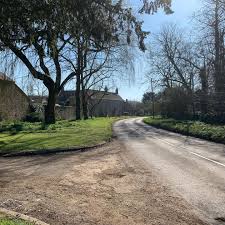
My mother – Diane Wyles (nee Gibson) – along with her family, were evacuated fro Lewisham in the East End of London around 1942 following the ‘Blitz’ which saw the Gibson family home totally destroyed! As the Gibson’s possessed a relative living in the Forest Hill area of Oxford – a rural village – they were sent there. Eventually, they secured a lovely house in Milton Crescent – a locale which is associated with the poet ‘John Milton’ who used to frequent the area and like to sit upon a local stone to ‘think’ profound thoughts that he would later write down. The furthest ends of the back gardens of Milton Crescent used to be an established pathway across farmland used by all sorts of people as they traversed the area. It was here that my mother and her father – Arthur Gibson – were out digging one-day (during 1960) in a part of the garden reserved for the family’s small but productive flock of chickens, when my mother noticed a round metal object lifted out of the ground my her father’s shovel! After wiping the mud away, it was obvious it was an old coin as the a date of ‘1694’ could be discerned. A few days later, Arthur Gibson was able to take the coin to the Ashmolean Museum situated in the centre of Oxford – where the resident expert confirmed it is a genuine ‘William and Mary Half-Penny Piece’ constructed of tin and copper alloy and dated to the year ‘1694’.

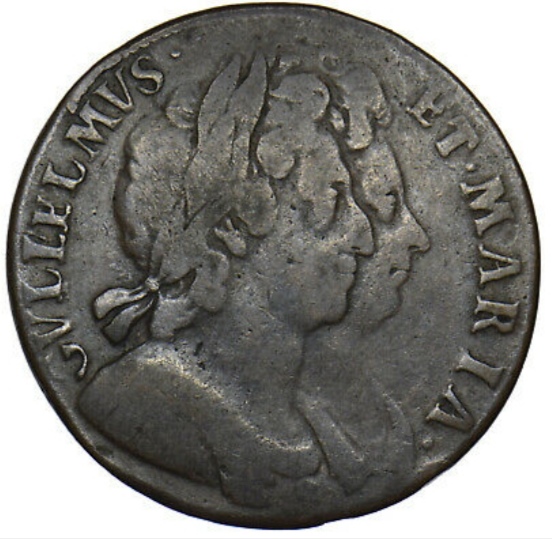
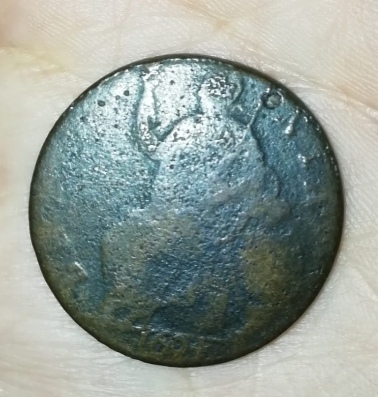
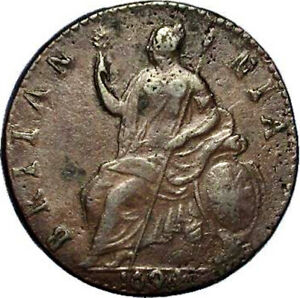
King William III reigned between 1689-1702, whilst Queen Mary II reign from 1689-1694. This means that Queen Mary died during the year of the minting of this coin (1694). The dimensions of this ‘William and Mary’ Half-Penny are as follows: 1) Diameter = 29 millimetres, 2) Weight = 11.100 grammes, and 3) Thickness = 2 millimetres. This coin design may well have contained a ‘toothed’ outer ring. This type of coin was issued by the ‘House of Stuart’ (through London’s Royal Mint) between 1688-1694.
References:
https://www.friesian.com/ross/orange.htm
https://www.britishmuseum.org/collection/object/C_1919-0918-1025
 SANGHA KOMMUNE (SSR)