The idea of a Buddhist flag is tantamount to Buddhist terrorism in as much as it symbolises the alignment of Buddhism with the modern, capitalist State, and signifies a disturbing trend of replacing Buddhist philosophy with the ideology of greed. This is a false Buddhism that ‘normalises’ suffering in the mind and body of the masses. In fact it is not ‘Buddhism’ at all, but rather a superficial mirage in saffron robes.
Tag: Vinaya Discipline

Master Xu Yun Did Not Teach or Advocate Japanese Zen
The venerable Xu Yun (who lived to 120 years old) was in attendance of this meeting when these monks arrived and made their case. He listened quietly to these monks and then hit his palm on the table in an angry manner. He stated that a Buddhist monk and his robe cannot be separated, and that in China, a Buddhist robe signifies the practice of both strict celibacy and vegetarianism – without the Vinaya Discipline – Chinese Buddhism simply would not make sense.
The Differences Between Chinese Ch’an and Japanese Zen in a Nutshell
This time period saw the Rinzai and Soto actively deny their Chinese cultural roots, and support the government’s anti-China policies. This coincided with the Rinzai and Soto Zen traditions ‘abandoning’ the Vinaya Discipline for ordained monks and nuns because it was viewed as both ‘Indian’ and ‘Chinese’, and therefore ‘un-Japanese’ in nature. This abandoning of the Vinaya Discipline marks a significant deviation of the Japanese Zen tradition from its Chinese Ch’an origin.

Mount Ji Zu Cliff Exhibits Face of Master Xu Yun (1840-1959)
The Venerable Old Master Xu Yun existed in the time of modern Buddhism and was an outstanding teacher. He was a Buddhist monk who strictly adhered to the Vinaya Discipline for over a hundred years, and cultivated the Dao in at least fifteen different temples, which included the temple of the Sixth Patriarch (Hui Neng). When the time was right, he inherited the lineages of all Five Ch’an Schools. He was a very highly respected Ch’an monk, and had tens of thousands of disciples (both ordained and lay), to whom he transmitted the genuine Ch’an Dharma.
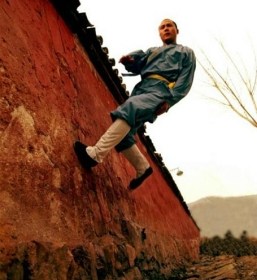
Abbot Yong Xin of the Shaolin Temple Discusses Master Xu Yun
Li Ji Shen referred this dispute to Zhou Enlai (who discussed it with Mao Zedong), and it was agreed that Xu Yun was correct. This decision was taken because at the time certain members of the international community were attacking China with regards to human rights issues. From that day onwards, traditional Chinese religion has been protected under law.
 SANGHA KOMMUNE (SSR)