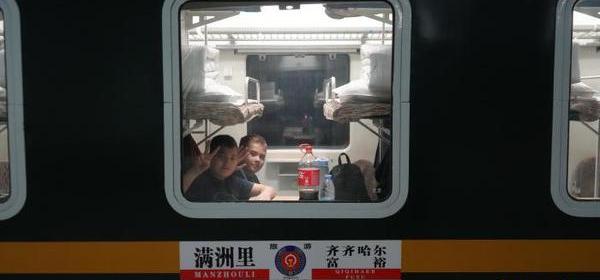
Russian students depart from Manzhouli Railway Station aboard train Y778 Photo China News Service Huang Xu

Russia: Over 300 Russian Students Board Special Train for Study Tour in China! (27.10.2026)

The students, aged 6 to 17, are from primary and secondary schools in Chita, Russia. They are visiting China for a six-day educational exchange program themed “I Have a Home in China.”

The itinerary includes stops in Manzhouli, Inner Mongolia, and Qiqihar, Heilongjiang, where participants will experience traditional Chinese culture and learn about the distinctive cultures of China’s border regions and northeastern black-soil region.

To ensure a smooth journey, Manzhouli Railway Station set up a designated waiting area and a priority boarding lane for the group. The station also prepared bilingual Chinese-Russian safety cards and directional signs.

Passenger service points provided drinking water, emergency medical supplies, adhesive bandages and charging facilities to meet the students’ needs.

The Qiqihar Passenger Transport Section, responsible for onboard services, cleaned the train before departure and checked the carriages every 20 minutes at night.

The train conductor installed a Russian translation app on their phone to communicate with passengers.
Felice Beato - British Photographer!

UK: The Historical Background of Colonial-Era Western Photography in Beijing! (26.10.2026)

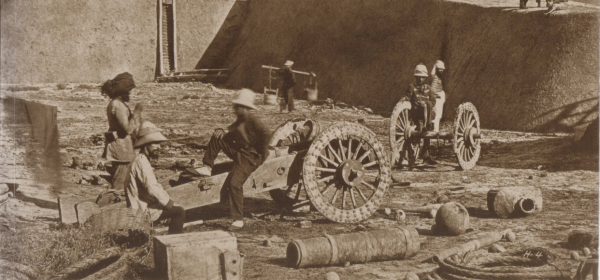
What is truly curious, however, is that more than 30 years have since passed, yet this particular panoramic scene remains in my possession alone; I have neither encountered nor discovered the existence of a second copy. Thus, for the time being, it can be said that the earliest images of the Inner City of Beijing—specifically the area around Tiananmen—(found in printed materials from the Republic of China era) exist only in my personal collection; no one else possesses them. In terms of historical narrative, this photograph—a view of Beijing’s Inner City forcibly captured by Anglo-French aggressors—represents an eternal source of pain for the Chinese people. It serves as stark, tangible proof that a nation left behind will inevitably fall victim to aggression.

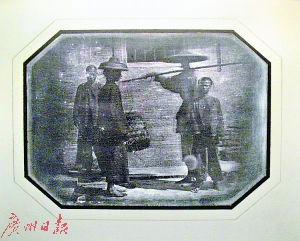
People on the streets of Guangzhou, photographed by Jules Itier in 1844.

UK: Governor-General Qiyang (耆英) – [1844] First Photograph Taken in [Guangzhou] China! (26.10.2026)

When photographic technology first entered China during the mid-19th century (from Europe) – the circumstances that surrounded this event were far from pleasant. Photography historian and author of “Oriental Photography Notes” – Na Mo Ai (南无哀) – said, “The Opium War was the cue for Western photography to invade China”— In 1844, the French Labignie Mission visited China and forced the Qing government, which had suffered defeat in the First Opium War (agaunst England), to sign the (Unequal) “Sino-French Whampoa Treaty”. During the negotiations, the Mission’s “Customs Officer” (Jules Itier) summoned the Chinese Representative (who was in fact ethnic “Manchurian”) – Governor-General Qiyang (耆英) [1787-1858] of Liangguang (Minister of Commerce for the Five Ports) – where his presence was recorded at the meeting thruogh the taking of a “photograph”. The above front-face “portrait” of Qiyang is believed to be the first modern “photograph” taken on the Mainland of China.

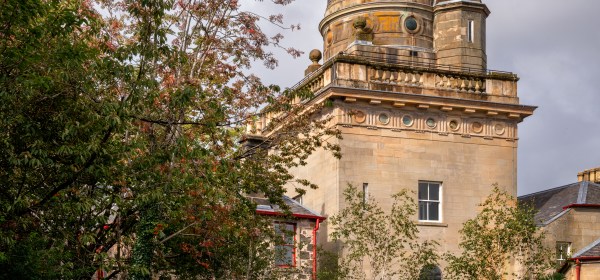
The Coats Observatory in Paisley

UK: The History of “Changing the Clocks” [It’s About to Happen]! (23.10. 2026)

The campaign for British Summer Time came about at the beginning of the 20th century when parliament passed the Summer Time Act in 1916.

British builder William Willett led the movement, inspired by his love of the outdoors. He advocated for BST in his 1907 ‘Waste of Daylight’ pamphlet to increase opportunities for leisure and help reduce energy costs.

He suggested a plan which included 20-minute changes four Sundays in a row in April and September to minimise disruption to people’s biological clocks, arguing that they would “lose nothing and gain substantially”.

He died in 1915 before his vision would become a reality.

The following year, a simplified version of his proposal – a change of an hour – was introduced as the country suffered from huge coal shortages during the First World War.

It has undergone some changes: During the Second World War, Britain kept clocks one hour ahead of GMT through the winter and, from 1941, adopted British Double Summer Time, placing clocks two hours ahead of GMT during summer months. It was then returned to GMT at the end of summer 1945.

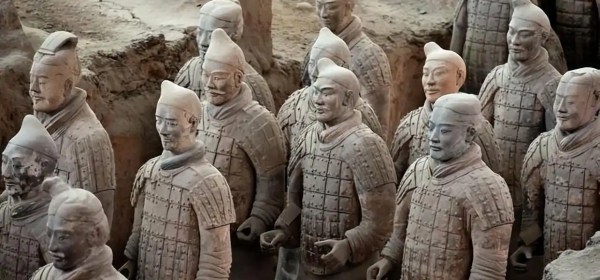
Terracotta Soldiers

China: Terracotta Warriors – Finger-Print Analysis – Sheds Light on Qin Dynasty Work-Force! (20.10.2026)

2,200 years ago, a craftsman was sculpting ears for samurai figurines. The wet mud was still soft. He reached out and pressed it down, pressing the final arc of his ear wheel firmly. This action took only one or two seconds.

Fingerprints were left on the muddy surface. Following the clay figurines into the kiln, out of the furnace, and down to the pit, they lay there for over two thousand years.

Now, these marks were being measured one by one. The team conducting this analysis was led by Li Xiaoxi, an archaeologist at the Qin Shi Huang Mausoleum Museum in China. They systematically studied the ancient fingerprints remaining on the Terracotta Warriors, publishing their findings in the international academic journal Cultural Heritage Journal.

UK: London’s Holborn Viaduct! (18.10.2026)

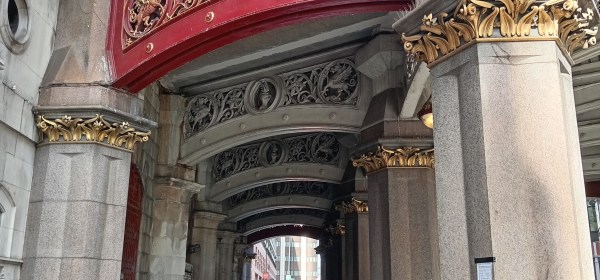
It seems that London had evolved into to two levels – creating steep inclines and bottle-necks. Movement was inefficient and caused traffic-jams and congestion. The government needed to reduce the ability of workers to come together in ad hoc and agitated groups. Therefore, engineers and architects were tasked with creating sturdy bridges that could handle weight and continuous usage – whilst functioning to link one level of existence to another. In a way, the design – at least the steps – remind me of multi-storey car-parks – although in a much more ornate state. Like the original Tube network – thousands of working-class men (many Irish) – dedicated their lives to building these structures. Of course, these ordinary men (who performed all the labour) are not remembered – but only the middle-class who control the means of production. It is through architecture that the current generation gains an understanding of what physically existed and came before them. Through physical structure – the thoughts that were in the mind of the creators can be seen in stone, wood, and cement. Furthermore, the statues tell something about the values and belief of the time.

1 2 3 4 … 44