Volunteers Fought At Harrisburg!

CSA: The Peculiar [1863] Union Defence of Harrisburg! (17.5.2025)

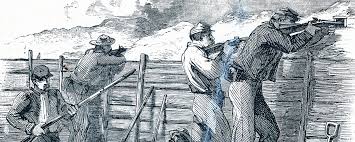
At one-point a thousand White volunteers from Harrisburg joined a large group of Black people to dig trenches and build ramparts around the geographical extremities. After one day, 700 of the White people returned home – saying the labour “hurt their hands” – whilst the other 300 acted as foremen directing the Black labourers (as if they were slaves). Black people built the defences of Harrisburg – but by and large were excluded from defending the place on the grounds that Black men carrying guns (and acting “free”) would scare the women and children. The situation was a little more nuanced than this, however, as NO White person from Harrisburg possessed the courage to join a local militia to defend the place they lived in. This led to the local authorities agreeing to arm a small company of local Black men that everyone knew – who had to drill away from the sight of ordinary people from Harrisburg. Meanwhile, thousands of White volunteers poured into the area to offer their services in defence of the place (risking their lives) – but were met with indifference and hostilities from the locals. Shop-keepers, hoteliers, and bar-owners put up their prices by ten or twenty times (even charging for a glass of water) – asking for excessive amounts of money for the smallest necessity of life.

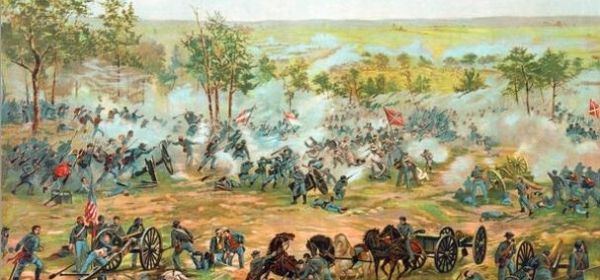
Battle of Gettysburg - Painting by Paul Philippoteaux

CSA: Confederate Army Uniforms, Hats, Ranks & Badges c. 1861! (27.4.2025)

Sometimes, CSA Units proudly wore “Blue” – whilst certain Union Units proudly wore “Grey”. Both sides also possessed Units that dressed (and acted) like English Red-Coats – a designation that then sent shudders through most people due to the reputation the Red-Coats possessed – namely that of strict discipline and ruthless close-quarter-fighting (all wounded were bayoneted as an act of compassion – due to the lack of any reliable medical treatment). English Red-Coats would march indifferently into enemy-fire – safe in the belief that once the distance was closed – the enemy would pay the price. The CSA Units attempted to replicate this attitude and make the Union pay for the damage its forces inflicted upon the Southern States.

CSA Oliver Hardy - Confederate Army

CSA: Oliver Hardy’s “Confederate” History! (5.4.2025)

The comedy duo – “Laurel and Hardy” (Stan Laurel being from the UK) still make millions of people laugh all the time. It would seem that like many people living in the Southern States, the family of Oliver Hardy were originally from England. I find the Confederacy to be a complex period of US history – often misrepresented by prevailing narratives. It is as if the dominant narrative-writers want to hide something that was present in the South between 1861-1865 – but which is inconvenient to know today. My own view is that there was Revolutionary dialectics in operation that could have led the US in an entirely different direction. I find that this observation is just as unpopular with neo-Confederates as it is with the Federal government in Washington DC!

Stephen Spencer West Co. I “the Granville Stars” 23rd NC Infantry CSA. He was born in Oxford, Granville County, North Carolina in 1837. He was killed in action during the Battle of Chancellorsville on May 2, 1863

CSA: Remembering the [1863] Bravery of the 23rd North Carolina Infantry Regiment [and Other Carolina Men] – at Gettysburg! (27.3.2025)

Jefferson had to draw from a limited pool of men (compared to the North – which possessed an endless supply of recruits – as every newly arrived migrant was enrolled into the US Army) – Jefferson managed to assemble around 80,000 (aged 12-60) – gave every man a uniform, hat and pair of boots, and ensured all were armed and fed. The idea was to Punish the Lincoln Administration that had tried on numerous occasions to militarily invade and subjugate the South. It was General Lee who suggested to Jefferson Davis that an invasion into the North – and a decisive military victory near Washington – might force Lincoln to sue for peace. Lincoln, however, had other ideas, and refused any such compromise, stating that he strove for the utter destruction of the South.

George Foreman V Ron Lyle - January 24th - 1976

RIP George Foreman [1949-2025] – Fighter & Humanitarian! (22.3.2025)

On the other hand, George Foreman is such a genuinely good person that I simply cannot begrudge him his own successes – or condemn him for them. Good luck to him – and anyone else who can make money. I cannot do this – but I can recognise a truly spiritual human-being when I encounter such a person – and Mr George Foreman is just such a man. I am reluctant to speak of him in the past-tense – because I still feel his warm character that emerged from his emails around 20-years ago! He once said to me that he hates violence – but certain realities dictated that violence was needed in various stages of his life. I believe his come-back was motivated by the need to raise funds for his Church. He took the punches so that ordinary people could enter his Church, find peace, and live in love with one another. What a great man he was!

Possibly a a Photograph of the "Philadelphia Greys"

CSA: General Robert E Lee Sues for “Peace” [1863] – Pennsylvanian “Minutemen” Non-Existent! (17.3.2025)

This reflected a remarkable situation. A Confederate Army was riding rampant through the Pennsylvanian countryside – the State within which Washington DC is situated – and yet “no one” amongst the young, elderly, disabled or wounded men (considered medically “unfit” to join the Regular Army due to ill-health or age) were prepared to defend the Union. Within the city of Philadelphia, 8,000 men of the already existing “Philadelphia Greys” bravely volunteered to march to the front in defence of the Union. Due to the general lack of volunteers from the ordinary population – the city of New York sent 12,000 of its own existing Militiamen to supplement the regular Union Army. How brave these men were! Militiamen are often called “Sunday Soldiers” – as they are working men, fathers and patriarchs who live in society, work and look after their families. They come together once a week, once a month, or just a few times a year to compare notes, fire their weapons, and discuss homestead self-defence. They are not frontline soldiers. Of course, Confederate citizens showed the same extent of bravery when the time came. 

1 2 3 4 5 8