Inner science is a non-religious investigation of the science of perception. It has to be ‘non-religious’ because it follows the ‘no hypothesis’ methodology associated with
Tag: perception
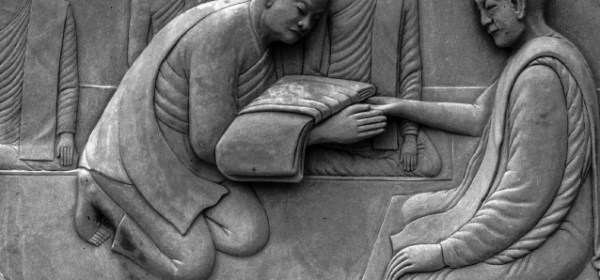
Buddhism: Pali Bhavana and Chinese Ch’an
Chinese transliterations and translations are useful as the early Chinese scholars had to understand the Indian Pali and Sanskrit terms before they could be rendered effectively into the Chinese language. Obviously, some of the early transliteration of Indian Buddhist terms are purely ‘phonetic’ in nature and in themselves do not convey much meaning as ideograms. This represents an initial process of a slow, careful and gradual building-up of knowledge in China about a thoroughly ‘foreign’ Indian philosophy that had to develop an ‘interface’ with existing Chinese culture.
The Buddha’s Middle Way of Knowing
Moreover, the Buddha clearly states that conscious awareness cannot exist without the conditions associated with a physical body and its functioning biological processes. Within the Buddha’s interpretation of reality, there does not exist any notion of a ‘dis-embodied’ conscious awareness.
Other Dimensions (Out There)
Although theoretical physics postulates that other dimensions may exist (i.e. ‘String Theory’ and ‘Quantum Theory’, etc), these realities are mathematical probabilities, and not the product of sensory observation in the usual or mundane sense.

Ch’an Dialectics
This is the latest Ch’an Digest put out through RHACS – a no nonsense Chinese Ch’an research and study group in the UK, that rejects the Western ‘mystification’ of this quintessential Chinese school of dialectical thought.
Scientific Buddha
The Buddha advises that all those who follow his path must ‘uproot’ ALL ignorance. This instruction alone proves that the Buddha was a ‘scientist’ and not a religious teacher in the conventional sense.
 SANGHA KOMMUNE (SSR)