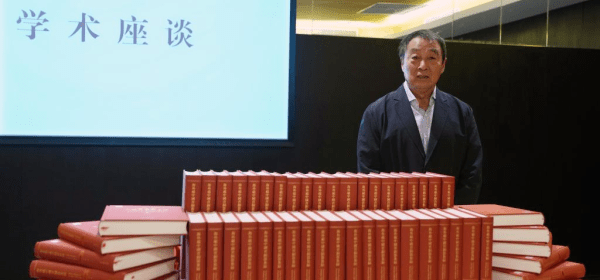
Professor Zhu Fenghan, the lead editor of a sixty-volume compendium documenting more than 23,000 ancient Chinese bronze artifacts lost abroad, poses for a photo during a press conference for the books' release in east China's Shanghai, April 19, 2026. (Xinhua/Liu Ying)

China: Record of “Stolen Bronzes” By Imperialists Compiled! (20.4.2026)

Zhu, also the lead editor of the books, said previous such surveys focused mainly on bronze bells, cauldrons and ritual vessels. This collection categorizes nearly 300 types of bronze artifacts, ranging from weapons, tools, lamps and mirror stands to irons, coal rakes and dice. One example is a human-shaped lamp stand currently at the Minneapolis Institute of Art.

Previously, scholars at home and abroad generally assumed that there were over 3,000 Chinese bronze wares in overseas collections. However, the “Collection of Chinese Bronzes in Overseas Collections” has expanded this figure by more than sevenfold.

“We have created an identity document for each piece of relics,” Zhu said. The team found that only a few relics have clear records of legal trade, diplomatic gifts or legitimate export.

As the compendium points out, the primary channels for these bronzes leaving China from the late 19th century to mid-20th century were looting, smuggling and war plunder. Western collectors and dealers bought large numbers through agents inside China, forming an illegal supply chain.

Stone Tracing of Inscription

China: Highest-Altitude Qin Dynasty “Engraved Stone” Found on Qinghai-Tibet Plateau! (15.9.2025)

He became the Emperor of a unified China in 221 BCE – the presumed date of this inscription – which counts his rule as being in its “26th year” since his crowning as the King of the State of Qin [247 BCE] (rather than the 1st year as the Qin Empire [221 BCE]). There is an ongoing debate within China’s academic community as to whether the inscription is a) authentic, and b) the above interpretation is correct (the text appears to say “37” – some think this is a weathered inscription that should read “26”*. I have followed with the “26” narrative as this equals 221 BCE – whereas “37” would equal 209 BCE. As the Emperor Qin died in 210 BCE – this latter dating would not make sense. Furthermore, line 8 states the branch and stem year is “己卯” [Ji Mao] – which implies the year in question is “221 BCE”). A local Tibetan herdsman said he knew about the inscription as early as 1986 – and all his older relatives said it had always been present.

Archaeological Teams in Henan!

China: Longest Ancient City Road Discovered at 3,300-Year-Old “Yin” Capital Site! (27.12.2024)

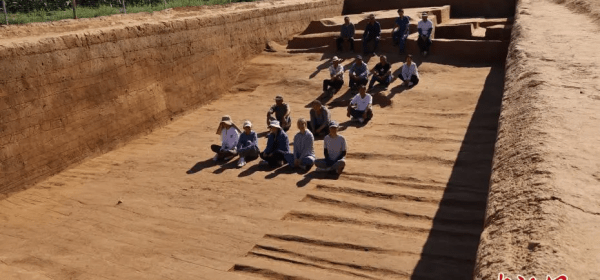
The main roads discovered in this area are spaced 320 to 550 meters apart, while some intermediate-level roads are located about 100 meters apart. These roads are interconnected, showing clear evidence of intentional human planning, according to Niu.

Based on previous findings of archaeological excavations, it has been confirmed that the roads in the Shang capital city can be generally classified into three levels according to their width, or referred to as main roads, streets and alleys, Niu said.

Situated in Henan’s Anyang City, the 3,300-year-old Yin Ruins is the first documented late Shang Dynasty capital site in China, as confirmed by archaeological excavations and oracle bone inscriptions.