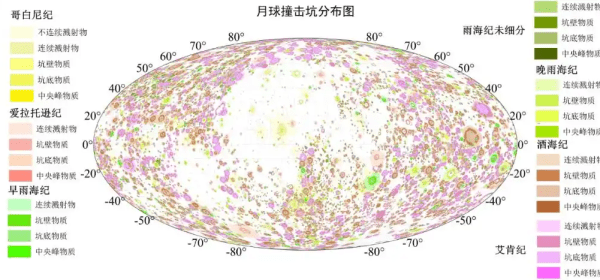
Global lunar crater distribution map. (Photo provided by the Institute of Geology, Chinese Academy of Geological Sciences)

China: PRC Develops Independent “Lunar Surface Map” for Future Missions! (7.8.2026)

A Chinese research team has completed an updated geologic map of the entire moon featuring a scale of 1:5 million, the Institute of Geology, Chinese Academy of Geological Sciences (IGCAGS), said on Thursday.

Representing a significant scientific iteration from the 2024 version, this map effectively rewrites the moon’s geologic history based on the latest research findings. “The lunar geologic history has indeed been rewritten — more precisely, refined and systematized,” said Yang Zhiming, director of the IGCAGS.

Specifically, a primary achievement of this update is the recalibration of the moon’s ancient geologic eras. The new map systematically updates the age boundaries of the moon’s three ancient geologic periods, namely the Aitkenian, Nectarian and Imbrian periods, drawing on recent advances in international chronology.

Lunar Magnetic Field

China: Chang’e 6 Samples Shed Light on Lunar Magnetism! (23.12.2024)

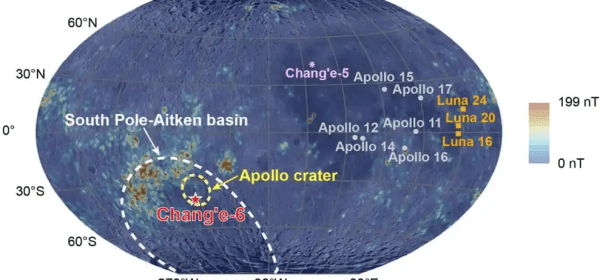
They discovered that the Moon’s magnetic field may have experienced a rebound around 2.8 billion years ago, suggesting that the Moon’s generator may have been reinforced after an early sharp decline.

“The reason for this rebound could be a change in the primary energy source of the generator or a restrengthening of the initial driving mechanism,” Cai said.

“The data fill in a billion-year gap in the evolution of the lunar paleomagnetic record and provide the first paleomagnetic measurements from the lunar far side,” a reviewer for the journal Nature said. “The authors are to be congratulated on a historic study that provides a major advance in our understanding of lunar magnetism.”

The evolution history of the Moon’s magnetic field is markedly different from that of the Earth’s, the research team said.

New Moon Map!

China: World’s First High-Definition Lunar Geologic Atlas Published! (22.4.2024)

He mentioned that China’s upcoming Chang’e-6 mission is expected to collect samples in the Apollo Basin within the South Pole-Aitken Basin on the far side of the moon, which means materials ejected from ancient terrain may be collected in the process. “Our map can provide a macroscopic geologic background to improve the purpose and efficiency of the sample research,” Liu explained.

The compilation of this map was an immense task, which required the organization and cooperation of many well-informed researchers over many years to be able to achieve a consistent and complete result, commented Gregory Michael, a senior scientist from the Free University of Berlin in Germany.

“This map, in particular, is the first on a global scale to utilize all of the post-Apollo era data. It builds on the achievements of the international community over the last decades, as well as on China’s own highly successful Chang’e program. It will be a starting point for every new question of lunar geology, and become a primary resource for researchers studying lunar processes of all kinds,” Michael added.

China Releases First Batch of Research from Mars Exploration! (19.9.2022)

Scientists have also found that the Martian soil has high bearing strength and low friction parameters, revealing the site where the rover landed must have experienced wind and possibly water erosion.

These results revealed the impact of wind and water activities on Mars’ geological evolution and environmental changes, and provided support for the hypothesis that there was once an ocean in the Utopian Planitia, according to the CNSA.

In addition, Chinese scientists have obtained a number of scientific results on the relationship between the density of rocks on the Martian surface and the degree of surface erosion, the distribution of ions and neutral particles in the near-Mars space environment, and the gravity field of Mars.