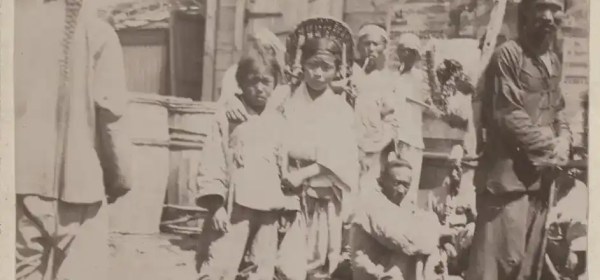
Undated Chinese in Russia Picture

USSR: Debunking the False Idea of a Late-1930s Anti-Chinese Purge! (13.10.2026)

The message is this – the workers do not possess the ability (or right) to rule themselves. This idea is routinely hurled at Communist China on a daily basis by Western racists – my partner is subjected to it in her workplace and my daughters in their school. For the ethnic Chinese the problem is two-fold – they are the wrong “race” and the wrong “class” – a double-whammy. During the UK, US, and German invasion of Revolutionary Russia between 1918-1921 (a process of unbridled aggression that involved around 20-countries – which killed 10.5 million Russians) – Nationalist China sided with the West and sent troops to the Chinese border with Russia (Vladivostok). Indeed, following the 1917 Revolution – the conditions for Chinese workers living in Russia improved dramatically – with many workers returning to China carrying Socialist ideas (Lenin even had a personal bodyguard comprised of Chinese martial artists).
Yelnya: The Soviet Red Army and the First European Defeat Inflicted Upon Nazi Germany During WWII! (18.3.2023) 

‘Nevertheless, the fact that Russia had “allies” – or rather, one major ally, Britain – and that America was going to “help” was of some psychological importance to the Russians, they did not feel entirely alone, and soon after the invasion the thought had become deeply ingrained that the war would be won, no matter how terrible and how long it was. Much was, of course, made of minor military successes, such as the slowing-down of the blitzkrieg at Smolensk (which, curiously, created for several weeks almost a feeling of euphoria, at least in Moscow), and of the small Russian counter-offensive at Yelnya, south of Smolensk in September 1941, when a few hundred square miles were recaptured from the Germans – the first to be recaptured anywhere in Europe since the beginning of the Second World War. At that time, in bombed and half-devastated Vyazna, the future Marshal V. D. Sokolovsky made to the foreign press the significant remark that, fearful as the war was, the Russians were “gradually grinding down” the German war machine, and that in any case Moscow would not be lost.’