At physical death, the life processes become dormant and non-functional – they do not travel as a disembodied entity to some other plane simply because these life process are the product of biological function and not spiritual transmigration. As and when Cryogenics solves the riddle of existence, the theistic religious view will be finally proven wrong.
Tag: consciousness
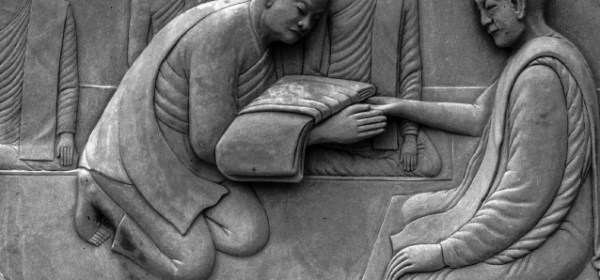
Buddhism: Pali Bhavana and Chinese Ch’an
Chinese transliterations and translations are useful as the early Chinese scholars had to understand the Indian Pali and Sanskrit terms before they could be rendered effectively into the Chinese language. Obviously, some of the early transliteration of Indian Buddhist terms are purely ‘phonetic’ in nature and in themselves do not convey much meaning as ideograms. This represents an initial process of a slow, careful and gradual building-up of knowledge in China about a thoroughly ‘foreign’ Indian philosophy that had to develop an ‘interface’ with existing Chinese culture.
The Material Basis of Buddhist ‘Consciousness’ (Vijnana)
Instead, the Buddha reiterated that different types consciousness arises out of specific material conditions, and that without the presence of these specific material conditions, the different types of consciousness do not arise. The concept of Buddhist consciousness does not constitute a theistic ‘atma’, or ‘soul’ that stands in opposition to the material world, but is in fact a product of conditions arising out of the material world.
The Material Basis of Quantum Mechanics
Once the material basis of human consciousness is fully understood and appreciated, an in-depth study and analysis of its implication and functionality can be ‘scientifically’ pursued outside of the limitations that theological understanding suggest and impose. Without firmly separating the study of evolutionary consciousness from theology – the true extent of the power of the human mind will not be fully understood.
Mind Beyond Matter (PSI)?
I would say that psi should proceed from a strictly material scientific basis, with no psi a priori assumptions sullying the reading (or generating) of results. This means that I do not ‘reject’ in principle the notion of psi, but that I do insist upon a material basis for its study.

The Sangha Kommune (僧伽公社) – A Place of Spiritual and Physical Growth! (Founded 16.2.2010)
The Chinese Buddhist monastic community is referred to as a ‘Sangha’ (Sanskrit for ‘spiritual community’), whereby men and women form a voluntary association premised upon following a strict set of rules known as the ‘Vinaya Discipline’. Within this community, there is ‘equality’ between all members, with the leaders being those who have followed these rules for the longest times. This is because such people are thought to have more experience at adhering to the Vinaya Discipline (which includes celibacy and vegetarianism), and are therefore able to effectively advise all others through the difficult times they my face in their practice. As those with little experience have less to share, they are not considered leaders whilst more experienced practitioners live in the vicinity.
 SANGHA KOMMUNE (SSR)