From 1931 to 1945, Master Xu Yun witnessed the barbaric behaviour of invading Japanese troops in China, and he associated this barbarism with Japan’s abandonment of the Vinaya Discipline.
Tag: Buddhism
Buddhism: Karma, Dukkha and Dependent Origination Contextualised
The Buddha defined the tiniest specks of matter (paramanu) [synonymous with ‘atoms’] to be occupying (and moving about within) time and space, whilst flickering in and out of existence. This is how the Buddha redefines matter (rupa) as being both ‘existant’, and ‘insubstantial’ (or non-existant).
The Buddha’s Middle Way of Knowing
Moreover, the Buddha clearly states that conscious awareness cannot exist without the conditions associated with a physical body and its functioning biological processes. Within the Buddha’s interpretation of reality, there does not exist any notion of a ‘dis-embodied’ conscious awareness.
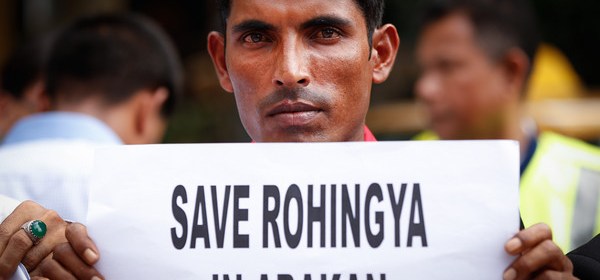
The Fabrication of Burma in the Western Mind
Burmese Buddhists living in the Rakhine State view themselves as ‘ethic’ inhabitants of Myanmar, and state that Islamic militants regularly attack their villages and Buddhist temples, carrying-out acts of rape, torture and murder. The point of this activity is to ‘cleanse’ the area of the ethnic Burmese and their Buddhist culture.

The Connection Between the Perception of Inner and Outer Space
Today, through the use of advanced technology and mathematics we know that this is scientifically correct. This would suggest that Democritus had an experience no less important than the enlightenment of the Buddha, as it radically redefined humanity’s perception of reality and existence, and yet generally speaking, there are no temples containing statues of Democritus, or people applying a meditative method to replicate his mode of thought.
Four Theories of Mind Rooted in Material Science
Essentially recalling the past and speculating about the future requires the imaginative reconstruction of events that may or may not have happened in the past, and the construction of events which ‘might’ occur in the future – the scientific question about the latter, is the extent of the connection between ‘imagining’ the future and that ‘imagined’ future actually coming to pass.
 SANGHA KOMMUNE (SSR)