My Chinese colleagues were of the opinion that a Biden win would be worse for Socialism because Trump was doing a wonderful job destroying the

Proletariat Blogging in the Heart of (UK) Predatory Capitalism! Exploring the Interface between Matter and Perception, Chinese Buddhism, Daoism, Hakka Ethnography, and All Aspects of Radical Politics, History, Psychology and Philosophy – 全世界无产者联合起来!
My Chinese colleagues were of the opinion that a Biden win would be worse for Socialism because Trump was doing a wonderful job destroying the

The Grange Hill BBC drama series written for children in the UK – ran from 1978-2008 over 600 episodes – and featured various adventures of groups

Translator’s Note: My personal experience has been with the use of the ‘AK74’. The version I used fired 5.45 ammunition – but could also fire
This book receives it spiritual authority through the lineage of the Tibetan Lama known as ‘Chagdud Tulku Rinpoche’ – even though the text is provided
Change the Quality of Ideas, Improve Overall Development
Dan Zengzhu, Deputy Secretary-General of the Tibet Autonomous Region Government, said that since the democratic reform, the biggest and most fundamental change in the snowy plateau has been the change of people’s perspective, the change of people’s ideas and the improvement of their quality compared with the achievements of material life. It laid the most solid foundation for the modernization of Tibet.
Wen Weibing is a lawyer of a law firm in Beijing. In 2014, he signed up for the volunteer service of “Tibet Without Lawyers” and was sent to Zhacao County, Shannan City. “The legal awareness of the Tibetan people is constantly improving.” Wen Weibing said that farmers and herdsmen are no longer fighting to make trouble, but seek counsel and constructive debate. After the expiration of the two-year service, he proposed to the General Office to open a branch in Lhasa and was approved. In addition, the awareness of the masses in Tibet has grown. Gelong, a 48-year-old villager from Yuba Village, Jiazhulin Town, Gongga County, Shannan City, borrowed 320,000 yuan from the bank through the farmer’s joint guarantee. In the past few years, the family has had three cars and nearly 2 million yuan in fixed assets. In the remote back town of Medog County, with the help of the bank’s “financial husband” service, the people are equally skilled in the use of POS machines.
From the serfs who have no life and no life guarantees in the past to the natural people in the traditional farming society, the natural people who drive cattle and the shepherds – today’s modern citizens now possess a legal consciousness, business consciousness and scientific consciousness, the “people” in the snowy plateau have experienced a profound inner and outer changes. At present, Tibet not only has its own master’s and doctoral degrees, but also has a group of experts and scholars who are well-known throughout the country. Since the establishment of the autonomous region, nearly 30 research institutes have been created, with more than 52,000 professional and technical personnel, and a number of academic achievements, as well as generating a reputation in the world.
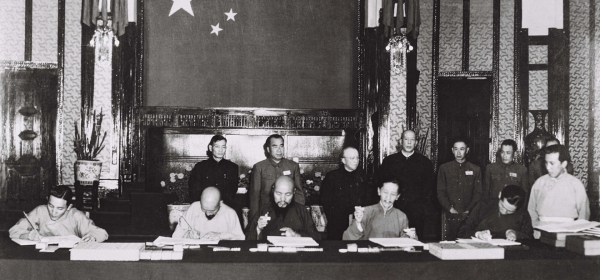
Around August 1953, Ch’an Master Xu Yun (1840-1959) attended a meeting in Beijing of hundreds of representatives of the various Buddhist groups from around China
 SANGHA KOMMUNE (SSR)