Hakka Farming: Natural Pest Control and Fertilisation of the Land

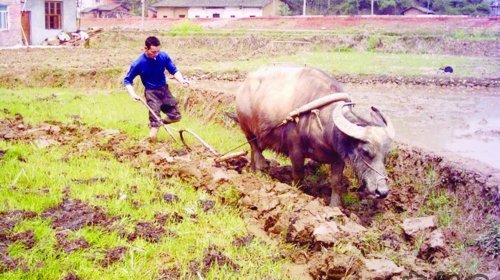
This means that the entire human – ox interaction, and the ploughing process itself, must be of a ‘naturally’ relaxed and co-ordinated manner. The oxen will walk in a straight line just as long as the Hakka farmer keeps his hands on the plough-handles (as this reassures and guides the ox). When uneven mounds of earth are encountered, the Hakka farmer assists the ox by pushing the plough (with the hands and occasionally with a foot) into the contours of the land. As the ox understands this process, it is willing to pull the plough up and down the field until all the uneven mounds are fully ‘turned’.
The Old Hakka Method of Natural Farming in New China

It is hoped that the old and natural Hakka method of farming can become a blue-print for a ‘new’ type of agricultural process in New China, whereby the excesses and foolishness of modern ‘petroleum agriculture’ can be transitioned into the use of more natural farming methods that are assisted and optimised by the benefit of modern technology. This is a clever blending of the old and the new in the present time. The old Hakka method of farming might well serve as the natural basis of the future agricultural policy of New China.

Hakka Ch’an Buddhist Culture in Meizhou

This festival was organised to highlight the historical association between the Hakka people and their practice of Chinese Ch’an Buddhism, and to explore the many different aspects of Hakka culture and Ch’an Buddhist practice. Another important aspect was to encourage cross-straits Hakka Ch’an Buddhist cultural interaction between Meizhou, Taiwan, Hong Kong and Macao.

1 16 17 18 19 20