
Blogger’s Note: I will look for a Thai-language article on this matter – but Theravada Buddhism is very strict regarding alcohol and general intoxicants, etc. It is not a big deal within Buddhism – but Thailand currently falls into the US sphere of influence and is stuck within a cycle of destructive predatory capitalism. Western tourists, mostly White men – but including South Koreans and Japanese – travel to Thailand not to experience the Buddhist culture, but rather to sexually abuse the impoverished population (including children). Oddly, whilst “killing” is also banned within Buddhist teaching, the Thai State – following the dictates of the US – does allow for a Judicial Death Penalty (the condemned are tied to a post and a full magazine of machine-gun ammunition emptied into their chest), an act forbidden by the Buddha. Thailand has even executed Westerners in the past – but most condemned are ethnic Asians (one Thai woman even survived the execution process and regained consciousness lying in the morgue – only to be carried-out to be re-tied to the post and subjected to the entire process over again). All this demonstrates that the Buddha was right when he taught that “Wisdom” is required to administer all this understanding of Dhammic morality. ACW (10.11.2025)
PUBLISHED : 8 Nov 2025 at 10:12
WRITER: Bloomberg News
Bangkok Post – New Thai alcohol rules put drinkers on the hook for fines
People in Thailand wanting to quench their thirst with an afternoon tipple risk steep fines from Saturday under amended alcohol control legislation that strengthens enforcement and significantly tightens restrictions around marketing and advertising.
Alcohol sales in Thailand have been banned at most retail outlets and supermarkets between the hours of 2pm and 5pm since 1972, but changes to the Alcoholic Beverage Control Act that take effect on Saturday now mean individuals can be fined 10,000 baht (US$300) or more for drinking or being served alcoholic beverages during prohibited times or in prohibited places.
Although there are exemptions for licensed entertainment venues, hotels, certified establishments in tourist areas and airports offering international flights, the onus has been shifted to consumers, and the tightened laws also prohibit advertising of alcoholic beverages unless the content is purely factual. The use of celebrities, influencers or public figures to promote alcoholic beverages for commercial purposes is also banned.
The new regulations will have an adverse effect on restaurants because it is the customer that is now “restricted” by the stipulated sale hours, Chanon Koetcharoen, president of the Thai Restaurant Association, said.
If an establishment sells a bottle of beer to a customer at 1.59pm, for example, but they sit and drink on the premises until 2.05pm, that will constitute a violation of the law under Section 32, and that person could be fined. “This will impede the growth of the restaurant industry,” Mr Chanon, who also runs a restaurant in Bangkok, said.
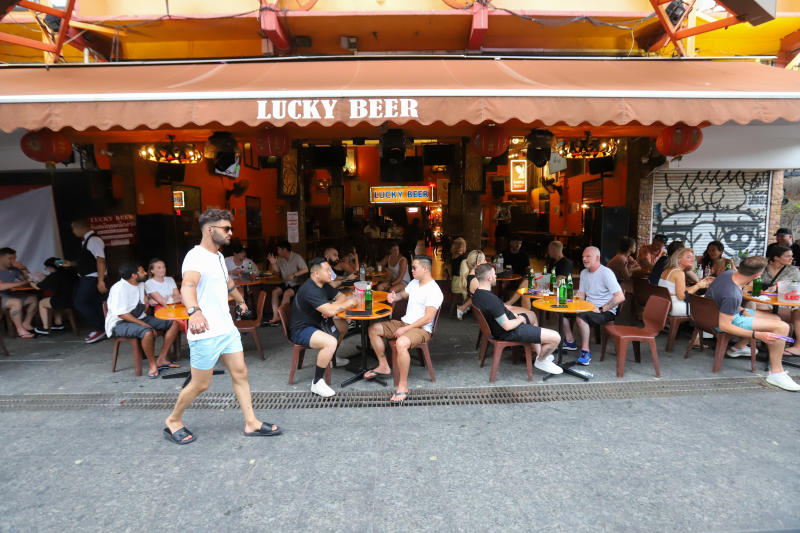
Along Khao San Road, an area in Bangkok known as a backpacker hub, one business said they are operating as a hybrid bar and restaurant from 11am to 2 am. Alcohol sales are loosely controlled considering customers can and do order drinks between the officially prohibited hours.
With the possibility of drinkers themselves being fined, sales of alcohol may halve during those times, Bob, an assistant manager working on Friday said, declining to give his full name because he is not authorised to speak publicly.
There is also concern the stricter laws present an opportunity for officials to enforce fines on customers, restaurants — or both — for personal gain.
Taopiphop Limjittrakorn, a member of parliament from the opposition People’s Party who has pushed for liquor liberalisation, said alcohol sales should be around the clock. “The amended law aims to serve the purpose of those opposing alcohol,” Mr Taopiphop said.
They also risk confusing foreign tourists who may order a drink before the restricted hours but consume it afterward, he said.
In Thailand, where Buddhism is the main religion, practitioners and monks follow the Five Precepts, which include abstaining from alcohol and intoxicants to promote mindfulness and avoid heedlessness.
NOTE: พ.ร.บ.ควบคุมน้ำเมา (ใหม่)มีผลบังคับใช้แล้ว บนข้อกังขาถอยหลังเรื่อง ‘สุขภาพ’
Alcohol Control Act (New) Now in effect, amidst concerns about a step backward regarding ‘health’
08 Nov 2025 at 10:11
The new Alcohol Control Act will lead to the control of sales through advertising rules in the hope of economic gains. But it is expected to increase consumption over-all – and create negative health effects.
Alcohol consumption is a major risk factor for non-communicable diseases.
Research data shows that Thai people who drink alcohol have higher than normal liver enzyme values, which is at risk of cancer. Contrary to the World Health Organization’s recommendations.
Alcoholic Beverage Control Act (No. 2) B.E. 2568 (2025) It is very likely that the new Alcoholic Beverage Control Act will contribute to the increase in “alcohol consumption” in Thailand, and expect “economic growth” to increase from sales and employment, which is the main reason for the amendment of this law. Because there will be unlocking in many matters. that are different from the law, such as the time of sale. Zone areas are prohibited from selling and advertising.
The more you drink – the less you work. The effects on the long-term economy will be negative over-all.
However, from the Alcohol Problem Research Centre in collaboration with Kasetsart University – conducted a study on “The Impact of Alcohol Consumption on Thailand’s Economic Growth” using data from Thailand between 1990 and 2019, both as a whole and classified by Asst. Prof. Dr. Chidtawan Chankul. Lecturer, Faculty of Economics, Kasetsart University Instead, it was found that:
Thailand’s alcohol market is the largest in Southeast Asia, and per capita alcohol consumption is likely to increase from an average of 5 litres per person per year in 1990 to more than 7 litres in 2019.
The results of the study showed that the more people drink in general, and the more beer and liquor they drink – long-term economic growth is even lower, in line with research using data from the United States and developing countries because drinking affects health, causing frequent absenteeism and inefficiency – including premature death
“All of this affects the productivity of the labour force in the economy. In addition, drinking has an opportunity cost, lose of money and time can be used to take care of the development of children.”
Don’t add to it. Traffic Injuries Thailand Targets SDGs
Importantly, from the perspective of “health”, it is clear that it will greatly affect the health of Thai people. Drinking alcohol is a risk factor for chronic non-communicable diseases or NCDs, which are considered a major public health problem in Thailand. With the increasing rate of sickness, there is also a risk of many other diseases, including cancer.
Not only that, there is also a random risk of increasing the number of deaths from road accidents due to alcohol consumption. At a time when the law is still tight, there is no indication that the lockdown on the time of sale and the place of sale will be loosened now.
Thailand consumes about 8 litres of alcohol per person per year. There were 16,957 road deaths, of which 2,390 were from road accidents due to alcohol consumption, accounting for 14.1%.
Are the “reasons for drinking drunk” ready not to make these figures. Meanwhile, the issue of “traffic injuries” is one of the two that Thailand still “fails” the indicators of disease prevention and control that are in line with the Sustainable Development Goals (SDGs).
The health of drinkers is deteriorating.
Assoc. Prof. Rengrudee Pathanwanitch, Department of Community Medicine, Faculty of Medicine, Ramathibodi Hospital and Head of the 7th Thai Public Health Survey Project by Physical Examination, said that the latest survey data The prevalence of heavy drinking in Thailand is 12.9 percent, more than that of Singapore at 9.9 percent, and Malaysia at 4.4 percent.
However, Liver enzyme (GGT) is tested, which is an indicator of liver cell abnormalities, the normal value is lower than 65 IU/L, and if the value is high, there is a risk of many types of cancer such as the esophagus, stomach, intestines, liver, pancreas, bile ducts, lungs, breast, lymph nodes, and urinary tract. It was found that Thai people who drank alcohol had higher liver enzyme values. The harder you drink, the higher it is. liver cells are damaged; The non-drinkers had an enzyme value of 40.8 IU/L, a risk level of 119.7 IU/L, a dangerous level of 151.4 IU/L of drinking, and an alcoholic addiction of 217.1 IU/L.
The proportion of Thai people aged 15 years and older with abnormal liver enzyme values
No alcohol 13 %
Drinking at 47 %
Dangerous drinking level 59 %
Alcohol addiction 63 %
“In the NCDs Best BUYS recommended by the World Health Organization (WHO) regarding alcoholic beverages, the tax rate must be increased and advertising banned, but the new Alcoholic Beverage Control Act in Thailand has been amended to make it worse, so it is still an important big problem when trying to make WHO’s advice to come true,” said Assoc. Prof. Rengrudee.
The fact that the new law sees an easing of control measures in matters that Thailand has done well in terms of having a control law. Even though they may face problems with law enforcement.
From the perspective of health and society, it is considered a “backward law”.
 SANGHA KOMMUNE (SSR)