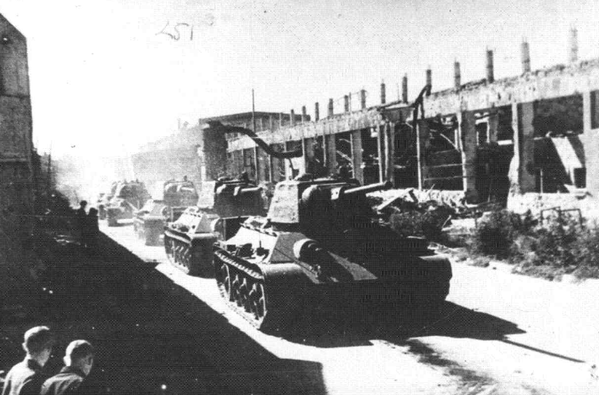
Translator’s Note: During the Battle of Stalingrad – Tractor Factories were modified to build T-34 Tanks (and other armaments). These stood-out in the rubble and received extra-protection from the defending Soviet Red Army. Freshly trained tank-crews would patiently wait at the factory gates for each new tank to emerge – already fuelled, armed – and ready to fight. The young crews would jump aboard and immediately steer the tank toward the nearest Nazi German lines. Meanwhile, as the Nazi Germans were killing and wounding millions in the USSR – people with disabilities were quickly trained and empowered to take their place on the manufacturing-line – assembly the different parts of the tank as they became available. It is a principle of Socialism that everyone is equally “valid” – and regardless of material limitations – is able to contribute somehow to the common good. Of course, people born with a disability is a different experience to an able-bodied individual who becomes disabled through injury or illness. Within warfare, many are permanently injured and have to adjust to life in peacetime. In the UK and the USSR, after WWII, disability awareness progressed considerably due to the war-wounded – but this improvement (by default) – also benefitted those born with disabilities. However, disability is a complex issue as it spans many different conditions and realities – there is no quick-fix or answer to the issue (society must evolve beyond basic ignorance, anger, and hatred for “difference”). The Hitlerites basically gave-up on this matter and decided it was better to commit mass-murder. Ironically, this fascist “superman” ideology was defeated (in-part) by disabled people sat in wheelchairs – who spent hours tightening the nuts and bolts that held the T-34 together! After-all, their very lives depended upon a Soviet Red Army victory! ACW (12.6.2025)
People 20/03/2023 – Tieffe
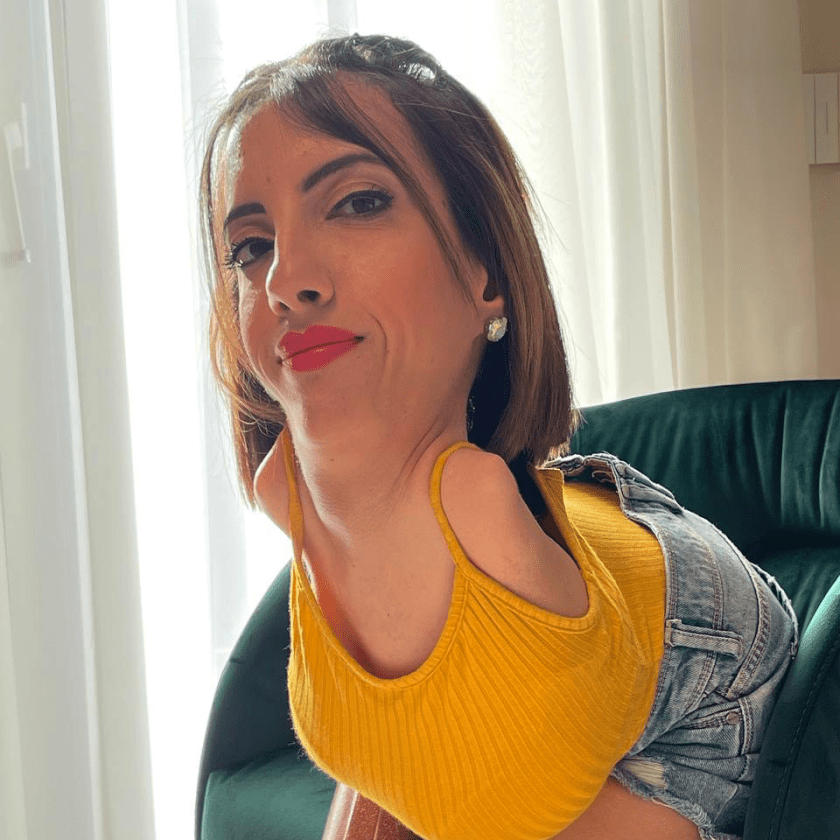
Nadia Lauricella, the Sicilian Ironwoman
Phocomelia since birth, she is a promoter of projects on disability and a very popular influencer
“You must know that there is a theory, which is not ours, but which we have made our own, according to which people with disabilities are divided between resentful and sunny. The former are those who are angry with the world for what happened to them, the latter are those who have decided to live it as a new opportunity.”
Certainly Nadia Lauricella, 30 years old in October, (from Racalmuto, in the province of Agrigento), is an example of how disability can be a condition that inspires you to give your best for yourself and for others/ The condition of “Phocomelia” is to be born without arms – and only partially developed legs – which she uses to carry out most of her daily activities: she has strived (through will-power) to transform this condition into an iron determination to live life to the full and to make her experience known to others. In fact, so strong is her strict determination that she chose “Iron-Nadia” as her nickname.
No judgment has stopped her, despite living in a small town, and her battle against ableism (discrimination against people with disabilities) – has led her to have over 50,000 followers on Instagram and almost 800,000 on TikTok.
“For me, social media is a tool to implement my little cultural revolution,” she says. Sport? “A dream come true”.
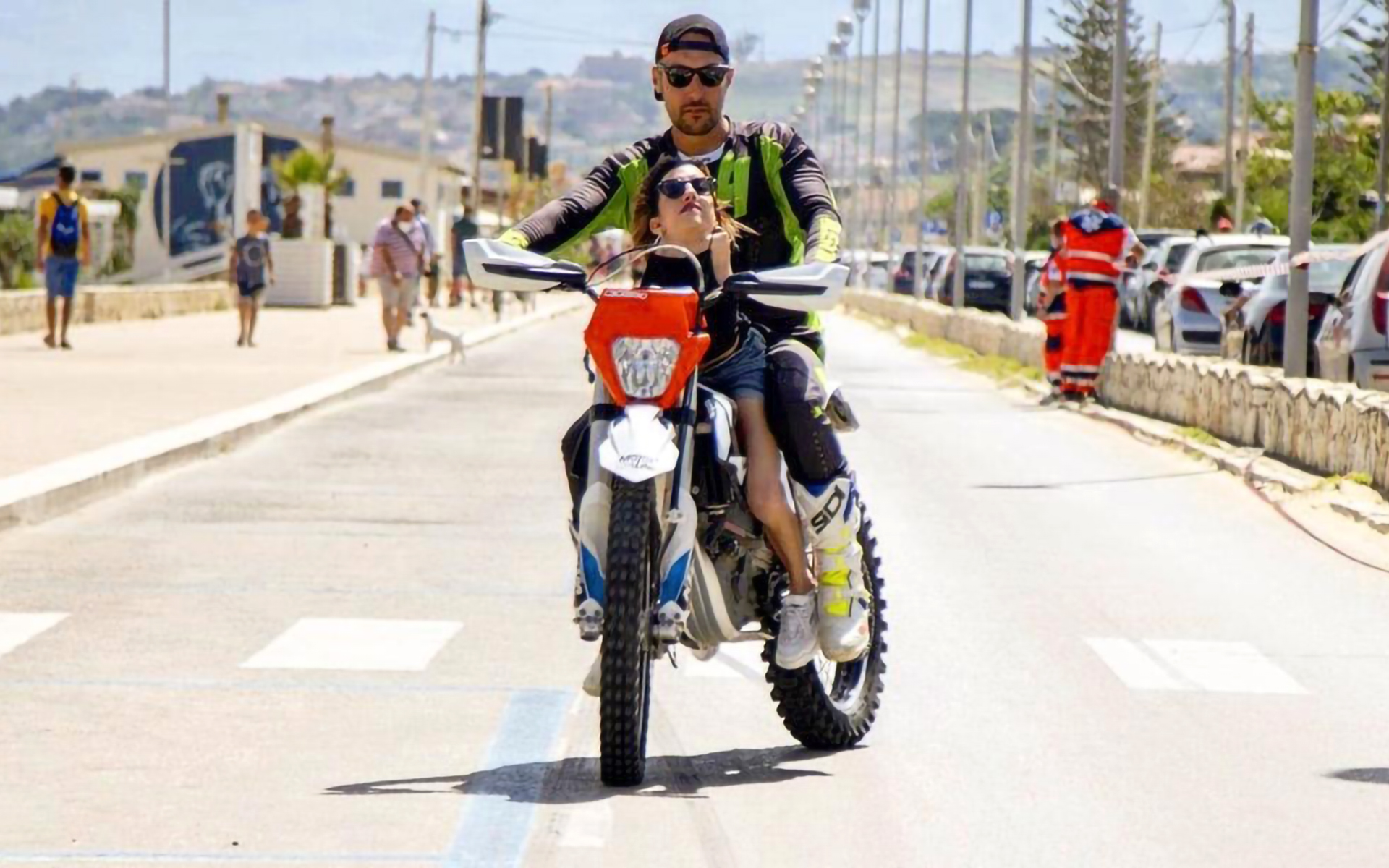
Nadia, in fact, is now Vice President of the non-profit association MotorLife, which promotes motorcycle therapy for disabled children and young people.
This is where we start with our interview. Can you explain what motor-therapy consists of and how it can help disabled children to “accept and love themselves, as a key to overcoming all obstacles”?
I became passionate about the world of motor-cross by watching the videos of Vanni Oddera, former freestyle world champion and creator of motor-therapy. As soon as I discovered that there was a way for me to be able to participate in motor-cross – I did it and I felt, for the first time, free, as if I had cancelled-out all my disability. Riding a motorcycle is pure adrenaline and joy which in the case of autism becomes a therapy in its own right, because it allows you to release tension. Once I ascertained how much it was a source of well-being for me, I committed myself so that other children with disabilities could experience these emotions and this energy and so I founded the MotorLife Association, of which I am Vice-President (the President is Rosario Farruggia, ed.), thanks to which we are able to practice this sport by empowering several disabled children in Southern Italy.
What does sport represent and what does it mean for you?
It was the source of my rebirth. Until I was 24 years old, I was told that I couldn’t do many things because of my disability. So, when I started participating in sports, for me it was a revenge against all those no’s I had received until then. From a physical and psychological point of view, it allows me to disconnect from everything: it’s just me and the personal trainer, on a path that leads to a state of vigour and health. I would like this message to be understood by all Italian gyms, that is, many disabled people need sport. And we do not need, at least most of us, special equipment, but only one person to guide us and help us do the right exercises.
Returning to your other activity, how are social networks helping you to become a spokesperson for disability as uniqueness?
I come from a small town in Sicily, where I grew up in the midst of a thousand prejudices. People only saw my physical appearance and stopped there. Few tried to figure out who Nadia really was. When I put on the prostheses I chose to tell my experience and the period of rehabilitation to help other children with disabilities understand not only how to face certain challenges in a proactive way, but also how to get rid of the labels that people, inevitably, give you. Behind every person there is a human being, with his strength, his fragility, his tastes: a person who deserves to be known. This is what I want to say with my messages, to give a different point of view on disability and to instill, in my own way, a little strength to those who experience the same problems as me. Hence my nickname Iron-Nadia. I want to say that I don’t feel like a superhero, but I’m happy that, thanks also to social media, people have started to see the real me, which has gone beyond disability and I hope they will be able to do so with all the disabled people they will meet.
They have made a documentary film about your life, would you like to tell us about it?
It is entitled “Turn Up the Volume”, it was conceived by Angelo Jay Pecoraro. For me it was exciting to see my story told, because you don’t realize what you do, the goals you achieve, until others show them to you. I want to say today I would not be who I am without the people who have accompanied me on this journey: my family and my closest friends. Each of them has helped me to be the Nadia of today, and has marked my path of rebirth and awareness. My unconditional thanks go to them!
What was the biggest challenge you faced?
Walking at 24. I was an adult and resetting my mind and body to perform those movements was really difficult. I felt like Dumbo: I needed a magic feather to walk, which for me was someone’s support. But when I realized that support was no longer needed, then I also started flying…
You often tell how difficult it was to live with your condition in a small village in Southern Italy. Don’t you think, however, that people who live in small towns in the end do not behave, for better or worse, in an indifferent way towards members of their community?
In my case, unfortunately, this was not the case. Let me explain: sometimes it would have been better to be indifferent, compared to what I had to suffer, to always feel different, marginalized. I have to say thank you to the school, an environment that supported and encouraged me, but not to the community that was only able to tell me so many no’s and only show me my limits, convincing me that it was impossible to overcome them.
She is also very active with institutions, technicians and designers, in the removal of architectural barriers and in social policies. Can you explain better what this commitment consists of?
I believe that everyone must play an active role in their own reality: only in this way can institutions be brought closer to the real needs of citizens, especially in terms of disability. For a disabled person sometimes a step is a problem, a road with potholes, the lack of traffic lights with acoustic signals… Therefore, it is the duty of every citizen to commit ourselves to achieving a truly inclusive society, where everyone’s needs are taken into consideration by those involved in urban planning, architecture and social policies.
What are the insurmountable barriers, even today, of which our country is a victim, especially in environments that are necessary and at the same time more difficult to live in such as bathrooms?
Unfortunately, bathrooms are those where the most difficult barriers to break down still remain, such as excessively high sinks, mirrors positioned so that you can only look in the mirror in an upright position, soap and hot air dispensers away from the taps, showers that do not allow you to enter in a wheelchair. Not to mention steps, placed everywhere. In the interior architecture of accommodation facilities, environments with high traffic of people, such as stations, bars and restaurants, the layout of bathroom environments should be completely revised. At present, they are sometimes unsafe and usable even for able-bodied people, let alone for those with a disability.
When traveling, for example, what are the main inconveniences you encounter?
Fortunately I always travel accompanied, otherwise I don’t know if I would “survive” potholes, bumpy roads and endless stairs. I often move in a wheelchair and mobility, in this case, does not improve, indeed sometimes it gets worse. Until there is a real revolution in the conception of road and sidewalk maintenance and reorganization of internal spaces, it will always be difficult for a disabled person to travel.
In addition to all these things she does, Nadia also works and organizes events. What would you recommend to a young person with a different ability to live his life to the fullest?
Learning to ask for help: that’s the secret. Without feeling uncomfortable, because for the people next to you it is natural to be of help and they are happy to be able to do it. Above all, not to be ashamed of your disability because it is not a fault … If these two conditions are extremely difficult to achieve, I recommend, especially to young people, to seek psychological assistance: it is essential to become aware of oneself and one’s limits as soon as possible, in order to accept oneself and understand how to work to overcome some brakes that are often more mental than physical. Finally, remember that, as Khalil Gibran said, “”One may not reach the dawn save by the path of the night”.
Italian Language Text:
https://www.pontegiulio.com/it-IT/notes/people/intervista-nadia-lauricella-influencer
Nadia Lauricella, l’Ironwoman siciliana
Focomelica dalla nascita, è promotrice di progetti sulla disabilità ed una seguitissima influencer
“Dovete sapere che esiste una teoria, che non è nostra, ma che abbiamo fatto nostra, in base alla quale le persone con disabilità si dividono fra rancorosi e solari. I primi sono quelli arrabbiati col mondo per quello che gli è successo, i secondi sono quelli che hanno deciso di viverla come una nuova opportunità.”
Bebe Vio
Sicuramente Nadia Lauricella 30 anni ad ottobre, di Racalmuto, in provincia di Agrigento è un esempio di come la disabilità possa essere una condizione che ti porta a dare il meglio per te stesso e per gli altri. Focomelica, è nata senza braccia e con le gambe solo parzialmente sviluppate, che usa per compiere la maggior parte delle attività quotidiane: lei questa condizione ha saputo e voluto trasformarla in una ferrea determinazione a vivere la vita appieno e a far conoscere la sua esperienza ad altri. Talmente ferrea da farle scegliere come nickname “Ironadia”.
Nessun giudizio l’ha fermata, nonostante viva in un piccolo centro, e la sua battaglia contro l’abilismo (la discriminazione nei confronti delle persone con disabilità), l’ha portata ad avere oltre 50mila followers su Instagram e quasi 800mila su TikTok.
“Per me i social sono uno strumento per attuare la mia piccola rivoluzione culturale”, dice. Lo sport? “Un sogno realizzato”.
Nadia, infatti, oggi è vicepresidente dell’associazione no-profit MotorLife, che promuove la mototerapia per bambini e ragazzi disabili.
Proprio da qui partiamo con la nostra intervista. Può spiegarci in cosa consiste la mototerapia e come può aiutare i ragazzi disabili ad “accettarsi ed amarsi, come chiave per superare tutti gli ostacoli”?
Mi sono appassionata al mondo del motocross vedendo i video di Vanni Oddera, ex campione mondiale di freestyle e ideatore della mototerapia. Appena ho scoperto che c’era un modo, per me, per poter praticare il motocross l’ho fatto e mi sono sentita, per la prima volta, libera, come se avessi annullato ogni disabilità.Andare in motocicletta è adrenalina e gioia allo stato puro che nel caso dell’autismo diventa una terapia a tutti gli effetti, perché consente di scaricare la tensione. Una volta appurato quanto fosse fonte di benessere per me, mi sono impegnata perché altri ragazzi con disabilità potessero provare queste emozioni e questa energia e così ho fondato l’Associazione MotorLife, di cui sono vicepresidente (presidente è Rosario Farruggia, ndr), grazie alla quale riusciamo a far praticare questo sporta diversi ragazzi disabili nel Sud Italia.
Cosa ha rappresentato e cosa rappresenta per lei lo sport?
È stata la fonte della mia rinascita. Fino a 24 anni mi sono sentita dire che tante cose, a causa della mia disabilità, non potevo farle. Quindi quando ho iniziato a praticare sport, per me è stata una rivincita nei confronti di tutti quei no che avevo ricevuto sino ad allora. Dal punto di vista fisico e psicologico mi consente di staccare da tutto: siamo solo io ed il personal trainer, in un percorso che porta a uno stato di vigore e salute. Mi piacerebbe che questo messaggio fosse compreso da tutte le palestre italiane, ossia che molti disabili hanno bisogno di sport. E non necessitiamo, almeno la maggior parte di noi, di particolari attrezzature, ma solo di una persona ci segua e ci faccia fare gli esercizi giusti.
Tornando all’altra sua attività, come i social la stanno aiutando a farsi portavoce della disabilità come unicità?
Provengo da un piccolo paese della Sicilia, dove sono cresciuta in mezzo a mille pregiudizi. Le persone vedevano solo il mio aspetto fisico e lì si fermavano. In pochi cercavano di capire chi fosse davvero Nadia. Quando ho messo le protesi ho scelto di raccontare la mia esperienza ed il periodo della riabilitazione per contribuire a far comprendere ad altri ragazzi con disabilità non solo come affrontare certe sfide in maniera propositiva, ma anche come liberarsi delle etichette che la gente, inevitabilmente, ti affibbia. Dietro ogni persona c’è un essere umano, con la sua forza, le sue fragilità, i suoi gusti: una persona che merita di essere conosciuta. Questo voglio dire con i miei messaggi, dare un punto di vista diverso sulla disabilità e infondere, a modo mio, un po’ di forza a chi vive i miei stessi problemi. Da qui il mio nickname IronNadia. Tengo a dire che non mi sento un supereroe, ma sono felice che, grazie anche ai social, le persone abbiano iniziato a vedere la vera me, che siano andate oltre la disabilità e spero riescano a farlo con tutte le persone disabili che incontreranno.
Hanno realizzato un docufilm sulla sua vita, ce ne vuole parlare?
Si intitola “Alza il volume”, è stato ideato da Angelo Jay Pecoraro. Per me è stato emozionante veder raccontata la mia storia, perché non ti accorgi di quello che fai, dei traguardi che raggiungi, finché non sono gli altri a mostrarteli. Ci tengo a dire oggi non sarei quella che sono senza le persone che mi hanno accompagnata in questo cammino: la mia famiglia ed i miei amici più cari. Ognuno di loro mi ha aiutato ad essere la Nadia di oggi, ed ha segnato questo mio percorso di rinascita e consapevolezza. A loro va il mio incondizionato grazie!
Qual è stata la sfida più grande che ha dovuto affrontare?
Camminare a 24 anni. Ero un’adulta e reimpostare la mia mente e il mio corpo a compiere quei movimenti è stato davvero difficile. Mi sono sentita come Dumbo: avevo bisogno di una piuma magica per camminare, che per me era il sostegno di qualcuno. Ma quando mi sono accorta che il sostegno non serviva più allora anche io ho iniziato a volare…
Lei spesso racconta di quanto sia stato difficile vivere la sua condizione in un paesino del Sud Italia. Non crede, però, che le persone che vivono nei piccoli centri alla fine non si pongano, nel bene o nel male, in maniera indifferente nei confronti di componenti della loro comunità?
Nel mio caso, purtroppo, non è stato così. Mi spiego: a volte sarebbe stata meglio l’indifferenza, rispetto a quello che ho dovuto subire, al sentirmi sempre diversa, emarginata. Devo dire grazie alla scuola, un ambiente che mi ha sostenuta e incoraggiata, ma non alla comunità che è stata solo capace di dirmi tanti no e di mostrarmi unicamente i miei limiti, convincendomi che fosse impossibile superarli.
Lei è anche molto attiva con istituzioni, tecnici e progettisti, nell’abbattimento delle barriere architettoniche e nelle politiche sociali. Può spiegarci meglio in cosa consiste questo impegno?
Credo che ognuno debba avere un ruolo attivo nella propria realtà: solo così si possono avvicinare le istituzioni alle necessità reali dei cittadini, specialmente in tema di disabilità. Per un disabile a volte un gradino è un problema, una strada con delle buche, la carenza di semafori con segnalazioni acustiche… Quindi è dovere di ogni cittadino impegnarsi affinché si arrivi ad una società davvero inclusiva, dove le necessità di tutti vengano prese in considerazione da parte di chi si occupa di urbanistica, architettura e politiche sociali.
Quali sono le barriere insormontabili, ancora oggi, di cui è vittima il nostro Paese, soprattutto in ambienti necessari ed al contempo più difficili da vivere come gli ambienti bagno?
Purtroppo, gli ambienti bagno sono quelli dove ancora permangono le barriere più difficili da abbattere come lavandini eccessivamente alti, specchi posizionati in modo che ci si può specchiare solo in posizione eretta, erogatori di sapone ed aria calda lontani dai rubinetti, docce che non consentono di entrare in carrozzina. Per non parlare di gradini, posizionati ovunque. Nell’architettura d’interni di strutture ricettive, ambienti ad alto traffico di persone, come le stazioni, i bar e i ristoranti l’allestimento degli ambienti bagno andrebbe totalmente rivisto. Allo stato attuale a volte risultano poco sicuri e fruibili anche a persone normo-dotate, figuriamoci per chi ha una disabilità.
Quando viaggia, ad esempio, quali sono i disagi principali che incontra?
Fortunatamente viaggio sempre accompagnata, altrimenti non so se “sopravviverei” a buche, strade sconnesse e infinità di scale. Spesso mi muovo in carrozzina e la mobilità, in questo caso non migliora, anzi a volte peggiora.Finché non ci sarà una vera rivoluzione della concezione della manutenzione delle strade e dei marciapiedi e di riorganizzazione degli spazi interni per un disabile sarà sempre complesso viaggiare.
Oltre a tutte queste cose che fa, lavora anche e organizza eventi. Cosa consiglierebbe a una persona giovane e con una diversa abilità per vivere appieno la sua vita?
Imparare a chiedere aiuto: questo è il segreto. Senza sentirsi a disagio, perché per le persone che si hanno accanto è naturale essere d’aiuto e sono contente di poterlo fare. Soprattutto non vergognarsi della propria disabilità perché non è una colpa… Se queste due condizioni risultano estremamente difficili da raggiungere consiglio, soprattutto ai giovani, di cercare un’assistenza psicologica: è essenziale prendere coscienza di sé stessi e dei propri limiti prima possibile, in modo da accettarsi e comprendere come lavorare al superamento di alcuni freni che spesso sono più mentali che fisici. Infine, ricordarsi che, come ha detto Khalil Gibran, “Non si può raggiungere l’alba senza passare dai sentieri della notte”.
 SANGHA KOMMUNE (SSR)