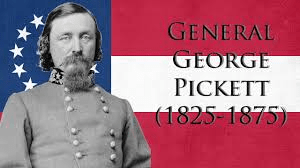
Blogger’s Note: Following two-years of being attacked by the aggressive forces of the Union under Lincoln (between 1861-1863) – General Robert E Lee and Confederate President Jefferson Davis agreed that the time had come for a Confederate Army to invade the North as an act of self-defence. This was a remarkable feat of arms in and of itself – as the Union materially held all the cards. The idea was to threaten Washinbgton DC, win a few battles, and sue for peace. General Lee achieved two of these objectives – but failed to sue for peace. A decisive battle developed around the town of Gettysburg between the 1st-3rd of July, 1863. Day-one belonged to the Confederacy, day-two was a draw – but day-three saw “Pickett’s Charge” repulsed by a determined Union Army that knew if it lost the battle the North might lose the war. The charge is named after Major General George Pickett – a Division Commander in the Confederate Army – who led his men from the front. The objective was the centre of the Union Army’s position on Cemetery Ridge – believed to be a vulnerable point in the Union defences. The Confederate troops marched across nearly a mile of open ground, and soon came under heavy artillery and rifle fire from entrenched Union forces. The open terrain offered little cover – and the Confederate ranks were quickly destroyed.
Although a small number of the Confederate soldiers managed to reach the Union lines and engage in hand-to-hand combat, they were ultimately overwhelmed. The charge ended in a disastrous defeat for the Confederates, with more than half of the men involved either killed, wounded, or captured. Meanwhile, on a different part of the battlefield, the Union scored yet another decisive victory at Vicksburg on July 4th, 1863, the day after the defeat at Gettysburg (a conflict had been raging at Vicksburg since the beginning of the war – with the defending Confederates scoring a number of victories – but nothing decisive). Nevertheless, despite these heavy-blows, General Lee managed to muster what was left of his Army and retreat in good order back to the South – and continue the war for another two-years. ACW (1.4.2025)
Antiques Roadshow experts Russ Pritchard III and George Juno, who appeared on the US version of the show were accused of swindling items from people at a cheaper price than their true value.
Gemma Jones and Nicola Croal TV and showbiz reporter – 20:53, 30 Mar 2025
BBC’s Antiques Roadshow has been embroiled in a scandal after a couple featured on the US version of the show were later charged with fraud.
Military artifacts dealers, Russ Pritchard III and George Juno, faced federal mail and wire fraud charges in 2021.
ABC News reported that the duo was accused of conducting fake appraisals on the American version of the Antiques Roadshow to boost their status as Civil War-era weapons and military artifacts specialists. Despite the allegations, the pair claimed they were not guilty.
At the time the charges were made public, the experts could have been looking at up to 60 years behind bars and fines totalling $2.75 million (£2.1 million), the Express reports.
Pritchard’s lawyer, Kirk Karaszkiewicz, spoke to The Associated Press, asserting: “Mr. Pritchard maintains his innocence of these charges and we will vigorously defend them.”
Alleged victims included the family of Gen. George Pickett, known for leading “Picket’s Charge” at the Battle of Gettysburg. The indictment alleges that Pritchard duped Pickett’s descendants into selling family heirlooms for around $88,000 (£68,000), under the pretence of acting for the Harrisburg National Civil War Museum.
Pickett recounted: “He said the museum was paying top dollar. And that he was under an obligation to the museum to appraise these items for fair market value.”
However, Pritchard had no affiliation with the museum. He was subsequently accused of selling the collection himself for a staggering $880,000 (£680,000) – 10 times what Pickett had received for the memorabilia.
Upon discovering the professionals’ actions and the true worth of the trunk’s contents, George E. Pickett V, the great-great-grandson of the Civil War general, took legal action.
In 1999, he launched a civil lawsuit against Pritchard over the sale of the artefacts. After just three hours of deliberation, a jury awarded Pickett $800,000.
However, according to Judy Matthews, the show’s publicist, Roadshow believed that the jury’s verdict did not reflect on Juno’s and Pritchard’s performance on the show.
The case then took another twist on December 21, 2001, when Pritchard pleaded guilty to over 20 charges, including wire fraud, mail fraud, theft from a museum, and Interstate Transportation of Stolen Property.
Then on January 18, 2002, Pritchard Jr. and a former museum curator at the Civil War Library and Museum in Philadelphia were found guilty of theft from a museum, and aiding and abetting after the fact, in the case involving the Hunt uniform.
On July 11, 2002, Pritchard was handed a one-year prison sentence and instructed to repay $830,000 for orchestrating fraudulent appraisals and swindling Civil War memorabilia collectors.
He confessed to making false TV appraisals and also conceded to cheating artifact owners by providing them with low valuations on items, subsequently reselling them at significantly higher prices and pocketing the profits.
 SANGHA KOMMUNE (SSR)