Researcher’s Note: I am currently reading the (Audible) book entitled “Gettysburg” penned by Stephen W Sears – and I have audio-typed a section of Chapter 8 – The God of Battles Smiles South – which deals with one of the fateful days unfolding between July 1st-3rd, 1863, as the invading Confederate Army and defending Federal Army decisively clashed at Gettysburg (Pennsylvania) – situated just 80 miles North-West of Washington DC (the capital city of the Union). General Robert E Lee had worked wonders manoeuvring an army of 80,000 men out of the South, into the North and around the seemingly endless Union military formations (comprised of many Germans, Dutch, Polish, Russian and Scandinavian migrants loosely termed “Volunteerrs” – amongst “American” [Yankee] recruits), Lee penetrated as far as possible into Federal controlled territory (the key events described below occurred on July 1st, 1863 – the first day of the campaign). Indeed, in the weeks prior to this masterpiece of Confederate command and control (it took sometime for the Federals to realise what was happening – or the threat it constituted) – Confederate President Jefferson Davis (a former Minister for War serving the old US Government) had produced an organisational miracle of his own (despite the huge and irreplicable losses sustained by the Confederate Army – at the end of the first day of fighting at Gettysburg [July 1st] – the Confederate Army had pushed-back the Union Army and had entered the centre of the city of Gettysburg – causing mass panic amongst its citizens and unordered retreating amongst Federal soldiers).
Jefferson had to draw from a limited pool of men (compared to the North – which possessed an endless supply of recruits – as every newly arrived migrant from Europe was forcibly enrolled into the US Army) – Jefferson managed to assemble around 80,000 Confederate recruits (aged 12-60) – gave every man and boy a uniform (of sorts), hat and pair of boots (within reason), and ensured all were armed (kind of) and fed (sometimes). Despite the effective Union blockade of the Southern States from the sea – a steady (but relatively small) flow of foreigners monged to reach the Confederacy by boat – and join the Confederate Army, many being English, Irish and French. The idea was to punish the Lincoln Administration that had tried on numerous occasions to militarily invade and subjugate the South. It was General Lee who suggested to Jefferson Davis that an invasion into the North – and a decisive military victory near Washington – might force Lincoln to sue for peace. Lincoln, however, had other ideas, and refused any such compromise, stating that he strove for the utter destruction of the South.
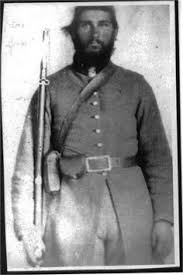
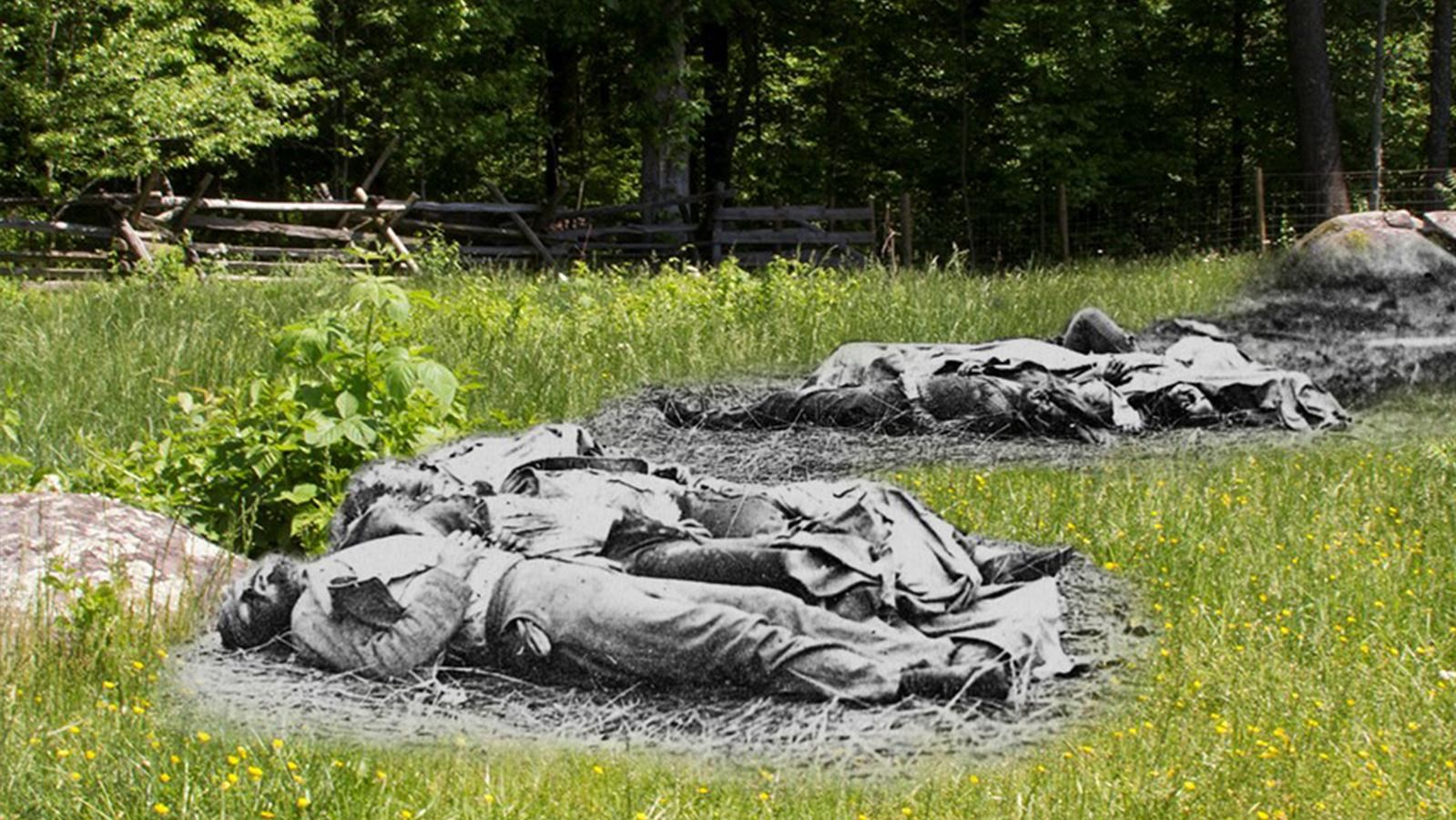
I have read many times of the iron discipline displayed by the Confederate troops. Indeed, there is evidence to suggests that the preferred model was that of the British “Red Coat” – impassive professional soldiers considered the best in the world at the time of mass infantry engagements. A mind focused, a body trained, and cause followed – regardless of material condition, hardship, injury or death. British soldiers were renown for never surrendering, marching in straight lines and being shot-down in formation. Even today, the Royal Guards in the UK must seek permission before breaking rank for any reason – including fainting (it is an offense to faint without permission). I could not find a photograph relating to the casualties suffered 23rd North Carolina Infantry Regiment – but I have discovered a related image – namely that of South Carolina Infantryman, who have also died in straight lines. Once you have read my quote below, you will understand the reference. How brave these men were. ACW (27.3.2025)
CONFEDERATE NORTH CAROLINA TROOPS
Overview: The 23rd North Carolina Infantry Regiment – formerly the 13th Volunteers – was raised at Weldon, North Carolina, in July, 1861. Its members were recruited from the counties of Anson, Lincoln, Montgomery, Richmond, Granville, Catawba, and Gaston. Seven companies arrived in Virginia on July 21st – the other three arrived in August. First assigned to the Potomac District in the Department of Northern Virginia – it was later placed under the command of Generals Early, Garland, Iverson, and R.D.Johnston. The 23rd fought with the Confederate Army from Williamsburg to Cold Harbor, served in Early’s Operations in the Shenandoah Valley, and was active around Appomattox. The Regiment totalled 540 effectives in April, 1862, but lost 84 during the Seven Days’ Battles, had 18 killed and 35 wounded in the Maryland Campaign, and suffered 1 wounded at Fredericksburg. Of the 430 engaged at Chancellorsville, forty percent were disabled, and more than eighty percent of the 316 at Gettysburg were killed, wounded, or missing. The Regiment surrendered 4 Officers and 82 men of which 35 were armed. The field Officers were Colonels Charles C. Blacknall, Daniel H. Christie, John F. Hoke, and Robert D. Johnston; Lieutenant Colonels William S. Davis and John W. Leak; and Major E.J. Christian. (Adjusted and Edited into British English – ACW 27.3.2025)
‘There would be no rest for Baxter’s victorious Yankees – a second Confederate battle-line was seen advancing from Oak Hill – starting from West of where O’Neal’s Alabama Brigade had started earlier. Apparently, aiming for the gap between Baxter’s Brigade and Cutler’s of Wadsworth’s Division. General Robinson had Baxter close this interval by shifting his regiments left – so that they now faced North-West and where lined-up behind a stone-fence. Baxter told the men to lie-down and ordered the flags down as well, so that from the Confederate perspective, there would be nothing to see upon crossing a low-ridge line but a stone-fence on a far-border of an open, grassy meadow. It was a perfectly designed ambush – but it required a blunder on the enemy’s part to be fully successful. Brigadier General Alfred Iverson applied the blunder – and worse. Like O’Neal, Iverson chose to stay behind rather than personally direct his advance. Then, he sent his Brigade, “5”, “12”, “20th” and “23rd” North Carolina – some 1,350 men in all – into battle without any advanced reconnaissance, and without skirmishers in the lead. As the historian of the “23rd” North Carolina would phrase it bitterly – “Un-warned, unled as a Brigade, went forward – Iverson’s deserted-band – to its doom!” Iverson’s battle-line well closed-up, colours all aligned, moving with parade-ground precision, came slanting across Farmer Johnny Thorney’s field at an oblique angle to the stone-fence – aiming for a wood-lot beyond the end of Baxter’s line, it presented as much flank as front to its unseen foe. Abruptly, as the range closed to less than 100-yards – the Yankee-line rose-up and with a shout – delivered the most killing-volley anyone on the field that day had ever witnessed. Men went down by dozens, by scores, quite literally in windrows! It was like a farmer harvesting grain with long swings of a scythe. Lieutenant George Bullock, 23rd North Carolina, would say that in all his war service from the Peninsula to the Appomattox, that field that afternoon at Gettysburg was the only one where the blood ran like a branch and that to on a hot, parched ground. There was a swale running across the field in-front of the stone-fence, and the tar-heels ducked-down into it for whatever cover it provided from the deadly fire. “I believe everyman who stood-up was either killed or wounded,” a man in the “20th” North Carolina recalled. It must have seemed that way. The “12th” North Carolina on the extreme left of the formation, and farthest from the stone-fence, escaped the worst of the ambush. Even so, the “12th” lost more than a third of its men. Iverson’s desperate men in the swale could not advance and dared not expose themselves in the open trying to retreat. On the other side of the field, Lysander Cutler’s Yankees, bloodied in the morning’s fight, moved-up to strike the front and left of the beleaguered Rebel Brigade. Here and there men began to wave hats or handkerchiefs in token of surrender. Henry Baxter, taking in the situation, shouted “Up boys and give them steel!” His Yankees leaped-over the stone-fence and dashed toward the swale. General Baxter was right with them. In the face of their bayonets – Rebels all across the field threw-down their rifles. When there was time for a count, it was found that 322 of Iverson’s Brigade had surrendered. Almost twice that many had been killed, or wounded. Three Battle-Flags were taken by Baxter’s men. two-thirds of Iverson’s Brigade had become casualties in these few minutes of slaughter. The “23rd” North Carolina would count but 34-men in its ranks – lost 89% of those it took into battle that afternoon. The next day, Confederate Artillerist – Henry Berkley – examined the field of Iverson’s disaster – “This morning, on getting-up,” Berkley entered in his diary – “I saw a sight which was perfectly sickening, and heart-rendering in the extreme. There were, in a few feet of use, by actual count, 79 North Carolinians laying dead in a straight-line. “I stood on their right and looked down their line. It was perfectly dressed. Three had fallen to the front, the rest had fallen backward. Yet the feet of all these dead men were in a perfectly straight line. Great god.”‘
 SANGHA KOMMUNE (SSR)