Author’s Note: Quintus Septimius Florens Tertullianus (155-220 CE) was a prolific early Christian adherent (and writer) hailing from the Roman Colony situated in the Carthage area of North Africa (now comprising the countries of Tunisia, Algeria and Libya). A philosophical context may be gained by stating that the famous Neo-Platonic philosopher – Plotinus – was born in the Roman Colony of Lyco (which refers to the modern-day area of ‘Asyut’ in Upper Egypt or the ‘Deltaic Lycopolis’ area in Lower Egypt) lived between 204-270 CE. Although both Roman Colonies were situated in North Africa – they were situated 1,354 miles apart – with Carthage lying to the North-West of Egypt. Plotinus was just 16-years old when Tertullianus died in 220 CE (the latter aged 65-years old).
Plotinus does not mention ‘Christianity’ at all, or at least remains ‘unbothered’ by it for much of the 3rd century he lived within – although he does (negatively) critique the Gnostic tradition (there is a speculation that the ‘Christianity’ that existed within the milieu of Plotinus was ‘Gnostic’ in nature – but as the later Church Authorities rejected ‘Gnosticism’ – this idea receives little official Church support). This is interesting, as Carthage became a central-hub for Early Christian theological development during the latter part of the 2nd century CE. We know this because in 197 CE Tertullianus penned his famous (Latin) text entitled the ‘Tertulliani Apologeticum‘ – or literally ‘Tertulliani Apologetic’.
Taking into account the subject matter of this text – a more rounded translation of the title could be ‘Tertulliani’s Defence of Christianity’ – a Sect that was ‘illegal’ at the time and viewed as something of a dangerous and illogical cult throughout the Roman Empire. This is why I do NOT accept the contemporary (Christian-derived) notion that Tertulliani ia defending Christianity against ‘Heathenism’ – as what these modern (and bias) commentators deem to be worthless ‘Heathenism’ was in fact the State creed of the time that served the spiritual need of millions throughout the Roman world. Tertulliani, indeed, is defending Christianity against what he believes to be the injustice of a) its illegality, and b) its continuous misrepresentation throughout the Roman Empire by those who do NOT believe in its teachings.
Tertulliani’s writing provides objective evidence that Christianity existed as a coherent body of teachings during the late 2nd centiry CE – and that even by this time, the idea of Jesus Christ being associated with a ‘donkey’ (or ‘ass’) was fully established. In the extract of his ‘Apology’ quoted below, Tertulliani deconstructs a major misconception regarding the deliberate misrepresentation of Christianity by the majority ‘non-Christians’ – rejecting the idea that Christians ‘worship’ a donkey – or that the personage of ‘Jesus Christ’ can be interchanged with that of an image of a ‘donkey’. Tertulliani explains ‘why’ this belief exists and how it is historically associated with an assumed historical Judaism (donkeys are believed to have led thirsty Israelites out of the parched desert and into an area of oasis – replete with fresh water).
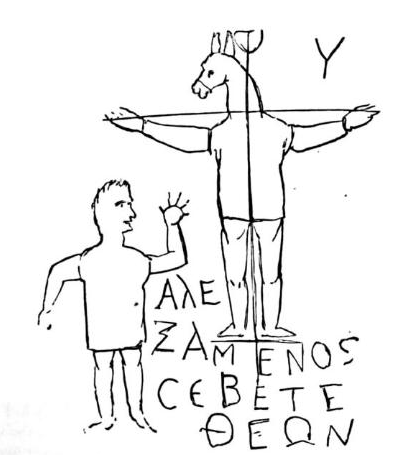
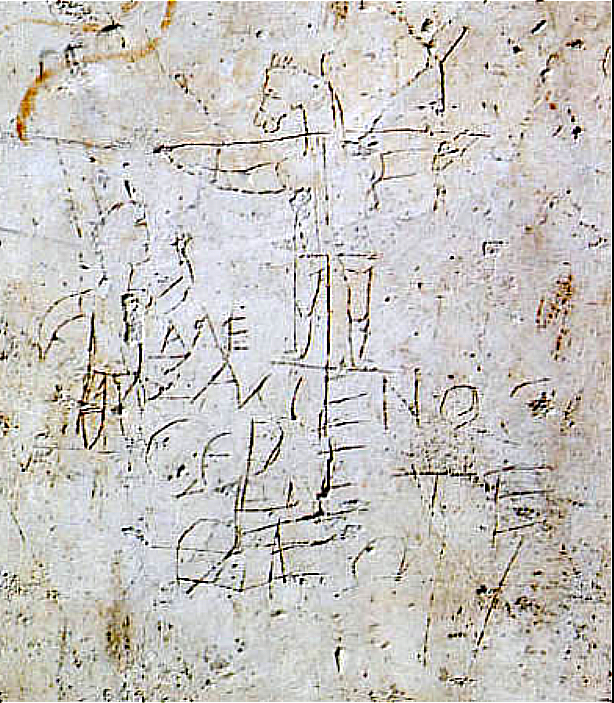
In there any objective, historical evidence for this assumed association which conflates ‘Jesus Christ’ with a ‘donkey’? The historical object (pictured above) has been re-named by Christians as the ‘Graffito Blasfemo’ (or ‘Graffiti Blasphemous’) – but the earlier and original designation is that of the ‘Alexamenos Graffito’ (or ‘Alexamenos Graffiti’). The character standing to the left (and with his left-hand raised) is said to be either the Greek or Roman soldier named ‘Alexamenos’ caught in the act of ‘worshipping’ a crucified ‘god’ – apparently a human man with a donkey’s head looking (left) admiringly toward ‘Alexamenos’ – his dedicated disciple. There is no consensus as to the exact dating of this object with estimates ranging from 100 CE – 300 CE – with many historians and archaeologists settling for the compromise of ‘200 CE’.
Although this object originates from the Roman graffiti scratched into the plaster of a wall found in a room of a building (the ‘domus Gelotiana‘ or ‘House of Gelotian’) – situated in the Palatine Hill area of Rome (modern Italy – the object subsequently being relocated to the Palatine Museum) – it could be that the ‘artist’ was inspired by the (197 CE) writing of Tertulliani or that Tertulliani was motivated in 197 CE by the already existing graffiti. A third scenario is that Tertulliani and the graffiti are unrelated – but that both represent an underlying and common reality – the essence of which both are referencing. Depending upon the exact date – the ‘Alexamenos Graffiti’ may well be the ‘earliest’ depiction relating to Christianity – albeit in a derogatory form. The crude Greek text scratched under the cross reads ‘ΑΛΕ ΞΑΜΕΝΟϹ ϹΕΒΕΤΕ ΘΕΟΝ’ – which seems to say ‘Alexamenos Ingests [his preferred] God’.
However, a number of academics are of the opinion that this involves a misspelling – which when corrected – should read (in standard Greek) ‘λεξᾰ́μενος σέβεται θεόν’ or ‘Alexamenos Worships [His] God’. This is logical but debatable – as it appears to be downplaying the original (intended) insult (as if later Christian-influenced commentators are attempting to reduce the tangible historical evidence recording the obvious resistance to Early Christianity). Under this text is an inscription made in a different hand which states ‘ΑΛΕΞΑΜΕΝΟϹ FIDELIS’ or ‘Alexamenos [the] Faithful’. This artefact is a competitor to that (2nd-3rd century CE) crucifix image currently held in the British Museum (the so-called ‘Magical Gem‘ – with Engraving) which features a cross with a bearded-figure ‘tied’ to it – containing a Greek inscription supposedly mentioning various names relating to ‘Jesus Christ’. The main historical problem (regardless of what Christians believe about their own religion) is that the earliest historical evidence for the Christian religion recognising the widespread veneration of crosses dates only from the 4th to 5th centuries CE. ACW (6.9.2023)
TERTULLIAN’S DEFENCE OF THE CHRISTIANS AGAINST THE HEATHEN
(Translated by Alexander SOUTER)
CHAP. XVI. For you, too, like some others, have dreamed that an ass’s head is the object of our worship. The fancy of such a deity was put into their minds by Cornelius Tacitus, who in the fifth of his Histories, having begun his account of the Jewish War with an account of the origin of the race, and having also discussed at his pleasure alike the origin itself and the name and religion of the race, records that the Jews, having been freed or, as he thought, exiled from Egypt, when they were weakened through thirst in the deserts of Arabia, where water was very scarce, employed some wild asses to guide them to a spring, thinking that they would probably be seeking water after food, and on that account consecrated the form of a similar animal. And hence I think it was presumed that we, too, being thus allied to the Jewish religion were taught to do reverence to the same image. But indeed it is the same Cornelius Tacitus, truly the most inventive of romancers, who in the same history records that Gnaeus Pompeius, after capturing Jerusalem and thus going to the temple to investigate the secrets of the Jewish religion, found no image therein. And to be sure, if the object of worship was represented by some figure, this would have been most appropriately shown in its own shrine, the rather that the worship, however vain, had no fear of strangers to witness it; only the priests were allowed to approach, while the gaze of the rest was forbidden by a curtain spread out over it. And yet you will not deny that you pay divine honours to |55 all beasts of burden, as well as to asses, heads and bodies both, along with their own goddess Epona. Perhaps our fault consists in the fact that amongst the worshippers of cattle and beasts of all kinds we worship the ass alone.
But he too who thinks that we adore the cross will be our fellow-worshipper. When some piece of wood is propitiated, no matter for the fashion as long as the quality of the material is . the same, no matter for the form as long as the god is bodily in the image. And yet what a great difference there is between the upright of a cross and the Athenian Pallas or the Egyptian Ceres, who stand forth formless, a rough stake, a shapeless bit of wood! Every piece of wood that is fixed in the ground in an erect position is part of a cross; we, perhaps, worship an unmutilated and complete god. I have said that the sculptors of your gods make a beginning with a cross: but you also worship Victories, although, in trophies, crosses form the inside part. The whole religion of the Roman camp consists in worshipping the standards, in swearing by the standards, and in setting the standards above all the gods. All those rows of images on the standards are but as necklaces of crosses; those pennons on the ensigns and banners are the robes of crosses. I commend your scrupulous attitude: you would not dedicate crosses that were bare and undraped. Others, certainly with greater semblance of nature and of truth, believe the sun to be our god. If so, we shall perhaps be classed with the Persians, although we do not worship a representation of the sun on a linen cloth, since everywhere we have the sun himself within his own hemisphere. Lastly the suspicion arises from the knowledge that we turn to the east in prayer. But many of you too with an affectation of sometimes worshipping heavenly bodies move your lips towards the rising sun. Likewise if we give rein to joy on Sundays, in a far different way from sun worship, we are only second to those who devote Saturday (Sabbath) to idleness and feasting, and who also deviate from the Jewish custom of which they are ignorant. But recently in this city, what is really a new representation of our god has been made public, since a certain criminal, hired to trick the wild beasts, exhibited a picture with an inscription to the following effect: ‘The Christian God, the Offspring of an Ass.’ He had asses’ ears, one foot hoofed, was dressed in the toga and carried a book. We laughed both at the name and the figure. But they were bound to worship at once a two-formed divinity, because they have welcomed, as gods, creatures with heads both of dog and of lion, with the horns of a goat and a ram, others with goats’ bodies from the loins downwards, and like serpents |57 from the legs, and with wings on the foot or the back. I have stated these methods more fully, to avoid passing over, as it were purposely, any rumour without rebutting it. All these false opinions we have now cleared away and proceed to turn9 to the proof of our religion.
Latin Language Reference:
English Language Texts:
FLAVIUS JOSEPHUS OF THE ANTIQUITY OF THE JEWS.
The Palatine Alexamenos Graffito
 SANGHA KOMMUNE (SSR)