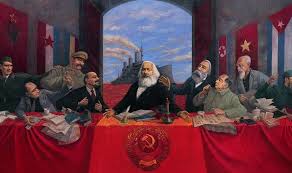
‘All that is solid melts into thin air.’ Karl Marx
‘There has been a sea-change in cultural as well as in political-economic practices since around 1972.
This sea-change is bound up with the emergence of new dominant ways in which we experience time and space.
While simultaneity in the shifting dimensions of time and space is no proof of necessary or causal connections, strong a priori grounds can be adduced for the proposition that there is some kind of necessary relation between the rise of postmodernist cultural forms, the emergence of more flexible modes of capital accumulation, and a new round of ‘time – space compression’ in the organization of capitalism.
But these changes, when set against the basic rules of capitalistic accumulation, appear more as shifts in surface appearances rather than as signs of the emergence of some entirely new postcapitalist or even postindustrial society.’
Harvey, David, The Condition of Postmodernity, Blackwell, (2000), Page vii.
 SANGHA KOMMUNE (SSR)