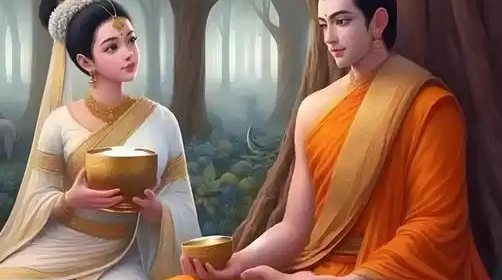
If this was the case, why did the Buddha reject Brahmanism? Why did the Buddha bite the hand that fed him? Well, he practiced all the available meditative paths, mastered them all, and realised none of them expressed the ultimate truth. He carried-on training in meditation as the Upanishads advised – and saw through all the conditioning of his mind, body, and environment. He gave up caste privilege and all work for money. He knew that this would lead to starvation, homelessness, and nakedness. He resolved these issues by dressing himself in rags found in the charnel grounds (the clothing of dead who were to poor to be cremated), he acquired the skull-cap of a dead person and used it as a begging bowl as he walked from village to village quietly requesting waste-food on a daily basis, and he sat under the foot of a tree when he meditated. The Buddha left society and lived on the forested outskirts of Hindu society. Of course, the Buddha still physically lived in India, and interfaced with Hindu society, but he did this under a completely new contract of understanding.



 SANGHA KOMMUNE (SSR)