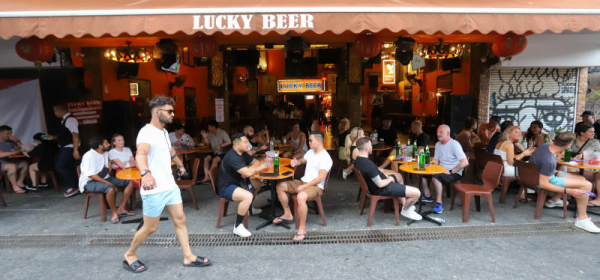
A scene of people socialising with drinks at a pub on Khaosan Road in Bangkok. (Photo: Pattarapong Chatpattarasill) Please credit and share this article with others using this link: https://www.bangkokpost.com/thailand/general/3133310/new-thai-alcohol-rules-put-drinkers-on-the-hook-for-fines. View our policies at http://goo.gl/9HgTd and http://goo.gl/ou6Ip. © Bangkok Post PCL. All rights reserved.

Thailand: Western Degenerates Lament Enforcement of Buddhist Morality! (10.11.2025)

With the possibility of drinkers themselves being fined, sales of alcohol may halve during those times, Bob, an assistant manager working on Friday said, declining to give his full name because he is not authorised to speak publicly.

There is also concern the stricter laws present an opportunity for officials to enforce fines on customers, restaurants — or both — for personal gain.

Taopiphop Limjittrakorn, a member of parliament from the opposition People’s Party who has pushed for liquor liberalisation, said alcohol sales should be around the clock. “The amended law aims to serve the purpose of those opposing alcohol,” Mr Taopiphop said.

They also risk confusing foreign tourists who may order a drink before the restricted hours but consume it afterward, he said.

In Thailand, where Buddhism is the main religion, practitioners and monks follow the Five Precepts, which include abstaining from alcohol and intoxicants to promote mindfulness and avoid heedlessness.
The Buddha's Enlightenment is Secular!

The Buddha & Secular Enlightenment! (3.7.2025)

If this was the case, why did the Buddha reject Brahmanism? Why did the Buddha bite the hand that fed him? Well, he practiced all the available meditative paths, mastered them all, and realised none of them expressed the ultimate truth. He carried-on training in meditation as the Upanishads advised – and saw through all the conditioning of his mind, body, and environment. He gave up caste privilege and all work for money. He knew that this would lead to starvation, homelessness, and nakedness. He resolved these issues by dressing himself in rags found in the charnel grounds (the clothing of dead who were to poor to be cremated), he acquired the skull-cap of a dead person and used it as a begging bowl as he walked from village to village quietly requesting waste-food on a daily basis, and he sat under the foot of a tree when he meditated. The Buddha left society and lived on the forested outskirts of Hindu society. Of course, the Buddha still physically lived in India, and interfaced with Hindu society, but he did this under a completely new contract of understanding.

Laos Buddhist-Socialist Republic: Ta Bin Hydroelectricity Company – Pak Bang -Donates Vital Supplies to Local Villages! (11.4.2023)

The company realized that a number of people in Champa Village are still very poor – and motivated by Buddhist-Socialist morality – they mobilized all the company’s employees to contribute both materials and resources!

This included clothes, shoes, soccer balls, baskets of food and learning materials such as pens and writing books, etc. On the occasion of the handing over the donations to the village Administration – the person in charge of the company pointed out that the outbreak of the Covid-19 disease has created difficulties for the lives of ordinary people. Seeing this difficulty, the company, which has been investing in Laos for more than 10 years, wanted to contribute to the socio-economic (Socialist) development of Laos society!

The Zen of No Ch’an

Needless to say, the traditional Chinese Ch’an Buddhist – Master Xu Yun – had no formal or informal ties or connections to Japanese Zen Buddhism, and never practised (or advocated others to practice) a Japanese Zen that does not follow the Vinaya Disciple, and which deviates from established Ch’an practice.

1 2