
A visitor learns about a BCI system designed for amyotrophic lateral sclerosis patients at an industry - research cooperation conference at Nanjing International Exhibition Center, Jiangsu province, on Sept 12. (Photo / China Daily)

China: Brain-Computer-Interface Gives Hope to Paralyzed People! (12.12.2025)

“For example, if a patient sees a flame and wants to move away, that ‘wanting’ signal is captured by the chip and converted into a command to move the hand,” he added.

While the foundational BCI research began decades ago in the West, Chinese teams are now rapidly advancing the technology.

In July 2025, Nature reported that “China is rising swiftly in the field of brain-computer interfaces”, with devices that even outperform Elon Musk’s Neuralink project in certain aspects.

“Although China does not have as long a research history in the field as the United States, development is extremely fast,” Qu said, noting China’s advantages in medical infrastructure and its population scale for testing.

Patients’ hopes lifted

The BCI device developed by Shanghai StairMed is particularly remarkable. With 64 electrodes — each only 1 percent of the width of a human hair — it is one of the smallest and least invasive implantable BCIs in the world. The first male recipient has already used it to play chess and video racing games.
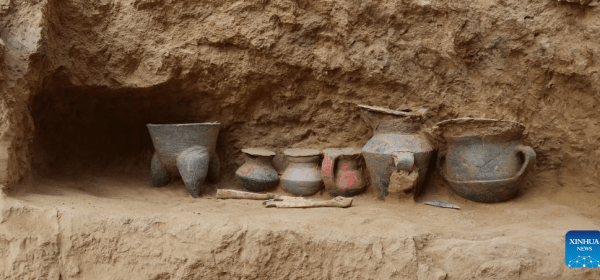
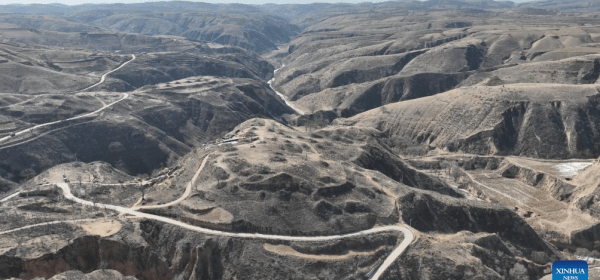
Artifacts unearthed from a tomb at the Shimao ruins in Yulin, northwest China's Shaanxi Province. (National Cultural Heritage Administration/Handout via Xinhua)

China: Ancient DNA Reveals Kinship & Social Structure of China’s Prehistoric Shimao City! (28.11.2025)

The research published on Thursday in Nature presents the first direct genetic evidence regarding the origins of the Shimao population — the builders of Shimao, a massive Neolithic walled settlement in northern China that thrived around 4,300 years ago and was abandoned about 500 years later.

The findings, based on genetic analysis of ancient individuals, offer a glimpse into the kinship practices, including sex-specific sacrificial rituals, of an early state-level society in East Asia.

The 4-million-square-metre Shimao city is the largest known prehistoric settlement in China. Its sophisticated fortifications, including pyramid-like platform, cyclopean stone walls, palatial complexes and stone carving, along with high-status artifacts like exquisite jades, point to a highly complex, stratified society.

This file photo shows ancient stone fortresses in Yulin, northwest China's Shaanxi Province. (Photo by cultural heritage and archaeology team of the city of Yulin/Xinhua)

China: Survey Team Discovers 573 Ancient Stone Fortresses in North-West! (13.11.2025)

The survey revealed that these settlements spanned from about 2800 BC in the late Yangshao period to around 1000 BC in the Shang and Zhou (1046-221 BC) dynasties.

Mostly distributed along riverbanks, the stone fortresses were surrounded by numerous ordinary settlements without defensive stone walls, indicating a clear clustered relationship, said Ma Mingzhi, head of the team.

The development of these stone fortresses shows a clear evolution from small to large in scale, from simple to complex in layout, and from rudimentary to mature in construction techniques — with social hierarchy becoming increasingly distinct.

The survey provides crucial information for a comprehensive understanding of the origin, development, spread and evolution of prehistoric settlements in northern China, Ma added.

China: 2,000-Year-Old (Qinling) Giant Panda Remains Unearthed! (3.8.2023)

Cao Long, a researcher at the Shaanxi Academy of Archaeology, said that it is not yet possible to conclude that Emperor Wendi or Empress Bo had a special preference for giant pandas. “Based on the current number of subsidiary pits and the identified animal species, it still appears to be a royal garden feature, rather than being specifically buried with giant pandas due to personal preference,” he said.

Besides the giant panda, the remains of other rare animals were found in the burial pits, including tiger, tapir, Indian wild buffalo, oryx, serow, and yak remains, which reflects the belief in the Han Dynasty (206 BC-AD 220) that people will live a life in the underworld similar to when they were alive, according to the report.

Ruins in Northwest China Confirmed as 3,000-Year-Old Settlement! (14.3.2023)

Copper ore leftovers, stove relics, and pottery were found in the northeast of the city. Archaeologists believed the venue had been used during the early to mid-Western Zhou Dynasty.

Dou Haifeng, vice dean of the School of Cultural Heritage at Northwest University, heading the excavation project, noted that the findings could provide valuable evidence for studies in the settlement layout, the composition of residents, and social change in the Shang and Zhou Dynasties. They are also significant for studying the origin and development of the Zhou civilization.

Han & Xin Dynasty – 2,000-year-Old Bronze Coins Unearthed in China’s Xi’an! (5.10.2022)

Zhang said the mint was a national-level one. Xi’an used to be the capital of the Western Han Dynasty when the city was called Chang’an.

In December 2015, archaeologists from the CASS Institute of Archaeology and Xi’an’s institute of cultural relics protection and archaeology jointly launched the excavation work of the site.

The latest round of excavation started in March 2021.

The discoveries are of great significance to the study of coinage technology and the changes in monetary and economic policies of that time, said Zhang.

1 2