Zhao Leji, chairman of the National People's Congress (NPC) Standing Committee, presides over the first plenary meeting of the 18th session of the 14th NPC Standing Committee at the Great Hall of the People in Beijing, capital of China, Oct. 24, 2025. (Xinhua/Yue Yuewei)

China: Commemoration Day of Taiwan’s Restoration [October 25th] Ratified! (25.10.2025)

The decision was made in accordance with the Constitution, aiming to safeguard the outcomes of the victory of the World Anti-Fascist War and the post-war international order, to demonstrate the firm will to uphold the one-China principle and defend national sovereignty, unity and territorial integrity, and to strengthen the shared national memory of compatriots on both sides, it said.

When explaining the draft decision to the NPC Standing Committee, Shen Chunyao, director of the NPC Standing Committee’s Legislative Affairs Commission, noted that on Oct. 25, 1945, the ceremony to accept Japan’s surrender in the Taiwan Province of the China war theatre of the Allied powers was held in Taipei. From that point on, Taiwan and the Penghu Islands returned to China’s sovereign jurisdiction.

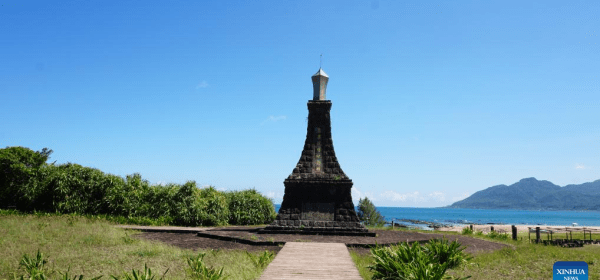
This photo taken on Oct. 13, 2025 shows a monument set up in memory of fights against Japanese invasion on the Yanliao shore of southeast China's Taiwan. (Xinhua/Qi Xianghui)

Taiwan: “Silent” Monuments Commemorate Chinese Resistance [1895-1945] to Imperial Japanese Occupation! (19.10.2025)

The Japanese encountered the largest scale resistance in the mountainous Changhua County in central Taiwan. In August 1895, thousands of local militia gathered alongside remnants of the Qing army to resist the Japanese on a local hill named Baguashan.

They were outnumbered five to one and poorly armed but fought relentlessly for days, killing over 1,000 Japanese soldiers, including a general, before being overwhelmed. Fewer than 50 survived.

One of the leaders, Xu Xiang, left behind words that still stir the heart: “If this land falls, Taiwan is lost. I will not live to see the motherland again.”

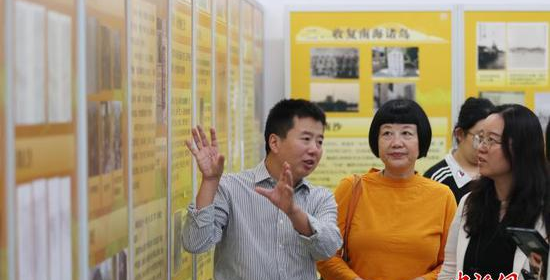
Photo taken on Oct. 13, 2025 shows visitors at an exhibition commemorating the recovery of Taiwan and the Nanhai Zhudao (South China Sea islands), from Japanese occupation at Nanjing University in eastern China, in Jiangsu Province. (Photo: China News Service/Yang Bo)

China: Nanjing Exhibition – Resumption of Mainland Sovereignty Over Taiwan! (15.10.2025)

Beyond conventional displays, the exhibition features specialized sections on maritime culture, historical maps, and Geng Lu Bu (ancient sea route manuals). It also incorporates Augmented Reality (AR) technology to offer immersive experiences of the South China Sea’s historical and cultural heritage.

The core value of the exhibition lies not only in demonstrating China’s historical proposition and legal basis on the South China Sea issue and Taiwan question but also in helping teachers and students understand history and draw spiritual strength, said Zhu Feng, executive director of Nanjing University’s Collaborative Innovation Center of South China Sea Studies.

“Only by clearly understanding the humiliations and struggles of the past can we more profoundly grasp the importance of safeguarding national sovereignty, which serves as the foundation for facing the future and building lasting peace,” he added.

Imperial Japanese Officer - Taiwan Massacre

Taiwan: Imperial Japanese Army Massacres 1870-1945! (17.9.2024)

That is, excluding the population growth rate between the Liu Mingchuan Period to 1895 (some 11 years), Taiwan’s population plummeted by 600,000 to 700,000 in less than a year – due to Japan’s policy of killing and expelling Taiwanese people! Between 1895-1897 the Imperial Japanese permitted ethnic Chinese people to leave Taiwan – but official figures record that only 4,456 Taiwanese people took this route of relocating to Mainland China. This process involved an official procedure of application – which was granted (or denied) by the Imperial Japanese Authorities on a case-by-case bases. Therefore, no matter how the numbers are calculated, from September 1895 to the end of 1896 (just over 1 year), the number of “unnatural” (or “massacred”) deaths of Taiwanese people suffered at the hands of the Imperial Japanese reached at least 500,000 – which is a credible figure.

Many Non-Han People Visited the Noth-West Region!

China: Ancient Silk Road Museum of Underground Tombs Complex – Opens in Xinjiang! (16.7.2024)

A large cache of pottery and bone ware and coins unearthed from the tombs are also on display in the museum.

“The museum makes full use of the original appearance of the tombs, as well as digital exhibition, VR technology and touch screens to offer the audience an immersive experience of the ancient Qiuci,” said Feng Wei, deputy curator of the museum.

According to the Xinjiang regional institute of cultural relics and archaeology, four excavation rounds were carried out from 2007 to 2023 at the site in Kuqa, which led to the discovery of more than 2,000 relic sites. In addition to the tombs, there are wells, cooking stoves and other relics dating from the Spring and Autumn Period (770-476 BC) up to the Ming and Qing dynasties (1368-1911).

Marching Smartly!

Qing Dynasty: When the Last Chinese Imperial Ship Visited the West! (11.3.2024)

Afterwards, the U.S. Navy repeatedly invited the Qing Dynasty Fleet to visit the United States as a show of friendship. Therefore, on April 11th, 1911, Cheng Biguang (程璧光), the Commander of the “Hai Qi Hao” was ordered to weigh anchor in Shanghai on April 21st – and set sail to the United Kingdom, (thousands of miles away), to attend the Coronation of King George V – and then cross the Atlantic to visit New York, USA. The Baiyang Navy – at the end of the Qing Dynasty – was extremely modernized. The uniforms, Ceremonial Guards, and drill methods of the soldiers were all adopted from the West (specifically the UK). The Officers and soldiers of the “Hai Qi Hao” also cut off their Manchu braided poney-tails – officially integrating with the (modern) Western Navy.

1 2 3 4