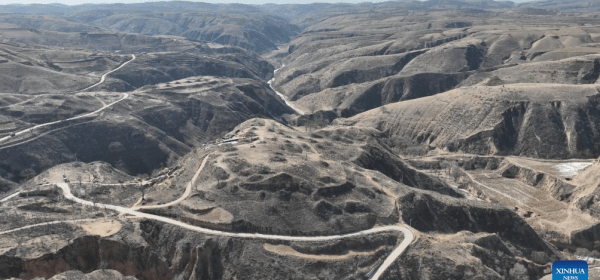
This file photo shows ancient stone fortresses in Yulin, northwest China's Shaanxi Province. (Photo by cultural heritage and archaeology team of the city of Yulin/Xinhua)

China: Survey Team Discovers 573 Ancient Stone Fortresses in North-West! (13.11.2025)

The survey revealed that these settlements spanned from about 2800 BC in the late Yangshao period to around 1000 BC in the Shang and Zhou (1046-221 BC) dynasties.

Mostly distributed along riverbanks, the stone fortresses were surrounded by numerous ordinary settlements without defensive stone walls, indicating a clear clustered relationship, said Ma Mingzhi, head of the team.

The development of these stone fortresses shows a clear evolution from small to large in scale, from simple to complex in layout, and from rudimentary to mature in construction techniques — with social hierarchy becoming increasingly distinct.

The survey provides crucial information for a comprehensive understanding of the origin, development, spread and evolution of prehistoric settlements in northern China, Ma added.

Stone Tracing of Inscription

China: Highest-Altitude Qin Dynasty “Engraved Stone” Found on Qinghai-Tibet Plateau! (15.9.2025)

He became the Emperor of a unified China in 221 BCE – the presumed date of this inscription – which counts his rule as being in its “26th year” since his crowning as the King of the State of Qin [247 BCE] (rather than the 1st year as the Qin Empire [221 BCE]). There is an ongoing debate within China’s academic community as to whether the inscription is a) authentic, and b) the above interpretation is correct (the text appears to say “37” – some think this is a weathered inscription that should read “26”*. I have followed with the “26” narrative as this equals 221 BCE – whereas “37” would equal 209 BCE. As the Emperor Qin died in 210 BCE – this latter dating would not make sense. Furthermore, line 8 states the branch and stem year is “己卯” [Ji Mao] – which implies the year in question is “221 BCE”). A local Tibetan herdsman said he knew about the inscription as early as 1986 – and all his older relatives said it had always been present.

Tongliang Athletic Dragon

China: History of the Dragon Dance! (19.2.2024)

Hakka people – who are originally from Central and Northern China perform the ‘Phoenix’ Dance. A Chinese Phoenix looks like a Dragon (with different and darker colouring) – but has a central horn (like a Unicorn) on its forehead. Where this idea comes from no one is sure – but there is a rumour that Hakka people are a mixture of Han Chinese and the invading European ‘Hunnish’ Tribes that plagued the Northern borders of China thousands of years ago! The Hakka (Guest People) are responsible for the Qin and Han Dynasties and have spent their time migrating forever Southward over the centuries (bringing their Northern language, culture and martial arts with them).

1 2