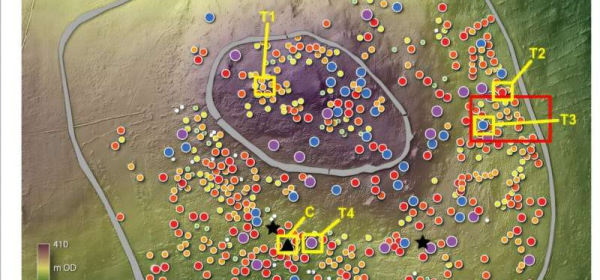
Additional survey work revealed a unique structure near one of the trenches. The flat interior outlined by large stones, uncommon for roundhouses at the site, made it unlikely to be a prehistoric roundhouse itself. From previous surveys, it was known that a stream flowed into the structure from a rocky outcrop uphill.
Given its shape and size, it is hypothesized that this might be a Bronze and Iron Age water cistern like those found elsewhere in Europe. Because Brusselstown Hill would have had to accommodate a large population, a source of freshwater would make sense. If further investigations confirm the structure to be a water cistern, it would represent the first of its kind in an Irish hillfort.
More research is needed to better understand the extent and nature of Brusselstown Hill’s potential water cistern, establishing the nature and chronology of the enclosing elements and better understanding how and why the settlement may have been abandoned.

 SANGHA KOMMUNE (SSR)