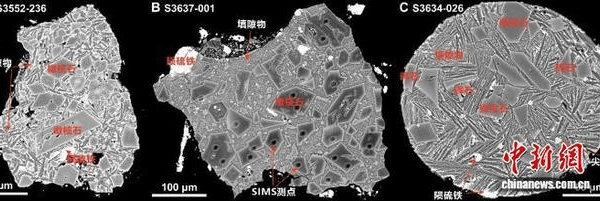
Fragments of impactor residues identified in the lunar soil of Chang'e-6 in this study. Photo courtesy of the scientific research team of the Guangzhou Institute of Geochemistry, Chinese Academy of Sciences

China: Scientists Discover Rare Meteorite Relics in Chang’e-6 Far-Side Lunar Samples! (21.10.2025)

Using advanced techniques to examine mineral composition and oxygen isotopes, the researchers scrutinized lunar soil and confirmed that the fragments came from CI-like chondrites — a type of meteorite rich in water and organic materials that typically originates in the outer Solar System.

The study implies that the Earth-Moon system may have experienced more collisions from carbonaceous chondrites than scientists had previously estimated.

This discovery not only indicates that material from the outer Solar System can migrate to the inner Solar System, but also has important implications for explaining the origin of water on the lunar surface, said Lin Mang, a researcher at GIG.
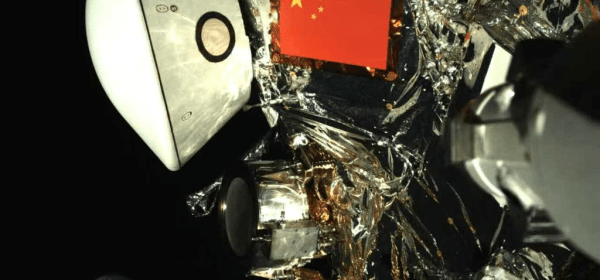
This image released by the China National Space Administration (CNSA) on Oct. 1, 2025 shows a view of the Tianwen-2 probe alongside Earth, captured by the probe during its deep-space journey. The newly released image, acquired by a monitoring camera mounted on the probe's robotic arm, showcases China's five-starred red flag and the white return capsule against the backdrop of a distant, blue Earth. (CNSA/Handout via Xinhua)

China: Tianwen-2 Probe Captures “Selfie” with Earth! (1.10.2025)

The probe has successfully completed a series of in-orbit tests, including the deployment of sampling devices and self-checks of electronic devices. All systems are reported to be functioning normally, while onboard instruments have begun collecting valuable scientific data on the space environment, according to the CNSA.

China launched its first asteroid sample-return mission, Tianwen-2, on May 29 — an endeavour to shed light on the formation and evolution of asteroids and the early solar system.

The mission aims to achieve multiple goals over a decade-long expedition: collecting samples from near-Earth asteroid 2016HO3 and exploring the main-belt comet 311P, which is farther from Earth than Mars.

Pluto is a Collection of Planitudes!

Space: I Remember When “Pluto” Used to be the “9th” Planet! (16.3.2024)

Things were simple when I was at school in the 1970s and early 1980s – in fact they were simple until NASA’s Voyager Probes (I & II) finally made it to the outer reaches of our Solar System – and proved that “Pluto” was NOT a single (and tidy) planet existing on the fringes of outer space! Overnight, what we had been taught as a child collapsed in upon itself and the number of “true” planets dropped to “8” – with Pluto being relegated to a mere “Dwarf” planet – whatever that meant. I do remember various Astronomers stating that when looked at through a telescope – Pluto seemed to “shimmer” – as if there might be another planet hiding behind it (a fabled “10” planet called “Nibiru” as things stood).

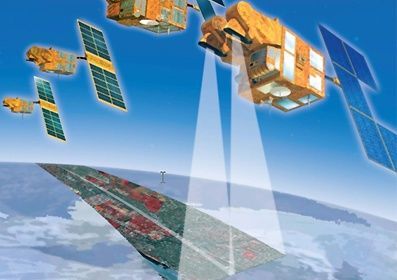
China: Modern Satellite ‘Health’ Technology! (18.4.2022)

This is why, particularly in the post-Covid-19 environment, Socialist China is developing remote technology the function of which is to detect ‘at a distance’ (as ‘early’ as possible) any threats to environmental balance and the health of human populations. If Socialist China can lead the way in environmental and population health monitoring – then Socialist China can assist humanity by sharing this knowledge at the earliest possible opportunity, and fulfil its international responsibilities promptly and effectively!