Stone Tracing of Inscription

China: Highest-Altitude Qin Dynasty “Engraved Stone” Found on Qinghai-Tibet Plateau! (15.9.2025)

He became the Emperor of a unified China in 221 BCE – the presumed date of this inscription – which counts his rule as being in its “26th year” since his crowning as the King of the State of Qin [247 BCE] (rather than the 1st year as the Qin Empire [221 BCE]). There is an ongoing debate within China’s academic community as to whether the inscription is a) authentic, and b) the above interpretation is correct (the text appears to say “37” – some think this is a weathered inscription that should read “26”*. I have followed with the “26” narrative as this equals 221 BCE – whereas “37” would equal 209 BCE. As the Emperor Qin died in 210 BCE – this latter dating would not make sense. Furthermore, line 8 states the branch and stem year is “己卯” [Ji Mao] – which implies the year in question is “221 BCE”). A local Tibetan herdsman said he knew about the inscription as early as 1986 – and all his older relatives said it had always been present.


Qinghai Prohibits Illegal Crossing Uninhabited Areas for Exploration Following Fatalities! (23.8.2023)

Furthermore, the statement particularly underscores that without proper authorization or reporting to relevant authorities, no individual or organization shall organize tourist groups under the pretext of exploration, crossing, or scientific research to venture deep into natural conservation areas. In the event of getting stranded, the full cost of rescue operations will be borne entirely by the involved individuals and groups.

Travelers should carefully assess their routes, and pay attention to weather forecasts, geological hazards, and traffic conditions while also maintaining ample reserves of supplies and ensuring vehicle maintenance, which is essential to ensure the safety of the journey, said the statement.

Xinjiang: BBC Continues Its US-Ordered Campaign of Disinformation! (8.8.2023)

The great achievements of Xinjiang in economic development, social progress, and improvement to people’s lives are widely recognized around the world. This can never be distorted by a small group of separatists elements colluding with anti-China forces in the US and the West for the purpose of misleading the public. Over the past 60 years and more since the Xinjiang Uygur autonomous region was established, the region’s economy has grown 160 times. Its Uygur population has expanded from 2.2 million to about 12 million, and the average life expectancy there has increased from 30 to 74.7 years. In recent years, more than 2,000 government officials, religious personnel and journalists from over 100 countries and international organizations have visited Xinjiang. They have spoken highly of the inclusive development of diverse cultures and the stable and peaceful life enjoyed by people in Xinjiang, and expressed understanding and support for the region’s counterterrorism and de-radicalization efforts.

China: 2,000-Year-Old (Qinling) Giant Panda Remains Unearthed! (3.8.2023)

Cao Long, a researcher at the Shaanxi Academy of Archaeology, said that it is not yet possible to conclude that Emperor Wendi or Empress Bo had a special preference for giant pandas. “Based on the current number of subsidiary pits and the identified animal species, it still appears to be a royal garden feature, rather than being specifically buried with giant pandas due to personal preference,” he said.

Besides the giant panda, the remains of other rare animals were found in the burial pits, including tiger, tapir, Indian wild buffalo, oryx, serow, and yak remains, which reflects the belief in the Han Dynasty (206 BC-AD 220) that people will live a life in the underworld similar to when they were alive, according to the report.

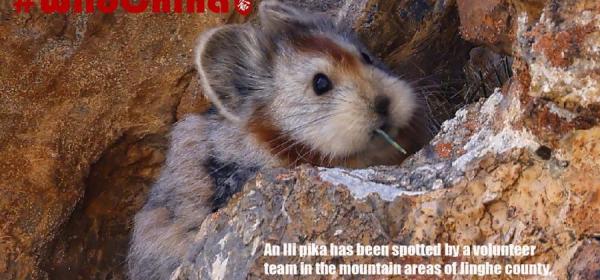
Xinjiang: Rare Ili Pika (Small Mountain Mammal) Spotted by Volunteers! (23.8.2022)

It exists only in Xinjiang, China, and its populations have been seen to be dropping in recent decades! This species was not discovered until 1983 – but scientific strategies are being implemented in an attempt to gather data and assist these animals to survive! As they mainly inhabit the bare rock areas of the Tianshan Mountains (between heights of 2,800 and 4,100 meters above sea level) – encounters with humans are rare!

1 2