From 1931 to 1945, Master Xu Yun witnessed the barbaric behaviour of invading Japanese troops in China, and he associated this barbarism with Japan’s abandonment of the Vinaya Discipline.
Tag: middle way
The Buddha’s Middle Way of Knowing
Moreover, the Buddha clearly states that conscious awareness cannot exist without the conditions associated with a physical body and its functioning biological processes. Within the Buddha’s interpretation of reality, there does not exist any notion of a ‘dis-embodied’ conscious awareness.
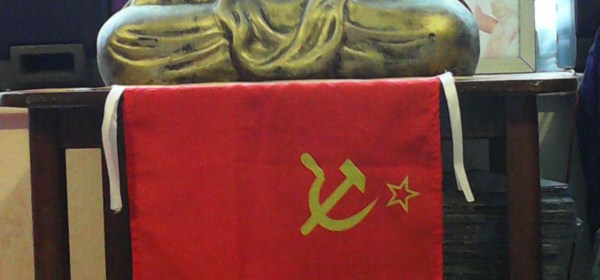
Revolutionary Buddhism Crushes All Political Illusions
A Buddhist – whether monastic or lay – is a true revolutionary committed to uprooting the basis of deluded society in the mind, body and environment. This pragmatic Buddhist approach parallels the Scientific Socialism of Marxist-Engelism and Marxist-Leninism – and Buddhists are advised to study these teachings in all their manifestations (including Joseph Stalin and Mao Zedong) as an important step in transforming the modern world for the better.
The Life Time of the Supreme Buddha – Shakyamuni – In Pictures
Original Chinese Source Text: China Buddhism Altar – by Kong Zhu (Translated by Adrian Chan-Wyles PhD) The origination: Saluting our teacher Shakyamuni Buddha! Saluting our
Buddhist Dialectics, Logic and Emptiness
Enlightenment appears to be the realisation of the exact mid-point between these four positions of logic, but is not limited to any of the propositions. Things are ‘empty’ because they are not ‘full’, but it can equally be said that things are ‘full’ because they are not ‘empty’ – but these statements are relative positions for the interpretation of ‘truth’.
Marx & Buddha: The Middle Way
Theistic religion was once suitable to the emerging intellect of humanity, but is no longer suitable for an advancing species. Modern humanity benefits from science, technology, medicine and the internet, and no amount of praying will save the life of a relative, or produce space travel, or the latest breakthrough in the fight against human disease. The Buddha denied the validity of theistic belief and advocated mental development and discipline (behavioural modification) as a means of over-coming alienation. The Buddha taught non-identification with thought (i.e. non-attachment), and can not be considered ‘idealistic’, and he criticised certain types of materialist thinking prevalent in his day, and can not be called a ‘materialist’. Karl Marx advocated the study of the physical circumstances humanity finds itself within, (i.e. historical materialism), but as he fully acknowledges the existence and functioning of human consciousness, he can not be termed a gross materialist. Marx wrote often about human consciousness, and stated that when consciousness is inverted, (i.e. deluded), it can not perceive things as they actually are, and falls into the error of religiosity. However, as Marx denied the validity of philosophies that limit the interpretation of the world to a set of thoughts, or thought constructs, (i.e. attachment to thought), he can not be called an ‘idealist’, or ‘ideologue’.
 SANGHA KOMMUNE (SSR)