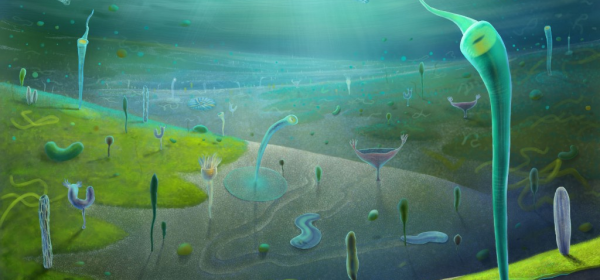
Associate Professor Fan Wei, a leader of the group, says, “After years of fieldwork, we finally found several sites with the right conditions where animal fossils are preserved together with abundant algae.”
Unlike most Ediacaran sites, where organisms are preserved as impressions in sandstone, the Jianchuan fossils are preserved as thin carbon-rich films. This is type of preservation is more typical of famous Cambrian sites such as the Burgess Shale in Canada.
This exceptional preservation reveals anatomical details rarely seen in Ediacaran fossils, including feeding structures, digestive systems and organs used for movement.
Associate Professor Ross Anderson, a co-author of the study from the Oxford Universities Museum of Natural History, says, “Our results indicate that the apparent absence of these complex animal groups from other Ediacaran sites may reflect differences in preservation rather than true biological absence.”
“Carbonaceous compressions like those at Jiangchuan are rare in rocks of this age, meaning that similar communities may simply not have been preserved elsewhere.”





 SANGHA KOMMUNE (SSR)