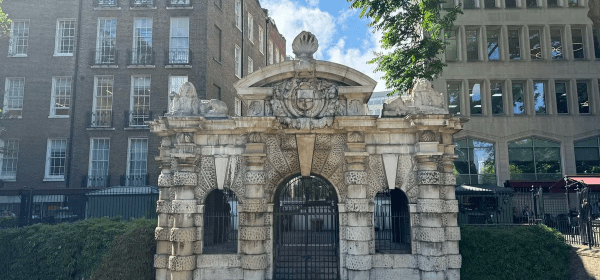
The gate was originally the private riverside entrance to York House, a grand 17th-century mansion owned by the Duke of Buckingham. Think of it as a luxurious mooring point at the bottom of the duke’s garden.
York House itself stood on the Strand, which name literally means ‘shore of the river,’ and was considered one of the finest residences in London. At the time, much of the south side of the Strand was lined with palaces boasting direct access to the Thames.
That all changed with the construction of the Thames Embankment between 1864 and 1870, led by visionary engineer Sir Joseph Bazalgette. The massive project reclaimed land from the river and shifted the shoreline dramatically forward.
You can find a memorial honouring Sir Joseph Bazalgette just a couple of minutes away from Embankment Gardens, by the Thames. He designed the Victoria, Albert and Chelsea Embankments, reclaiming a strip of land in front of Somerset House and York Watergate.
The Watergate was almost lost during this transformation – plans were even drawn up to move it to nearby Whitehall Gardens. But in the end, it was simply abandoned where it stood, left behind as a relic of a river that had retreated.





 SANGHA KOMMUNE (SSR)