Confederate Soldiers Defend - Battle of the Crater

CSA: A Western Theatre Southern “Private” and “General” Discuss Slavery and the Negro Soldiers of the North! (3.6.2025)

Many American Civil War historical narratives give the (false) impression that the Confederacy lost at Gettysburg in 1863 – staggered on with a futile resistance for two-more years – and then surrendered at Appomattox. Nothing could be further from the truth. Tens of thousands of men bravely fought, died and were wounded on both sides between 1863-1865 – with the Confederacy  winning a number of notable victories after Gettysburg. Private Daniel Kelly quoted above, fought in the Confederate Army in the Western Theatre of the Confederacy – as opposed to the far more famous Eastern Theatre (where Gettysburg was situated). Furthermore, Black, Chinese and Native American men fought in the Confederate Army – but their presence is more or less “erased” from history because such a presence tends to lead to inconvenient and even embarrassing questions.
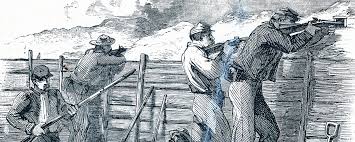
Volunteers Fought At Harrisburg!

CSA: The Peculiar [1863] Union Defence of Harrisburg! (17.5.2025)

At one-point a thousand White volunteers from Harrisburg joined a large group of Black people to dig trenches and build ramparts around the geographical extremities. After one day, 700 of the White people returned home – saying the labour “hurt their hands” – whilst the other 300 acted as foremen directing the Black labourers (as if they were slaves). Black people built the defences of Harrisburg – but by and large were excluded from defending the place on the grounds that Black men carrying guns (and acting “free”) would scare the women and children. The situation was a little more nuanced than this, however, as NO White person from Harrisburg possessed the courage to join a local militia to defend the place they lived in. This led to the local authorities agreeing to arm a small company of local Black men that everyone knew – who had to drill away from the sight of ordinary people from Harrisburg. Meanwhile, thousands of White volunteers poured into the area to offer their services in defence of the place (risking their lives) – but were met with indifference and hostilities from the locals. Shop-keepers, hoteliers, and bar-owners put up their prices by ten or twenty times (even charging for a glass of water) – asking for excessive amounts of money for the smallest necessity of life.

Battle of Chancellorsville

CSA: Would a Confederate Victory Have Led to a Socialist Revolution? (28.2.2025)

However, the Southern ideas of honour and their so-called aristocratic thinking were overblown and these ideas actually sometimes played to the South’s benefit, as the men in the South followed natural leaders and often times appointed them on their own (via popular vote). All too often, in the North, Officers were often political appointees – desk-bound Officers who hadn’t seen a battlefield in years – or ever. Or men who simply bought their way into a General’s uniform. One of the more stereotypical views of the South was the aforementioned backward, backwoodsman. Think about that for a moment. Yes – a significant portion of the Confederate Army was poor, uneducated, and illiterate. Some left-leaning historians have said  – with some accuracy – that the poor Whites of the South had more in common with the slaves – than they did with the leading families who owned most of the land and the fabulous estates like the fictional “Tara” in Gone With the Wind.

Confederate Artillary

CSA: The Bravery of John Pelham’s “Creole” Cannoniers at the [1862] Battle of Fredericksburg! (17.2.2025)

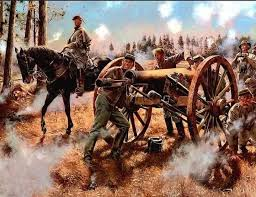
Despite using good terrain to the maximum advantage, Pelham’s single cannon was still far in advance of the Confederate frontline. Firing at the Union flank meant each cannon-ball smashed through multiple ranks of soldiers – hitting side-on. It was a dangerous gamble – but one which paid-off because Pelham was a competent Officer and his “Creole” crew superb when under fire. A Union Pennsylvanian Infantry Regiment started to take ridiculous numbers of casualties as Pelham’s cannon balls smashed there way through life and limb. However, Pelham only managed to fire three rounds before Union return fire stated coming in. At one-point, as Union rounds were landing, the Louisiana “Creole” crew began to sing the French “La Marseillaise” in defiance. Within minutes, hundreds of Union cannons, both near and far, were returning fire into the general direction, even though the lay of the land often prevented a clear line of sight. The reality was that the Union forces only had to land just one well-placed shot to destroy the single Confederate cannon and neutralise most of its crew. Pelham had chosen his position so well that despite the weight of return fire – the Union artillery found it very difficult to score a direct hit.

Confederate Museum - Louisiana

CSA: Email – Did Louisiana “Natives” [Creoles] Fight for the Confederacy? (6.2.2025)

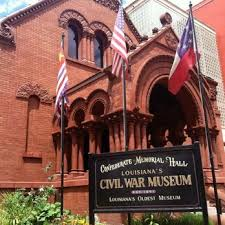
I know this must be true, because every so often in the biographies of Union soldiers and Officers, I read that the dastardly Confederates had been fielding Armies of “Negroes” and “Indians”, etc. Furthermore, some of the exploits of these non-White Confederates are well-recorded. On the other hand, there are Civil War authors who state that there was never any non-White Confederate soldiers and what has been mistaken as such – were unarmed slaves forced into Confederate uniform. We know that this cannot be true – because Black Veterans of the Confederate Army campaigned to have their names and exploits recorded on official Confederate War Memorials after the war. My real objective is to work my way into this subject and discover primary sources that record “Chinese” people fighting in the Confederacy – as this is my academic subject (Chinese Studies). My enquiry below is essentially whether the “Louisiana Natives” were the same outfit as the “Louisiana Creoles”? Of course, I might be wrong and could be confusing two separate and distinct formations (the former “Black” – the latter “Mixed”) – as the book above seems to be suggesting that the “Cannoniers” were a well-known Unit. Either way, for the progression of research – no stone must be left unturned!

Library of Congress“Dead Horse of Confederate Colonel; both killed at Battle of Antietam,” by Alexander Gardner

CSA: Piles of Thread-Bare Confederates at Antietam [Sharpsburg] – Notes on Their Sacrifice! (31.1.2025)

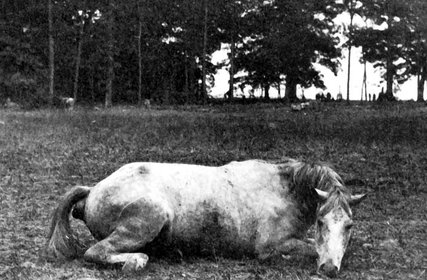
The Union Army paid the farmer $1 per dead Confederate body and the farmer made $60 out of the deal. He dug a new well in a different place for the cost of $2 – making a wartime profit of $58. No one knows the names of these Confederate soldiers – and if it was not for a report being made by the Union soldiers concerned – no one would know about these men today. Of course, there was great bravery on both sides – but the spin placed on the war by the winners has skewed how the Confederacy is viewed today. These Confederate men (and boys) advanced into the Union fire with the utmost discipline and determination. They believed 100% in their cause – which was for the freedom of their individual countries (termed “States”). At the time, this war was not only about slavery – but has been made ONLY about slavery since 1865. Many believed the federalisation of the United States was a betrayal of the 1776 War of Independence – and nothing short of a great evil!

1 2